| accountable |
Someone who is accountable is required and expected to justify actions or decisions to a person or body with greater authority, from whom the accountability has been formally assigned. Note: accountability is normally associated with a specific scope of work or set of responsibilities and accountabilities can be tiered such that there is a hierarchy of accountabilities, with a higher-level having overall accountability over lower-level accountabilities. An accountable person usually has associated formally delegated authority for their actions and decisions, such as through delegated letters. |
| accounting officer |
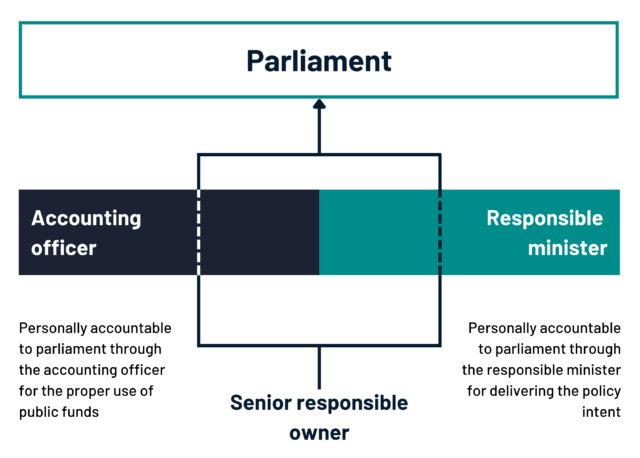
A person appointed by the Treasury or designated by a department to be accountable for the operations of an organisation and the preparation of its accounts. The appointee is the head of a department or other organisation or the Chief Executive of a non-departmental public body (NDPB) or other arm’s length body. |
| analysis |
Generation, processing and presentation of data, evidence and research, to inform choices and improve outcomes for the UK government and UK citizens. |
| arm’s length body |
Central government bodies that carry out discrete functions on behalf of departments, but which are controlled or owned by them. They include executive agencies, non-departmental public bodies, and government-owned companies. |
| assurance |
A general term for the confidence that can be derived from objective information over the successful conduct of activities, the efficient and effective design and operation of internal control, compliance with internal and external requirements, and the production of insightful and credible information to support decision making. Confidence diminishes when there are uncertainties around the integrity of information or of underlying processes. |
| baseline |
A measurement, calculation, or location used as a basis for comparison. In a project delivery context, baselines typically apply to plans and to sets of data relating to the solution. Note: examples include schedule baseline, cost baseline, requirements baseline, design baseline. |
| benefit (project delivery) |
In the context of project delivery, benefit is the measurable value or other positive impact resulting from an outcome perceived as an advantage by one or more stakeholders, and which contributes towards one or more objective(s). |
| board |
The highest-level governing body (e.g. a board of directors, a supervisory board, or a board of governors or trustees) charged with the responsibility to direct and/ or oversee the organisation’s activities and hold senior management accountable. |
| business case |
The justification for an organisational activity (strategic, programme, project or operational) which typically contains benefits, outcomes, timescales, costs and risks against which continuing viability is tested. |
| commercial |
Commonly used term in central government to define broad procurement activity but does not include wider commercial activity including income generation for the purposes of this document. |
| constraint (project delivery) |
In the context of project delivery, a constraint is a limitation or restriction on planning or undertaking work. Note: planning constraints can include, but are not limited to scope, performance, time, cost, resources and risk |
| contract |
A legally binding agreement that sets out obligations between parties. A contract can take any form, such as a licence agreement, memorandum, service agreement. |
| control (organisational) |
Any action taken by management, the board and other parties to manage risk and increase the likelihood that established objectives and goals will be achieved. |
| defined (way of working) |
In the context of standards, defined denotes a documented way of working which people are expected to use. This can apply to any aspect of a governance or management framework. For example, processes, codes of practice, methods, templates, tools and guides. |
| delegated authority and delegation letter |
A standing authorisation by HM Treasury under which a body may commit resources or incur expenditure from money voted by Parliament without specific prior approval from HM Treasury. Delegated authorities may also authorise commitments to spend (including the acceptance of contingent liabilities) and to deal with special transactions (such as write-offs) without prior approval. |
| delivery strategy (project delivery) |
In the context of project delivery, the delivery strategy outlines longer term objectives, outcomes and outputs, and the means to achieve them, to inform future decisions and planning and includes phasing and strategies for commercial, business, societal change and solution delivery aspects. |
| disbenefit (project delivery) |
In the context of project delivery, disbenefit is the measurable value or other impact resulting from an outcome perceived as a disadvantage by one or more stakeholders, and which partially or fully negates the achievement of one or more objective(s). |
| diversity and inclusion |
Diversity provides a focus on championing a broad range of backgrounds and opinions- including those protected by prevailing equality legislation- with the merit principle front and centre and drawing on the talents of the widest possible range of geographical, social and career backgrounds. All diversity and inclusion people policies, processes and practices should be data-driven, evidence-led and delivery-focused. |
| established (way of working) |
In the context of standards, established denotes a way of working that is implemented and used throughout the organisation. This can apply to any aspect of a governance or management framework- for example processes, codes of practice, methods, templates, tools and guides. |
| executive agency |
A type of arm’s length body. A public body that acts as an arm of its sponsoring department. |
| gate |
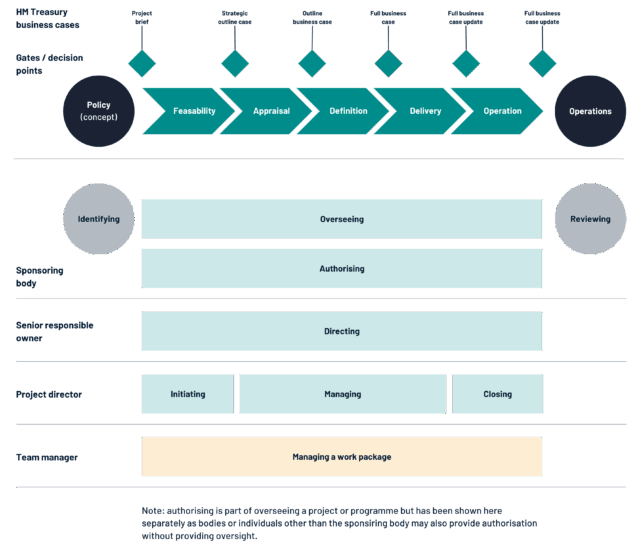
A decision point, carried out as part of formal governance, at significant points in the life cycle to ensure that the decision to invest as stated in an agreed business case and plans is, and remains, valid. |
| governance |
Governance defines relationships and the distribution of rights and responsibilities among those who work with and in the organisation. It determines the rules and procedures through which the organisation’s objectives are set and provides the means of attaining those objectives and monitoring performances. Importantly, it defines where accountability lies throughout the organisation. |
| government major project |
A central government funded project or programme that requires HM Treasury approval during its life, as set out in Delegated Authority Letters, or is otherwise of special interest to the government. A government major project is listed in the Government Major Project Portfolio (GMPP). |
| Government Major Projects Portfolio (GMPP) |
The portfolio of the government’s largest, complex, innovative, risky and ambitious projects that have been agreed by the National Infrastructure and Service Transformation Authority, HMT and departments and are delivering the government’s main policy initiatives. |
| government profession |
A grouping aligned across government to increase the professionalism and engagement of people with particular skills, knowledge or expertise. A profession sets professional standards, supports professional development and career progress, and provides a consistent way to attract and retain people. |
| integrated assurance and approval plan (IAAP) |
The planning, coordination and provision of assurance activities and approval points throughout the ‘policy to delivery’ life cycle, proportionate to levels of project cost and risk. |
| integrated assurance strategy (IAS) |
The integrated assurance strategy sets the strategic requirements for assurance provision to ensure agreed and consistent standards across an organisation’s portfolio of major projects. |
| issue |
A relevant event that has happened, was not planned and requires management action. It could be a problem, benefit, query, concern, change request or risk that has occurred. |
| lessons learnt |
The practice of continuous improvement based upon organisational learning in a risk management context. |
| life cycle |
The life cycle provides a phased structure for governing the work and underpinning the delivery plan, from start to finish. Life cycles can be applied to a portfolio, service, product, system, programme or project. |
| lines of defence |
An assurance model that defines three distinct groups of stakeholders involved with separate but complementary assurance activity. |
| outcome |
The result of change, normally affecting real-world behaviour or circumstances. Outcomes are desired when a change is conceived. Outcomes are achieved as a result of the activities undertaken to effect the change; they are the manifestation of part or all of the new state conceived in the target operating model. |
| output |
A specialist product (the tangible or intangible artefact) that is produced, constructed or created as a result of a planned activity and handed over to users. |
| plan |
A plan sets out how objectives, outcomes and outputs are to be delivered within defined constraints, in accordance with the strategy. |
| portfolio |
A portfolio comprises part or all of an organisation’s investment required to achieve its objectives. Governed through its portfolios (or business) plan, a portfolio comprises work components, such as other portfolios, programmes, projects, other related work and work packages. |
| portfolio management |
Portfolio management is a coordinated collection of strategic practices and decisions that together enable the most effective balance of organisational change and business as usual. |
| programme |
A programme is a unique, temporary, flexible organisation created to coordinate, direct and oversee the implementation of a set of projects and other related work components to deliver outcomes and benefits related to a set of strategic objectives. |
| project |
A project is a unique temporary management environment, undertaken in stages, created for the purpose of delivering one or more business products or outcomes. |
| project delivery |
Collectively, portfolio, programme and project management are referred to in government as “project delivery”. |
| quality |
The degree to which the features and inherent or assigned characteristics of a product, person, process, service and/or system bear on its ability to show that it meets expectations or stated needs, requirements or specification. |
| regularity |
Compliant with the relevant legislation and wider legal principles such as subsidy control and procurement law, delegated authorities and the guidance in Managing Public Money. |
| residual risk |
The risk remaining after the risk response has been applied. |
| responsible |
Someone who is responsible has some control over or care for an action, or the obligation to do something as part of a wider job role. Note: a responsible person is responsible to an accountable person, or themselves if they are the accountable person. |
| risk |
The effect of uncertainty on objectives. Risk is usually expressed in terms of causes, potential events, and their consequences: a cause is an element which alone or in combination has the potential to give rise to risk; an event is an occurrence or change of a set of circumstances and can be something that is expected which does not happen or something that is not expected which does happen. Events can have multiple causes and consequences and can affect multiple objectives; the consequences should the event happen- consequences are the outcome of an event affecting objectives, which can be certain or uncertain, can have positive or negative direct or indirect effects on objectives, can be expressed qualitatively or quantitatively, and can escalate through cascading and cumulative effects. |
| risk appetite |
The amount of risk the organisation, or subset of it, is willing to accept. |
| risk management |
Risk management is the co-ordinated activities designed and operated to manage risk and exercise internal control within an organisation. |
| senior responsible owner |
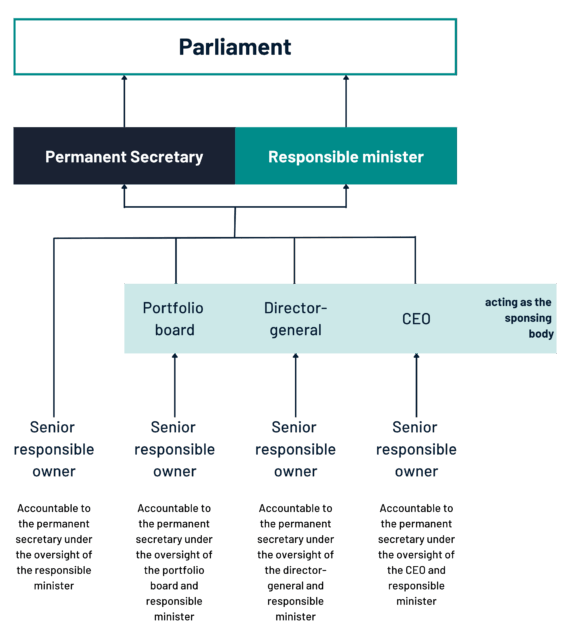
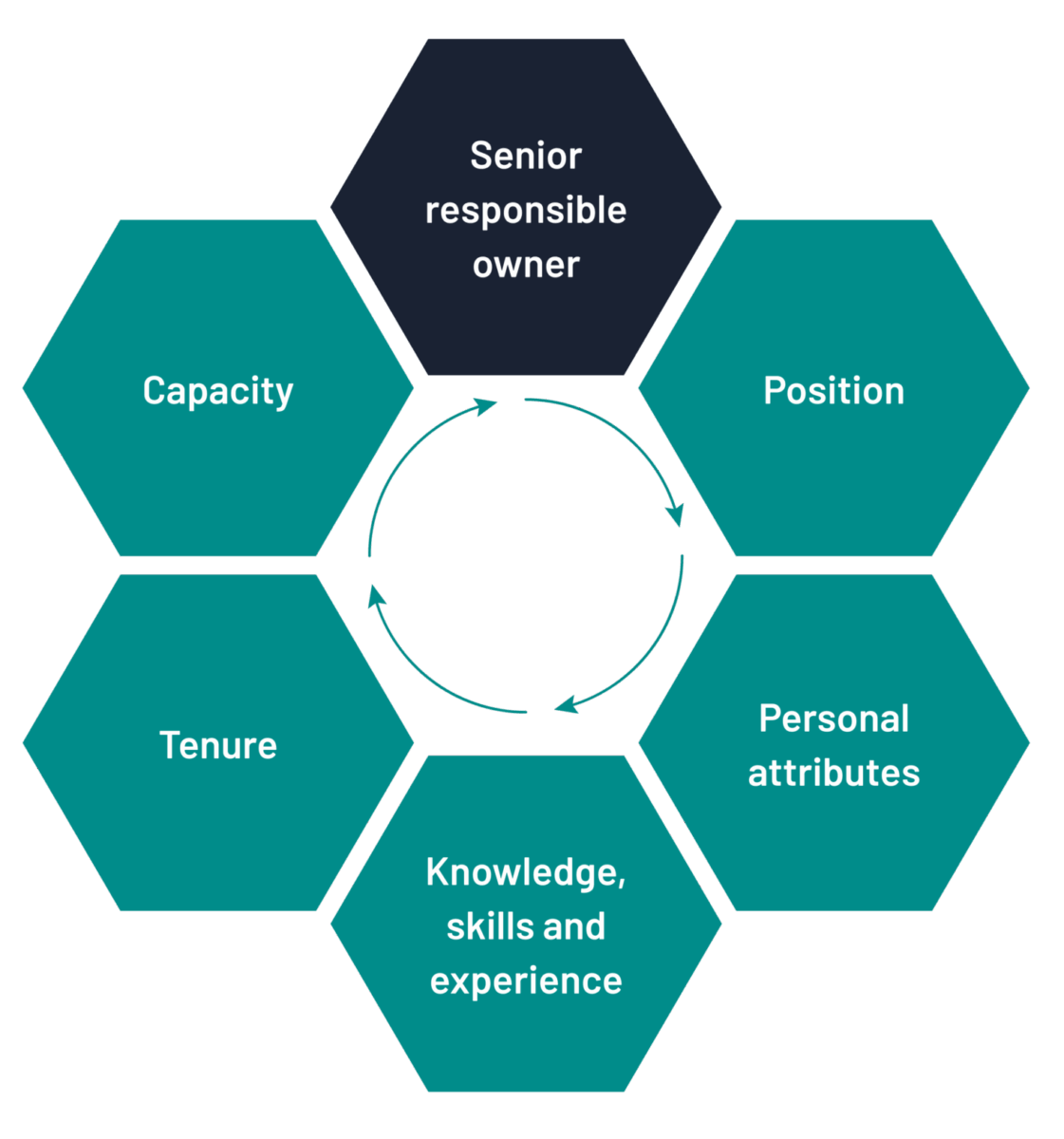
The individual accountable to the sponsoring body for a programme or project meeting its objectives, delivering the required outcomes and realising the required benefits. Note: the senior responsible owner owns the business case and is accountable for governance. The sponsoring body could be a group or individual. The senior responsible owner of a government major project is ultimately accountable to Parliament. |
| sponsoring body |
The driving force behind a programme, which provides the investment decision and top-level endorsement for the rationale and objectives of the programme. |
| stage (project delivery) |
In the context of project delivery, a stage is a subdivision of a project life cycle. |
| stakeholder |
Any individual, group or organisation that can affect or be affected by or perceive itself to be affected by an initiative (programme, project, activity, risk). |
| strategy |
A strategy outlines longer term objectives, outcomes and outputs, and the means to achieve them, to inform future decisions and planning. |
| termination |
Termination is the premature closure of a work component because it is no longer needed or viable, or because the risks associated with it have become unacceptably high. |
| tolerance |
The permissible deviation above and below a plan’s target for time and cost without escalating the deviation to the next level of management. There can also be tolerance levels for quality, scope, benefit and risk. Tolerance is applied at project, stage and team levels. |
| tranche (project delivery) |
In the context of project delivery, a tranche is a subdivision of a programme designed to enable an incremental approach to delivery of outputs, outcomes and benefits. |
| transformation |
A distinct change to the way an organisation conducts all or part of its business. |
| validation |
An activity that ensures a solution (or part of) meets the needs of the business. Validation ensures that business requirements are met even though these might have changed since the original design. |
| value for money (project delivery) |
Value for money is a balanced judgement based on the benefit cost ratio which brings together social costs over the entire life of a proposal, together with decisively significant unquantifiable deliverables, and unmonetised risks and uncertainties, to deliver a proposal’s objectives. |
| verification |
An activity that ensures that a solution (or part of) is complete, accurate, reliable and matches its design specification. |
| work package |
An activity that ensures that a solution (or part of) is complete, accurate, reliable and matches its design specification. |