Orange Book and supporting guidance (requires sign in)
Author(s): Government Finance Function and HM Treasury
Issued: 4 May 2023
Collection

HM Treasury’s guidance on evaluating government policies, programmes and projects.
All these documents are published on the Magenta Book’s GOV.UK page.
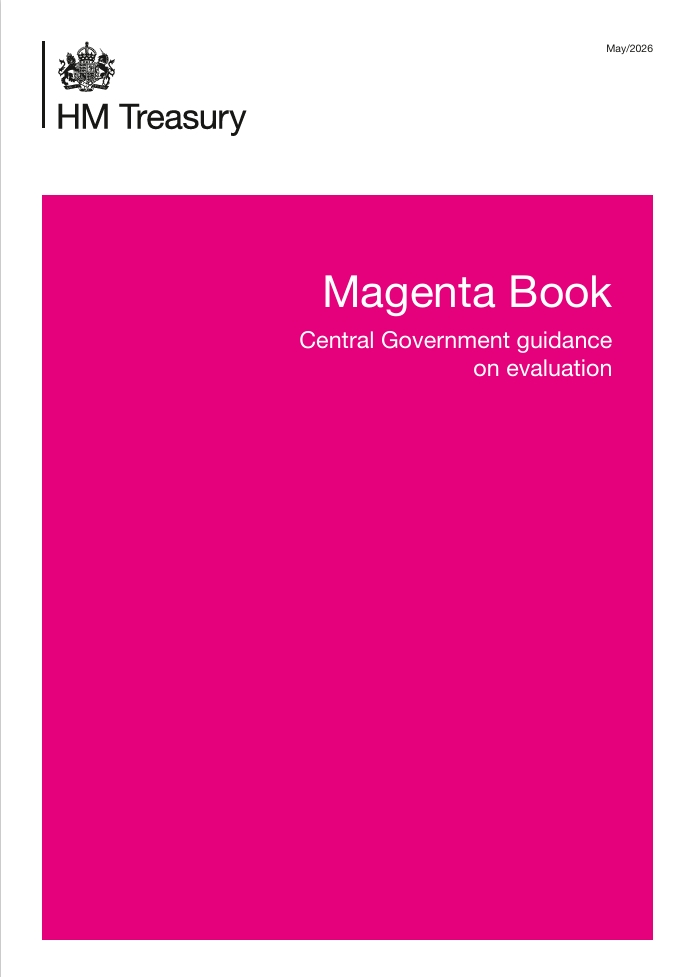
The Magenta Book explains how to evaluate government work. Evaluation looks at how something was designed and carried out, what difference it made and whether it was a good use of public money.
If you work in a central government department or one of its arm’s length bodies, you should follow the Magenta Book when you evaluate your work.
Your accounting officer is responsible for making sure you do. This is set out in Managing public money.
You must also register every evaluation on the Government Evaluation Registry (on cabinetoffice.gov.uk).
If you work anywhere else, you do not usually have to follow it, but it’s good practice to. It’s the approach government uses to evaluate its own work, endorsed by the heads of the government’s social research, finance and policy professions.
The main book is the place to start. The other documents cover specific types of evaluation, and most are written for the analysts who design them.
The main book explains how to scope, design, manage and commission an evaluation, and how to share and use what you find. Chapters 1, 2, 5 and 6 matter most for programme and project teams.
Magenta Book: Central government guidance on evaluation (on GOV.UK)
Test and Learn is a way of working that uses small, structured tests to check your most important assumptions early. Use it when a problem is uncertain, or when you need to compare options before scaling up.
This guide helps you commission and manage an evaluation in a complex setting, and choose an approach that suits it. A setting is complex when many organisations are involved, cause and effect is unclear, or outcomes change over time.
Supplementary guide: Handling complexity in policy evaluation (on GOV.UK)
This guide explains the main designs for measuring what difference your work made. It sets out how well each one shows that your work caused the change. Use it to choose a proportionate design, or to check the quality of evidence you already have.
Quality in policy impact evaluation (on GOV.UK)
Realist evaluation looks at how a programme produces its outcomes, and how the setting it runs in affects that. It suits new or pilot programmes, programmes moved to a new setting, and programmes with mixed results.
Supplementary guide: Realist evaluation (on GOV.UK)
This guide helps you design a proportionate impact evaluation of a programme or project that uses artificial intelligence (AI) in government or public services. It does not cover technical testing of AI models. Use it with the main book and with help from evaluation specialists.
Guidance on the impact evaluation of AI interventions (on GOV.UK)
A post implementation review checks whether a regulation is having the effect it was meant to, and whether the assumptions behind it still hold. It’s usually triggered by a review clause, 3 to 5 years after the regulation takes effect, then every 5 years.
Supplementary guide: Guidance for conducting regulatory post implementation review (on GOV.UK)
This annex sets out 9 recommendations for being open about how an evaluation is planned, analysed and reported. Scale them to the cost, profile and risk of your evaluation, and apply them from before data collection through to the final report.
Transparency in government evaluation research (on GOV.UK)
This framework helps you judge the quality of a finished qualitative evaluation report. You can also adapt it to assess research proposals.
Quality in qualitative evaluation (on GOV.UK)
Annex A gives detailed guidance on the methods used in an evaluation. It’s mainly for the analysts designing it.
Magenta Book Annex A analytical methods for use within an evaluation (on GOV.UK)
The capabilities framework describes the skills needed to manage a government evaluation. The interactive tool lets you assess your own skills against it.
Government analytical evaluation capabilities framework (on GOV.UK)
The May 2026 update is the first full update since 2020. The main changes are:
Delivery vehicle Programme, Project
Practice Quality management, Solution Delivery
Product type Codes of practice, Tools, templates and techniques, Workbooks and guides
Updated for the May 2026 version of the Magenta Book, which replaces the 2020 version. Added who has to follow it, how it’s used in programmes and projects, and the main changes in the 2026 update.
Publication of new edition of Magenta book. Please see the relevant GOV.UK page for individual product updates before this.
First published.
Author(s): Government Finance Function and HM Treasury
Issued: 4 May 2023