We use some essential cookies to make this website work.
We'd like to set additional cookies to understand how you use the Government Project Delivery website, remember your settings and improve government services.
Part B explained how to get ready for benefits management. Part C shows how to put that preparation into practice during delivery.
Managing benefits involves five key activities, shown in Figure C.1. These are listed below and explored further in the rest of Part C.
Identifying benefits (Section 7)
Work with stakeholders to identify and classify potential benefits. Explore the impacts of proposed changes and build a benefits map.
Valuing benefits (Section 8)
Identify benefit owners and work with them to profile and assess the value of benefits. Use this to inform investment decisions.
Planning benefits (Section 9)
Plan how and when benefits will be realised. Manage risks, optimise delivery, and set up processes to track progress for reporting and evaluation.
Realising benefits (Section 10)
Carry out change and benefits realisation activities. Track and report on progress and take action to address any issues.
Reviewing benefits (Section 11)
Review benefits realisation against the plan. Recommend further action if needed, and feed findings into evaluation.
Figure C.1 Overview of activities in managing benefits
Figure C.1 shows these activities as a sequence, but in practice they may be repeated or revisited. This is especially true in programmes, which often use iterative cycles, and in portfolios, where the process is usually cyclical (see Section 3).
All these activities are central to planning and controlling delivery and apply across all types of benefits management. The way you carry them out will depend on whether you are working with a portfolio, programme or project.
As in Part B, you should tailor these activities to the nature, scale and complexity of your work, and to the life cycle you are using. Each section explains how to do this in more detail.
7 Identifying benefits
7.1 Purpose of identifying benefits
Identifying benefits builds the evidence base for the proposed work and is a key part of planning.
The benefits identified will:
provide the basis for deciding whether to proceed with the work
support the appraisal of options and the choice of preferred solution
help set baselines for controlling delivery and tracking progress
Clear identification of benefits helps everyone understand what the work aims to achieve and how success will be measured.
7.2 Key points
What to consider
Who are the stakeholders for the work? How can they best be involved in identifying benefits? How can negative impacts best be identified?
How should benefits be organised to enable understanding, prioritisation and delivery of benefits? Who is best placed to be the benefit owner for each benefit?
Key activities
Agree stakeholders to be consulted
Identify benefits with stakeholders
Create a benefits map
Classify benefits
Develop the benefits register
Identify benefits owners
Key products
Benefits management map
Benefits management register
7.3 Why is identifying benefits important?
Identifying benefits is the next step after preparation. It moves from objectives and outcomes to examine what positive, measurable impacts the proposed changes could have, seen through the eyes of different stakeholders.
Without this detailed work, planning and investment decisions may be based on broad assumptions or untested theories about what the change might achieve. These outcome assumptions may be wrong or skewed, so they need to be tested further.
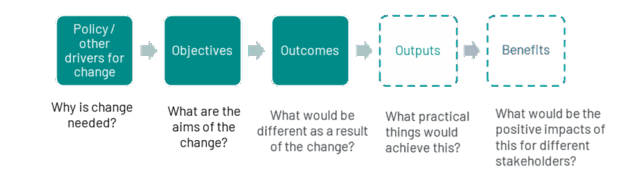
By identifying benefits, you break down these assumptions into, practical outputs and their positive impacts – benefits – for different stakeholder groups, as shown in Figure 7.1 below. Once identified, the benefits can be grouped into different types, valued, and used to inform decisions about the way forward.
Figure 7.1 Mapping drivers, objectives and outcomes to potential outputs and benefits
7.4 What is involved in identifying benefits?
Identifying benefits involves several activities, usually carried out in sequence but sometimes repeated as the work develops. The approach should be set out in the benefits management framework.
Identifying benefits starts with stakeholders. First, agree who should be involved in identifying benefits. Then work with them to explore the proposed changes and understand both the positive and negative impacts.
This should generate a long list of potential impacts. These are organised into groups and recorded, either as:
positive impacts – benefits to society, called social benefits in government
negative impacts – counted as costs to society, or social costs in government, which are sometimes called disbenefits or detriments
This list forms the basis for the benefits register.
An owner is then be agreed for each benefit or cost to society and recorded in the benefits register. In the early stages, benefits can be uncertain and are sometimes described as ‘potential’ benefits. As plans develop and decisions are taken, the associated benefits are described as ‘planned’. New benefits identified later in the life cycle, especially in agile or iterative work, are called ’emergent’.
Think carefully about which social costs and benefits are likely to have the greatest impact, particularly in showing the difference between different options. Not all benefits and costs need to be identified: only those that are significant.
All benefits and costs, whenever identified, should be classified, recorded and assigned an owner in the same way.
7.5 Who is involved in identifying benefits?
The portfolio, programme or project manager is accountable for overseeing the identification of benefits and for developing the benefits register. They may also lead these activities. Where a benefits manager is appointed, day-to-day responsibility is usually delegated to them.
In a portfolio
The portfolio manager is accountable for benefits identification at portfolio level and oversees the portfolio benefits register. However, most activities are carried out at programme and project level, with responsibility held by the relevant senior responsible owner and programme or project manager, or delegated to the benefits manager. See Section 7.6.1 for more detail.
In a programme or project
As well as the people above, other team members are often involved as the work develops. For example:
analysts should be consulted on the approach to identifying benefits and may help develop it
programme, project or work package managers often work with stakeholders to identify benefits and benefit owners in their areas
the stakeholder engagement manager should help design, plan and manage activities with stakeholders to identify benefits and owners
the business case manager should help classify benefits and develop the long list of benefits as part of the business case
commercial managers should ensure that benefits requirements are identified and valued as part of procurement, in line with the Public Services (Social Value) Act 2012 and relevant Procurement Policy Notes
Once the benefits register is developed and benefit owners identified, the portfolio, programme or project manager should review and approve it according to the benefits management framework.
7.6 Key activities in identifying benefits
7.6.1 Overview
Identifying benefits is the first step towards managing and realising them. Benefits may be recognised early during planning, or may emerge as work progresses. A systematic approach to identifying, classifying and recording them is therefore. This should be set out in the benefits management framework.
Negative impacts (social costs) should also be identified and recorded alongside benefits. These are important for options appraisal and impact assessment, including place-based and distributional analysis, as required by The Green Book.
Identifying both positive and negative impacts is critical for evaluation. Analysts who lead evaluation work should be involved from the design stage, ensuring that impacts are properly identified, classified and handled as part of investment appraisal
In a portfolio
In portfolios, the work to identify benefits often starts at the programme or project level.
Some benefits or costs, however, only become apparent through the collective impact of multiple projects or programmes, so work at portfolio level is needed to capture the higher-level picture.
The aim then is to bring together all of these benefits and costs into a single comprehensive view across the portfolio. This can be a snapshot over a defined period, such as a spending review, to support investment decisions, or it can be a rolling view, updated regularly to support ongoing management and optimisation.
In a programme or project
At the programme or project level, work to identify benefits is typically part of planning and business case development, usually during feasibility or discovery phases.
This work is closely linked to stakeholder engagement and impact assessment, but new benefits may also be identified as the work continues.
In agile or iterative environments, benefits identification is often a progressive activity, carried out in each cycle, though high-level benefits are usually identified early to support the initial business case.
Outputs
The main outputs from benefits identification are the benefits map and the benefits register. These are described in more detail later in this section.
7.6.2 Agree the stakeholders to be involved
7.6.2.1 Defining who has a stake
Benefits are the positive impacts of change as seen by stakeholders, so it’s important to understand their views. Negative impacts similarly need to be understood so they can be considered in decision-making.
Stakeholders can be individuals, groups or organisations who sponsor, deliver, benefit from, are affected by, or have an interest in the work. This includes customers or end-users, operational teams, commercial teams, subject-matter experts, analytical teams, and current or future asset owners.
7.6.2.2 Deciding who to consult
Not every stakeholder can be consulted individually. Use the stakeholder register and the high-level logic map (linking drivers, objectives, and outcomes) to identify a representative mix. The chosen group should reflect those who benefit from, deliver, are impacted by, or are responsible for the change.
7.6.2.3 Checking legal and practical requirements
Some forms of engagement, such as public consultation and statutory impact assessments, are required by law in government. Understand these obligations before planning your engagement approach.
7.6.2.4 Involving the right teams
Consult the evaluation team early to align with evaluation activities and avoid duplication. Bring in specialist analytical support if needed. Other teams or organisations may also need to be involved, for example if they already work closely with particular stakeholder groups.
7.6.2.5 Sense-checking and refining
Test the proposed list of stakeholders with senior leaders such as the portfolio director, senior responsible owner, or governance board. Add further stakeholders later if gaps are found.
7.6.3 Identify benefits with stakeholders
7.6.3.1 Overview
The aim is to explore with stakeholders what successful change could look like from their perspective. Often this is done face-to-face , for example through facilitated workshops or user research. Different stakeholder groups may need separate sessions or a mix of approaches.
At this stage, the aim is to gather as broad a set of perspectives as possible, rather than narrowing them down.
This helps ensure that both potential benefits and downsides are considered early. It also reassures stakeholders that the process is transparent, inclusive and balanced, recognising negative impacts and unintended consequences as well as positive outcomes.
Sometimes stakeholders can be reluctant to talk about negative impacts if they support the change. Equally, people who oppose a change may not want to talk about benefits. Most proposals have both positive and negative aspects, and something seen as an improvement by one group may be a problem for another. The process should be designed to surface as many perspectives as possible so that they can all be considered.
There are also specific requirements for identifying and valuing social value impacts in procurement, covered in Section 7.6.3.5.
7.6.3.2 Designing the approach
The approach should be designed to generate a long list of potential benefits and other impacts. Providing stakeholders with information in advance helps them consider the key questions and ensures that time spent together is used well.
A clear description of the proposed changes is the best starting point. This could be a written summary, a presentation, a target operating model, a visual map, or a demonstration of a prototype. The more visual and tangible the description, the easier it is for stakeholders to engage and imagine the future.
Prompts can help people think broadly about impacts. One example is the MEDIC framework, which asks whether a change might:
maintain: keep something constant that would otherwise be expected to change (for example, to maintain market share)
eliminate: remove something that is undesirable (for example, to eliminate errors in data)
decrease: reduce the size, impact or frequency of something (for example, to decrease the cost of maintenance)
increase: increase the size, impact or frequency of something (for example, to increase the capabilities of staff)
create: produce something that doesn’t currently exist (for example, to create new jobs for local people)
This helps surface a wider range of benefits and downsides.
It can also be helpful to offer a menu of different benefit types. For example, social wellbeing is usually defined as social, economic, or environmental. These can then be broken down further, for example, by government mission, as in the social value model used for procurement (see 7.6.3.5).
Some organisations use the ‘seven capitals’ model, which looks at different types of ‘capital’ created by investment (financial, manufactured, intellectual, human, social and relationship, natural and political capital). These models are not exhaustive, but they provide a useful starting point for generating ideas.
7.6.3.3 Running a stakeholder benefits workshop
In a workshop, a facilitator guides participants through the objectives, outcomes, and outputs of the work, and gathers their views on how these might affect them or others. This can be done using sticky notes or group discussions recorded on flip charts. The information is grouped as positive or negative impacts against the outputs and explored in more depth as time allows.
Capturing as much detail as possible is important, including:
where or how the benefit or impact happens
what causes it
what results from it
who receives the value
This information forms the basis for benefits mapping and the benefits register.
7.6.3.4 Conducting user-based research
User-based research follows a similar approach but relies on individual interviews or surveys to gather responses. It’s important to involve someone with the right expertise, such as an operational research analyst, in designing and conducting this research. When user-based research is used, alone or in combination with other approaches, benefits mapping should always be done separately.
7.6.3.5 Identifying social value benefits in procurement
The Public Services (Social Value) Act 2012 requires public authorities to consider how procurement can improve economic, social, and environmental wellbeing. This might include supplier commitments to create local jobs or apprenticeships, increase access to services, cut carbon emissions or improve local biodiversity.
Procurement Policy Notes 002 and 003 requires social value benefits to be explicitly evaluated in all central government procurements, using the criteria in the social value model, where relevant and proportionate to the contract. This applies to all central government organisations, subject to defined exemptions in the Procurement Act 2023.
Social value data is typically used for procurement evaluation, but all social benefits and costs identified should also be included in investment appraisal.
7.6.3.6 Collating the long list of benefits
Outputs from workshops or user research should be shared with stakeholders, and further contributions incorporated. Once validated, the long list of benefits and beneficiaries can be collated. Negative impacts (social costs) and where they fall should also be collated. This may show some duplication, which should be removed, or gaps, which may need further discussion. The final long list then feeds into the benefits map and the benefits register.
7.6.4 Develop the benefits map
7.6.4.1 Overview
As benefits and impacts are identified, you can start to create a benefits map. This can be done progressively or once the long list has been established.
A benefits map is a visual tool that links the objectives, benefits, and the activities needed to achieve them. It helps you plan, manage, and review the delivery of benefits throughout the project life cycle. Negative impacts can also be included so you can plan to manage them.
The benefits map is essential for understanding key dependencies and for monitoring progress. It shows how outcomes, benefits, and objectives are connected. Keep the map up to date as the project develops, and make sure it is handed over to operational teams at transition.
7.6.4.2 Designing the approach
A benefits map is a type of logic model. It sets out the relationships between objectives, requirements, outputs (or solutions), outcomes, and benefits. This helps you show how your work can deliver the intended objectives.
There are several ways to develop a benefits map, and some are shown here. The method you choose should fit the scale, complexity, and needs of your work. Templates are available in the Benefits Management Toolkit, and specialist software can also be used.
Bi-directional benefits mapping
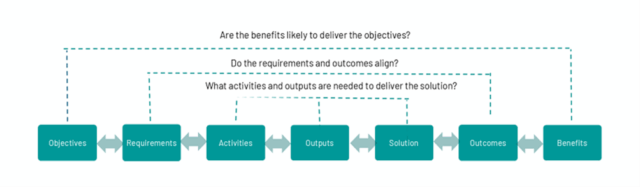
This method traces the links between objectives, benefits, and the activities needed to deliver them. It works both forwards and backwards, helping you check that all objectives are supported by clear actions and benefits. Bi-directional mapping is simple and useful early in planning, or for providing a high-level overview.
The simple logic map shown earlier can easily be developed into a bi-directional map, as shown below.
Figure 7.2 Example of bi-directional benefits mapping
Benefits dependency network mapping
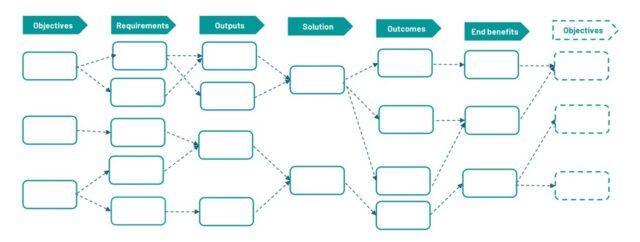
This approach starts with the benefits and works backwards to identify the outcomes, outputs, and enablers needed to achieve them. It is useful for highlighting dependencies and supporting planning and risk management.
Figure 7.3 Example of benefits dependency network mapping
Results chain mapping
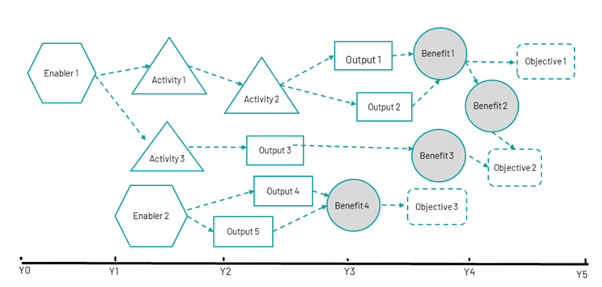
This method shows the sequence of activities, outputs and outcomes that lead to benefits over time. It is especially useful for complex or long-term projects and programmes, as it can show multiple intermediate states and dependencies.
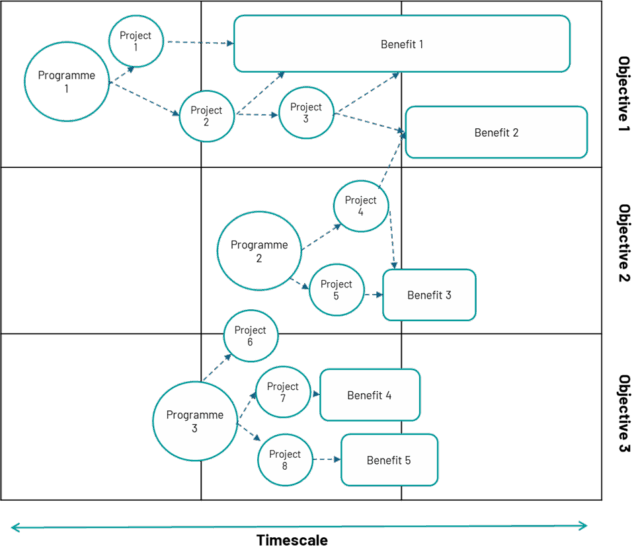
Figure 7.4 Example of results chain mapping
Portfolio benefits matrix
This approach uses a matrix (such as a 2×2 or 3×3 grid) to map different elements of a portfolio against benefits or objectives. It can also help prioritise work by mapping value across the portfolio. For more detail, go to Section 8.
Figure 7.5 Example of portfolio benefits matrix
7.6.4.3 How to do a benefits mapping exercise
Benefits mapping works best as a collaborative exercise. Workshops with stakeholders can help generate ideas and challenge assumptions. Usually, you can start mapping after gathering and validating information from stakeholders.
Benefits mapping involves working through different elements to establish a cause-and-effect relationship between them. It can be used to map negative impacts also.
The mapping process is iterative. Begin with an initial workshop to create a draft map, refine it with the team, and then review it in a follow-up session.
A typical process
Start with the benefits identified, for example in the long list (Section 7.6.3).
Identify beneficiaries (individuals or groups) and the benefits they may receive.
Group benefits and link them to outcomes and objectives.
Identify the enablers and outputs needed to achieve the outcomes and benefits.
Link activities to outcomes and benefits in a causal chain.
Identify assumptions and risks that underpin the map.
Record the mapping, including key assumptions, risks and actions to refine or test the analysis, with clear owners for each action.
Benefits mapping can be challenging, particularly in large-scale work where there may be many benefits. If so, you could try:
mapping high-level benefits or themes first and adding detail later
presenting the map vertically
producing separate maps for different types of benefit, or for benefits and costs
7.6.4.4 Refining the benefits map
Benefits maps are rarely finished in one go. They should be developed and refined over time. Avoid making the map too detailed; focus on the key outputs, outcomes, and benefits that relate to your objectives.
It can be hard to reach consensus between stakeholders on the importance of different benefits. If in doubt include the benefits and then review them when prioritising and valuing benefits against objective criteria.
Some benefits identified by stakeholders may not link directly to your objectives. Record these separately as they may still add value or support wider government aims. However, investment decisions should be based on social value as defined by government objectives (see Section 8), so keep these additional benefits distinct.
If needed, develop more detailed maps for different parts of a programme or portfolio. Always maintain a high-level map that links back to the overall objectives. Once agreed, baseline the map as part of the benefits management framework, and keep track of any changes.
7.6.5 Classify benefits
7.6.5.1 Overview
Once benefits have been identified and mapped, they should be classified.
Benefits are grouped into different types, or ‘classes’, so they can be valued more easily. This makes it easier to appraise and prioritise options and make investment decisions. It also helps you plan, manage, and review benefits realisation throughout the life cycle.
7.6.5.2 Green Book approach to classification
The Green Book sets out how to categorise and assess benefits in terms of social value, considering UK society as a whole.
All investment appraisal, review and evaluation should use this approach. Record the categories in your benefits register.
The Green Book sets out how to classify and assess benefits and costs in terms of social value, considering UK society as a whole.
Changes delivered by a project or programme can have positive or negative impacts. Positive impacts are called social benefits. Negative impacts are called social costs
All investment appraisal, review and evaluation should use this approach. Record how social benefits and costs are classified in your benefits register.
Where the social benefit or cost falls
First, consider who receives the social benefits of the proposed change and who bears the social costs. This could be:
the public body that is developing the proposal
other public bodies
households and individuals
businesses
other non-government organisations such as charities
These groups can be sub-divided further, for example to distinguish between benefits to different social groups, or small and large businesses.
How the social benefit or cost can be measured
Each benefit or cost is then classified by how it can be measured.
Social benefits and social costs are either:
monetisable – they can be expressed in financial terms, for example
unmonetisable – they cannot be expressed in financial terms
Monetisable social benefits and social costs can be either:
cash – affecting the income or spending of a public body
non-cash – they do not affect the income or spending of a public body, for example, changes in greenhouse gas emissions
Unmonetisable benefits and costs can be either:
quantitative – they can be expressed in numbers but not in monetary terms, for example the number of households affected by a proposal
qualitative – they can only be described in words, rather than numbers, such as improvements to reputation, security or wellbeing
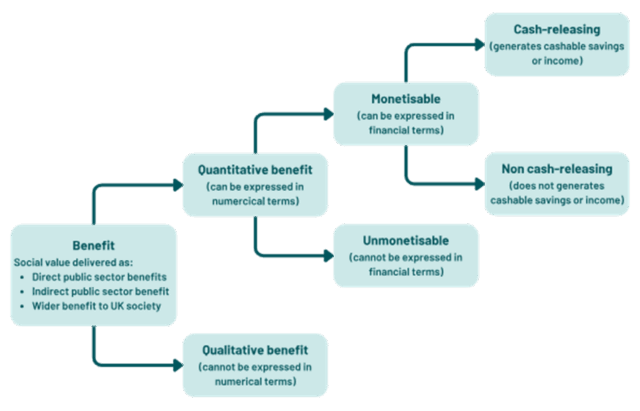
Figure 7.6 shows the different classes of benefit as defined in the Green Book.
Figure 7.6 Benefits classification in the Green Book
Classifying negative impacts
Negative impacts, sometimes called disbenefits or detriments, are considered social costs in the Green Book. These should be grouped in the same way as benefits, based on where the cost falls and whether the impact can be expressed in monetary terms (as cash or non-cash) or needs to be described in other ways.
It’s important to distinguish between public sector financial costs and social costs. The public sector often bears the direct financial cost of a scheme, but social costs may fall elsewhere. For example, the direct cost of building a new road may be funded by the public sector and accounted for in the business case. However, the costs of disruption to local households and businesses are social costs, and they too need to be identified and considered in making decisions on investment.
7.6.5.3 Other ways to organise benefits
In addition to the main Green Book classification, benefits can be grouped in other ways, and these groupings can be recorded in the benefits register. These secondary groupings help with analysis, evaluation, communication and reporting.
One useful approach is to group benefits according to objectives, whether those are specific to the work, the organisation or government priorities. This is often shown in a benefits map. Grouping benefits by objectives helps clarify how portfolios, programmes, and projects contribute to wider priorities, making these links clearer for senior stakeholders.
Other common ways to organise benefits include:
organisational categories
geographical area affected
social wellbeing type: social, economic or environmental
project or programme themes, such as the part of the organisation leading the work or affected by it
how they support the different UN Sustainable Development Goals
7.6.5.4 Recording different types of benefit and cost
Benefit classifications should be recorded in the long list, usually using a spreadsheet so benefits can be sorted by different types. This list can then form the basis for the benefits register. Alternatively, the long list can be imported into the benefits register directly, and classifications recorded individually.
7.6.6 Develop the benefits register
7.6.6.1 Overview
A benefits register is a record of all benefits, potential or planned. It allows benefit owners and decision-makers to sort and classify benefits easily.
The register is usually created as a spreadsheet or in project delivery software. A flexible template is available in the benefits management toolkit.
The benefits register is used for planning and control throughout the life cycle. It should be kept up to date as work progresses, with clear traceability maintained.
7.6.6.2 The key elements of a benefits register
At a minimum, the benefits register should include:
a description of each benefit, including the beneficiary (see 7.6.6.3)
the primary classification of the benefit
any secondary groupings
the benefit owner
As more information becomes available, the register should also include:
the proposed measure and baseline performance
expected timelines for realisation
its status (whether or not it is on track)
7.6.6.3 Describing benefits accurately
Describe each benefit clearly and concisely so that the team and stakeholders can quickly understand what it is, who benefits, how it will be achieved, and its scale.
This requires:
use of plain, concise language
a consistent approach to descriptions
a summary that gives a clear understanding of the benefit
a description that explains the value to stakeholders
Each benefit summary should cover:
the context: where and/or how the benefit happens
the means of change: what creates the benefit
the consequences: the result of the change
the beneficiary or beneficiaries: who receives the value
The same approach should be used for recording negative impacts. These should be entered as social costs in a separate section of the register to keep positive and negative impacts distinct.
Some impacts may have both positive and negative aspects. In these cases, record the positive and negative effects separately as benefits and costs, making clear the link between them. This helps ensure both aspects are considered when valuing these impacts.
7.6.7 Identify benefits owners
The final activity in identifying benefits is to agree a future owner for each benefit and record this in the benefits register. The same process applies to negative impacts.
Identifying owners early allows them to help value, plan for, and realise the benefit, or to manage the impact.
As described in Section 2, the benefit owner is a named individual who works with the benefits manager to:
confirm and value the benefit
develop the benefit profile
agree the benefit assumptions included in the business case
take responsibility for realising and reporting on the benefit at the agreed point
agree when the benefit is closed
Often, the benefit owner is clear from the nature of the benefit. For example, a product owner would usually own the benefits from developing a new product, while a senior operational manager responsible for a public-facing service would own the benefits from service transformation.
Sometimes, it can be difficult to identify an owner in the early stages. This is often the case for indirect public benefits, particularly where new organisations or services are being established.
This may not matter much while benefits are being identified but it becomes more important as benefits are valued for the investment case. If an owner cannot be identified at this point, one option is to appoint someone in the team or sponsoring body with appropriate knowledge or expertise to hold ownership on an interim basis until a long-term owner is agreed.
8 Valuing benefits
8.1 Purpose of valuing benefits
Valuing benefits provides a structured way to support planning and investment appraisal in government projects.
By applying a consistent approach, you can see what each benefit contributes and assess the overall value of the change.
This then allows the cost of the change to be weighed against its future value, so that proposals and options can be prioritised and decisions made on how best to use public funding. Once decisions are made, benefit values guide planning, track progress towards realisation, and provide evidence for review and evaluation.
8.2 Key points
What to consider
How can different benefits best be valued? What about negative impacts?
Are there standard measures or benchmarks you can use?
What are the critical outputs or deliverables that benefits depend on?
How might values change with different solutions or delivery options?
What assumptions affect how and when benefits will be realised?
What are the main risks, and how should these be reflected in your modelling?
Key activities
Agree the approach to valuing benefits and negative impacts
Develop benefits profiles
Value individual benefits
Identify and record risks, issues, assumptions and dependencies
Conduct and validate benefits modelling
Appraise and prioritise proposals
Key products
Benefits profile
Benefits RAID (risk, issues, assumptions and dependencies) log (usually part of the benefits register)
Benefits modelling and appraisal outputs
8.3 Why is valuing benefits important?
By understanding the type and scale of expected benefits, you can weigh them against the costs of delivery. This supports better investment decisions and helps prioritise activity.
Valuing benefits also sets a baseline for tracking progress, reviewing delivery, and learning lessons. It supports transparency by showing how well public funds are being used.
Government considers both costs and benefits from the perspective of UK society as a whole. Outcomes and benefits are assessed in terms of the social value they deliver through government objectives. Wherever possible, these should be given a monetary value, but other ways of measuring them should be used if this isn’t possible.
Valuing benefits can be challenging in some areas, such as security, defence, environment or socio-economic programmes. However, it should be done wherever possible to ensure investment decisions are based on the best available evidence.
8.4 What is involved in valuing benefits?
Valuing benefits involves a series of activities to profile, value and model the benefits to be considered in the investment case. Negative impacts should be handled in the same way.
This usually takes place during planning and developing the investment case, but benefits identified later should also be valued and included in further analysis.
Not all the benefits on the long list need to be profiled and valued for the investment case, and you may have to prioritise them, using criteria in the benefits management framework.
You should follow an organised, disciplined approach, as set out in your benefits management framework. Review and agree your approach before starting, adapting it as needed for the specific benefits identified.
Before valuing benefits you need to create a benefits profile for each benefit. This starts with the information in the benefits register and adds more detail, on what will be delivered and when, who will benefit and how it will be measured. Potential risks, issues, assumptions and dependencies are also identified. These may relate to individual benefits or all of them and could include things like delivery timing, sequencing of outputs, or user numbers. Record these in the benefits register and/or the relevant RAID log.
All this information is used to calculate the value of each benefit over time. Group benefits as needed. For bigger and more complex work, specialist benefits modelling may be needed. Modelling should reflect any risks, issues, assumptions or dependencies identified, and should allow for uncertainty.
Use the results of the benefits modelling, alongside economic cost information, to appraise and/or prioritise the proposed work.
8.5 Who is involved in valuing benefits?
The portfolio, programme or project manager, as appropriate, is accountable for overseeing the work to develop benefits profiles and value benefits. They may also lead the activities.
In a portfolio, the portfolio manager is accountable for overseeing work to value benefits at portfolio level. However, the activities are largely carried out at programme and/or project level, with responsibility held by the relevant senior responsible owner and programme or project manager respectively. For more on this see Section 8.6.1.
Where a benefits manager has been appointed, day to day responsibility for managing these activities is usually delegated to them. Alternatively, this work may instead be delegated to a business case manager.
Benefits owners play an important role in developing the benefits profiles for the benefits they own, and in supporting work to model and value them.
Economists and other expert analysts are often involved in valuing benefits and in leading benefits modelling, particularly in large and complex work.
Evaluation and finance specialists should be consulted on the approach to valuing and appraising benefits. They may also be directly involved in the work or in validating modelling.
Commercial managers should ensure that benefits requirements are identified and valued as part of procurement, in line with the Public Service (Social Value) Act 2012.
Other members of the team, such as planners and project or work package managers, may help develop benefits profiles, advise on timing, and identify risks and assumptions for modelling. Specialists from within or outside the team may also support validation where they have relevant expertise.
8.6 Key activities in valuing benefits
8.6.1 Overview
Valuing and modelling benefits should follow a clear, structured process to support robust investment appraisal and decision-making. The approach should be described in the benefits management framework but may need to be adapted for the specific benefits identified.
Both positive and negative impacts may also contribute to other forms of impact assessment, such as place-based or distributional analysis, as required by the Green Book.
Valuing benefits and costs supports evaluation but is not the same thing (see Section 1.5). Analysts responsible for evaluation should be consulted on how impacts are valued and may also help with benefits modelling or review the results.
In a portfolio
Benefits profiling, valuation and modelling usually start at programme and project level, following the approach in the portfolio benefits management framework. Results are then reported up to the portfolio on an ongoing basis or updated for new spending review or business planning cycles.
Some higher-level benefits may come from the collective impact of the portfolio. These should also be profiled, valued and modelled at portfolio level and used to support planning and prioritisation.
In a programme or project
Benefits profiling, valuing and modelling usually takes place during planning and business case development, often at the appraisal stage or, for programmes, during validation of the strategic outline case. This work is closely linked to planning and is central to shortlisting options and selecting a preferred solution.
In agile or iterative work
For agile or iterative delivery, benefits valuation can be progressive, carried out in each cycle of activity as new benefits are identified. Even so, a high-level benefits valuation is still needed to validate the programme case or outline business case.
Outputs
Across portfolios, programmes and projects, the main outputs from valuing benefits are:
the benefits profiles
a record of associated risks, assumptions, issues and dependencies
the results of benefits modelling, prioritisation and appraisal.
These outputs are described in more detail in later sections.
8.6.2 Agree the approach to valuing benefits
8.6.2.1 Overview
The approach to valuing benefits should be set out in the benefits management framework. Review this approach and make sure it still fits the needs of the work.
The approach should:
meet the requirements of the Green Book
follow any existing frameworks, such as organisational or sector level requirements
support analysis and evaluation, in line with the Aqua Book and the Magenta Book
Tailor the approach to the nature, scale and complexity of the work, and the types of benefits identified. See Section 8.6.4 for more detail.
8.6.2.2 Deciding which benefits are to be profiled and valued
One of the things to consider is whether all benefits in the long list are to be taken forward to be profiled and valued, or whether some prioritisation is needed, so that work can focus on the main impacts.
Agree a clear approach to prioritising benefits. This helps you decide which ones to profile and value, and where to focus effort. The benefits management framework may have guidance on this.
Use criteria like:
contribution to objectives – does a benefit directly support the goals of the programme or project?
scale – what will make the biggest difference?
type – are some types more important, for example, financial savings or socio-economic impact?
risk – how likely is it that the impact will occur?
stakeholder views – which impacts matter most to key stakeholders?
reach – how wide is the impact, for example, number of people or geographic area?
ability to measure – can the impact be measured reliably and consistently?
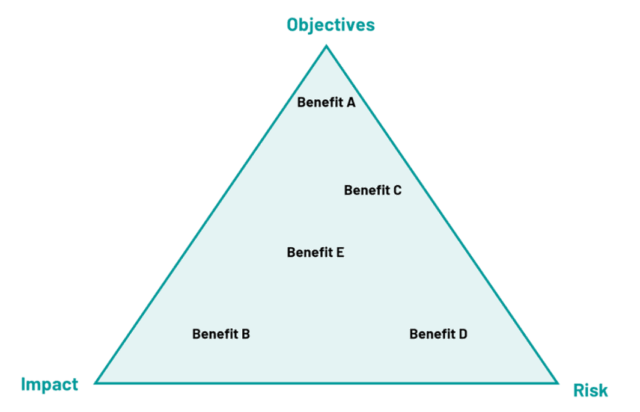
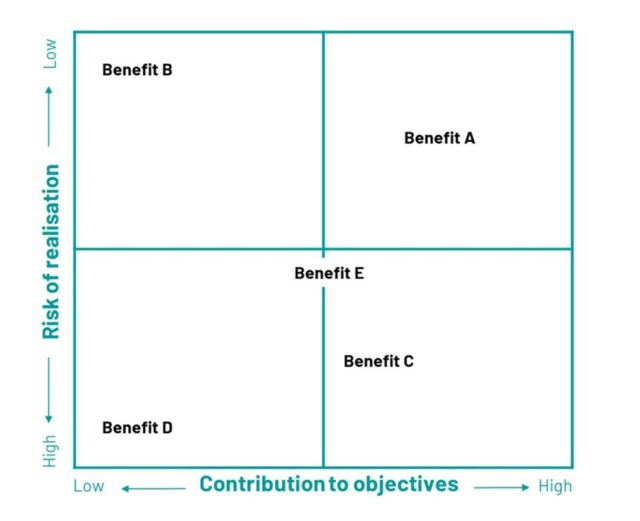
Involve stakeholders in prioritisation. Use visual tools to support discussion, as shown in figures 8.1 and 8.2.
These tools won’t give a definitive answer, but they help people understand the trade-offs and agree a ranking.
Figure 8.1 Example of triangle grid for benefits prioritisationFigure 8.2 Example of two-by-two grid for benefits prioritisation
If there’s no clear priority, focus on the impacts:
linked to the biggest changes
affecting the largest number of people
that help distinguish between options, especially if they’re hard to quantify
Remember: even if a benefit isn’t valued for investment planning, it can still be delivered and tracked in other ways.
8.6.2.3 Document the approach
Once the approach is agreed, update the benefits management framework to explain:
the methods and frameworks used to prioritise and value impacts
any expected challenges or risks, and how they’ll be managed
how modelling will be done, validated and verified
how modelling outputs will support appraisal, prioritisation and evaluation
This helps guide the next stage of work and provides a record of how valuation and modelling were carried out.
8.6.3 Develop the benefits profiles
8.6.3.1 Overview
A benefits profile gives detailed information about each benefit. It complements the summary in the benefits register and provides the source information for investment appraisal. Similar profiles can be created for negative impacts.
Once agreed, the profile becomes the main record for:
tracking changes in assumptions
monitoring progress against milestones
supporting handover to operations
recording decisions on benefit closure
8.6.3.2 Creating a benefits profile
The benefits manager (or designated lead) should work with the benefit owner to develop the profile. Not all information may be known, and further analysis may be needed.
Once complete, the profile should be reviewed and approved by the benefit owner before it’s used for valuation and modelling.
Each benefit profile should include:
the benefit title and named benefit owner
a description of the benefit, including:
its key features
its classification
the objectives it supports
any risks, issues, dependencies, or assumptions
when and how the benefit it to be delivered
how performance is to be measured
how the benefit is to be realised, including key enablers
how and when the benefit is to be closed
A standard template benefits profile is available in the Benefits Management Toolkit.
8.6.3.3 Maintaining a benefits profile
Once agreed, the profile should be baselined and managed under change control.
It should be:
reviewed and updated after the decision to proceed with the work
updated if assumptions change (for example, if delivery is rescheduled)
used to track progress against delivery and realisation milestones
updated to reflect changes in benefit ownership (for example, when handed over to operations)
When the benefit is fully realised, use the profile to record the final outcome and the reason for closing the benefit (see Section 12).
8.6.4 Value individual benefits
8.6.4.1 Overview
Once the benefits profiles are complete, the next step is to value each benefit. To do this, you need to know:
when the benefit will start to be realised
how long it will last
how it will be measured
how many people will be affected
Use this information to forecast the value of the benefit over time. The forecast should be developed with, and agreed by, the benefit owner.
The method you use will depend on the type of benefit. Some are easier to value than others. Section 8.6.4.3 explains how to approach different types of benefit.
8.6.4.2 Understanding timescales
The time period over which a benefit is realised affects how it’s valued and managed.
Planning should cover the whole life of the solution, including through use and disposal.
In portfolios, planning is cyclical, so it’s important to define the timescale over which benefits are to be valued for modelling purposes. This could be a spending review period or over a much longer timescale, as used, for example, in infrastructure, defence and nuclear portfolios.
In programmes and projects, benefits are usually modelled and valued over the whole life of the change, through operation and disposal.
The Green Book provides guidance on the length of time over which benefits, costs and risks are assessed, known as the time horizon. Time horizons are based on standard lifespan assumptions for different types of work and should normally be used. If the work is likely to have significant costs and benefits beyond the standard lifespan, the appraisal period may be extended if HM Treasury agrees. The same assumptions should be used through delivery, realisation and review.
Most benefits are realised once the solution is in use. However, some benefits may be realised during delivery, especially in iterative or phased work. Even in predictive and linear projects, benefits can arise from the work itself.
These might come from:
business investment
local employment and community involvement
digital and industry innovation
archaeological work or environmental interventions
initial benefits from piloting or enabling the work
Short-term, or transient, benefits should still be valued and tracked. Remember to include social value benefits identified in procurement. Make sure timing aligns to the terms of the contract and doesn’t make assumptions, for example, on contract extension.
8.6.4.3 Valuing different types of benefit
Where possible, benefits should be monetised. If not, try to quantify and value them in other ways.
The benefit’s classification should guide how you value it and so are the starting point for valuation. The main types are described below.
Some benefits are harder to value, like those relating to national security, the environment, wellbeing or risk to life. There are recognised government methods for valuing such impacts, using standardised indicators and weighting, listed in The Green Book. Use these where available.
If no standard measures exist, seek advice from economists, social or operational researchers, or other analyst teams in your organisation or from HM Treasury.
Monetisable cash-releasing benefits
Often called efficiency savings, these are usually the easiest benefits to value. They reduce government costs or avoid future spending. For example, they might be benefits that offer:
contract savings
lower utility bills
reduced employee costs
But they’re only cashable if the savings can be realised in practice. For example:
employee savings only count if roles are removed or not backfilled
vacating a building only saves money when the lease ends or the building is sold
a legacy technology platform may still incur support costs, even if most users have moved to a new service
Monetisable non-cash releasing benefits
These can be valued in monetary terms but don’t reduce government spending. They often relate to wider social impacts, for example through:
improved public services
better roads and railways
lower greenhouse gas emissions
Many economic and social infrastructure programmes deliver this sort of benefit, for example in meeting social need, supporting growth or providing other forms of public benefit.
These benefits are harder to measure. Subject matter experts and specialist analysts should be involved.
Unmonetisable but measurable benefits
These can’t be expressed in money but can be quantified (measured) in other ways. For example:
environmental benefits in terms of biodiversity
health benefits in quality-adjusted life years (QALYs)
Use the measures recommended in the Green Book and involve specialist analysts with appropriate subject matter expertise.
Qualitative benefits
These are the hardest to value but can still be important, especially for social value. You can assess them by:
asking stakeholders to rank their importance
using weighted scoring
Include key qualitative benefits in the strategic case, even if they can’t be modelled for the economic case.
Speculative benefits
These are uncertain and often linked to research and development. They can fall into any category. Use forecasting and expert judgement to assess them and always involve specialist analysts.
8.6.4.4.Consider mixed and uneven benefits
A single change can deliver several types of benefit. For example, a new ferry service might:
reduce operating costs
boost local tourism
improve passenger experience
Each type of benefit should be valued separately.
Some benefits may be unevenly distributed, having a positive impact in one area but a negative impact in another. Use distributional analysis to reflect this in the economic case. You can also apply weighting techniques to reflect impacts in specific areas, such as rural or deprived communities.
These methods are usually used to support prioritisation or shortlisting, rather than as part of formal valuation. See Section 8.6.7.3 and the Green Book for more on this.
8.6.5 Identify risks, issues, assumptions and dependencies
8.6.5.1 Overview
Valuing benefits always involves some uncertainty. It’s important to identify and record:
risks or issues that could affect the value or delivery of a benefit
key assumptions or dependencies that could influence how benefits are realised
This should be done for each benefit and across the work as a whole. Ask:
are there wider risks or dependencies, like delivery timing, sequencing or user uptake, that could affect multiple benefits?
are assumptions consistent across all benefits?
Record this information in the benefits register and, where relevant, in the RAID (risks, assumptions, issues and dependencies) log. Use it to inform modelling, appraisal and decision-making.
8.6.5.2 Building uncertainty into benefits analysis and modelling
Just like cost estimation, benefits analysis should account for uncertainty.
Use risk-based planning and estimation techniques to reflect uncertainty in your modelling.
Refer to:
the Orange Book for risk management
Cost Estimating Guidance for planning techniques
the Aqua Book for analytical quality and assurance
the Green Book for handling uncertainty, optimism bias and risk in business cases
All analysis and modelling should conform to the Government Functional Standard for Analysis.
Make uncertainty visible in your outputs. Use ranges and present different plausible outcomes, not just a single forecast.
When valuing individual benefits:
reflect risk in the economic case
include financial risk or liability in the financial case, where relevant
adjust assumptions as confidence improves over time
8.6.6 Conduct and validate benefits modelling
8.6.6.1 Overview
Benefits modelling should follow the Government Functional Standard for Analysis and the guidance in the Aqua Book.
Use the forecast value from individual benefits profiles to calculate and aggregate forecast values. This creates an overall view of expected benefits.
Modelling is often done using linked spreadsheets. For large or complex work, use specialist software.
The outputs should show:
the total forecast benefits
a breakdown by Green Book classification
This helps investment decision-makers understand the impact of each benefit, both on public spending and wider impact.
You can also present benefits by theme. For example:
contribution to government objectives
social, economic or environmental impact
These groupings should then also be used to track benefits realisation.
8.6.6.2 Modelling considerations
Modelling often involves multiple inputs from different sources. To maintain quality:
use clear protocols for data entry
ensure traceability back to the source data and benefits profiles
follow the Aqua Book guidance on analytical quality assurance
In long-term or complex work, models can grow large and errors may creep in. Build in regular checks and validation.
Include uncertainty and risk in your modelling (see Section 8.6.5). Use techniques like:
Monte Carlo analysis
probability-based estimation
These help show the likelihood of different outcomes and the range of possible scenarios.
Make uncertainty visible in your outputs. Present information in ranges and include a number of plausible outcomes to support appraisal, decision-making and target-setting.
Watch out for optimism bias – the tendency to overestimate benefits. You can reduce this by:
using probability-based techniques
benchmarking against similar work
inviting independent challenge
8.6.6.3 Verification and validation
Once modelling is complete, it must be independently reviewed and validated. This ensures the data used for appraisal and decision-making is robust.
Verification and validation are part of analytical quality assurance. Plan for them early, ideally when designing your approach to valuing benefits (see Section 8.6.2.3).
Tailor the level of scrutiny to the scale and complexity of the work. Follow the Aqua Book guidance.
If validation shows the modelling needs improvement, make changes where possible. If not, clearly explain any data quality issues when presenting benefits assumptions. This helps decision-makers judge whether to include the data and on what basis.
8.6.7 Appraise and prioritise proposals
8.6.7.1 Overview
Once benefits modelling is complete and validated, use it alongside cost modelling to appraise and prioritise proposals.
The aim is to:
compare different options
assess their value
identify a preferred way forward including comparing against the ‘do nothing’ option
Appraisal is usually led by the business case manager, with input from the benefits manager, finance lead and relevant analysts. It must follow the principles in the Green Book.
8.6.7.2 Appraisal methods
Government investment appraisal is based on assessing social value: the total benefits minus total costs to society.
The Green Book sets out how to express this value for different combinations of social benefits and social cost, for investment appraisal. In each case, the benefits or costs are adjusted for time factors and so expressed as real terms and in present value terms, for consistency.
Net present social value
This shows the difference between the total monetisable social benefits of a proposal and the total monetisable social costs. It shows the overall social impact of an option.
Benefit-cost ratio
The benefit-cost ratio is the social return of a proposal. It shows the monetisable social benefits generated for each unit of monetisable social cost.
Return on public sector cost
This metric helps in comparing different options in terms of how well they optimise social value in relation to their cost to the public sector.
Net present unit cost
This metric enables options to be compared in terms of whether their different levels of social benefit are worth the associated social costs.
These summary metrics of social value are used to compare and rank different options in a proposal, but on their own, they are not enough to make a balanced judgement about value for money. They should also not be used to compare different proposals with different objectives. The Green Book makes clear that decisions on investment should draw on a range of information to decide how to balance different considerations of value for money in each case. This might include, for example, the need to maximise public sector efficiency benefits, or achieve benefits for a particular place, sector or group.
Risk and uncertainty are also key factors to consider, using techniques like sensitivity analysis and switching values. These can also help in assessing unmonetisable benefits, for example by showing how much value they would need to generate a positive net present social value.
For detailed guidance on appraisal methods, see Chapters 6, 7 and 8 of the Green Book.
8.6.7.3 Appraisal and prioritisation in practice
Appraisal using Green Book methods is a requirement for government investment proposals. It provides a consistent way to compare options based on their benefits, costs and risks.
In a portfolio, appraisal helps prioritise proposals, for example, as part of a spending review or annual business planning cycle.
In a programme or project, it’s used to shortlist options in the outline business case, or programme case, and to confirm decisions in the full business case or updated programme case.
But prioritising proposals isn’t always as simple as ranking them by net present social value or other metrics, as the Green Book notes. These are useful measures, but they don’t tell the whole story. There are also often practical things to consider.
For example:
a higher cost option might deliver more benefit and a higher net social value, but it might not be affordable
a lower cost option might deliver a higher benefit-cost ratio, but it might not meet an important objective or might be delivered too late
an important benefit might not be included in the economic appraisal because it can’t be monetised or quantified
So prioritisation often needs to consider more than just benefit and cost, including the wider government objectives and success criteria set out in the strategic case.
You might also need to rank options based on:
timing
risk
distribution of impacts
These should link back to the agreed objectives and outcomes for the work (see Section 5).
8.6.7.4 Presenting appraisal results
Appraisal results should be shown using an appraisal summary table, comparing different options side by side.
Programmes and projects seeking investment approval should follow the template provided in the Green Book.
Sometimes, there are other impacts to consider alongside benefit and cost appraisal.
You can use techniques such as:
weighting, which gives more importance to certain impacts
scoring, which helps compare options fairly across different criteria
You can find more detail on these approaches in The Green Book.
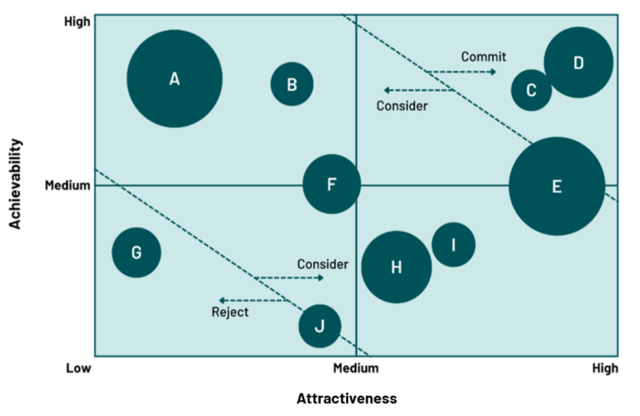
In a portfolio, decision-making can also be more complex. This is because there are more activities and variables to consider. A visual summary, like the one shown in Figure 8.4, can help make comparisons easier and support better decisions.
Figure 8.3 An example of portfolio mapping
This shows work components plotted against achievability and attractiveness. The size of the bubble indicates the scale of benefit to cost ratio (taken from The Teal Book).
8.6.7.5 Taking account of negative impacts
It’s important to consider negative impacts carefully when appraising investment proposals. Sometimes these are called disbenefits or detriments, but those terms are not used in government as they can cause confusion in appraisal and accounting treatment.
The Green Book says that all positive impacts, including cost savings, should be treated as benefits. All negative impacts should be treated as costs.
Some areas of government policy make this harder to apply consistently. For example, carbon emissions and environmental impacts in transport and infrastructure projects can be difficult to classify. In these cases, you may need to use distributional analysis or other techniques to assess how impacts vary across different groups or locations.
If a negative impact can be measured, include it in the economic case as a social cost. Any direct financial costs should go in the financial case. This helps make sure negative impacts are identified, considered in appraisal and managed properly.
If a negative impact is significant but can’t be measured, describe it clearly in the strategic case. You should also mention it in the economic case if relevant.
You can find more guidance on this in the Green Book, including on modelling and appraising social costs. If you’re unsure, speak to economists in your department or HM Treasury.
9 Planning benefits
9.1 Purpose of planning benefits
Planning how and when benefits will be realised helps make sure:
key activities are scheduled
the right people are involved
risks, issues and dependencies are managed
progress can be tracked
9.2 Key points
What to consider
Are benefits targets agreed and baselined? Are they achievable?
Is benefit documentation up to date?
What work is needed to deliver and realise the benefits?
What needs to happen when?
Who are the key people needed and when? What are the key enablers?
What are the key risks, issues and dependencies to be managed?
What information is needed to track realisation and to support review and evaluation?
What arrangements are needed to support handover to operations?
Key activities
Establish baselines for planning
Develop the benefits realisation plan, including
benefits realisation activities
risks, issues and dependencies
benefits tracking and reporting
review and evaluation
handover of benefits ownership to operations
Key products
Benefits realisation plan
Benefits tracker
Outline benefits reports
Outline of benefits handover arrangements
9.3 Why is planning benefits important?
Planning helps make sure benefits are delivered as expected. It ensures that:
activities are scheduled at the right time
the right people and enablers are in place when needed
risks, issues, assumptions and dependencies are identified and managed early
It also prepares for the work needed to support benefits realisation, including:
tracking and reporting
review and evaluation
handing over benefits realisation to operations
Without proper planning, benefits may be delayed, missed or harder to measure.
9.4 What is involved in planning benefits?
Benefits planning is part of wider planning, feeding into the developing case for investment and decisions on the preferred way forward. Planning links the outputs to be delivered and work needed to realise the benefits, such as business change activities, and ensures that these are costed and scheduled into the investment case and planned into any procurement.
Benefits realisation planning, however, really starts in earnest after the way forward is clear.
This could be:
the result of a spending review bid for a portfolio
approval to proceed after an outline or full business case
approval of a programme business case
The first step is to set a clear baseline for benefits. This means understanding what has been agreed in the investment case approved and what targets or assumptions on benefits are linked to the decision. If anything is unclear or unrealistic, it should be resolved before planning for realisation begins.
Update the benefits documents to reflect the agreed position.
Once the benefits baseline is confirmed, in-depth planning for realisation can begin. This should include:
agreeing the activities needed to realise benefits, when they’ll happen, and who and what is needed to support them
identifying risks, issues and dependencies that could affect benefits
setting up tracking and reporting arrangements, including a benefits tracker and outline reports
finalising plans for review and evaluation
preparing to hand over benefits realisation to operations
The main outputs are:
the benefits realisation plan
the benefits tracker
outline benefits reports
the benefits handover plan
9.5 Who is involved in planning benefits?
The portfolio, programme or project manager, as appropriate, is accountable for overseeing benefits realisation planning. Normally, however, planning activities themselves are delegated.
In a portfolio, cross-portfolio planning activities are overseen by the portfolio manager, who may lead activities or delegate them to the portfolio benefits manager.
Detailed planning activities are normally carried out at programme and/or project level, with accountability held by the relevant senior responsible owner and responsibility held by the programme or project manager respectively.
Where a benefits manager has been appointed, day to day responsibility for managing benefits planning activities is usually delegated to them.
Benefits owners should be involved in benefits realisation planning in relation to the benefits they own.
Analysts leading work on evaluation should also be involved in planning for review and evaluation.
Other members of the team, for example, planners and project managers can also be involved in work to plan and schedule activity. Commercial and finance managers should be consulted to ensure that social value benefits identified in procurement are fully factored in planning and documentation. The reporting manager should be involved in developing the benefit tracker and outline benefits reports.
9.6 Key activities in planning benefits
9.6.1 Overview
Planning for benefits realisation needs to look across the life cycle. This could be an agreed period in the case of a portfolio, or the solution life cycle in the case of a programme or project.
Start with the outline plan in the benefits management framework. Review and update it, along with any other benefits documents. Check that benefits targets and assumptions are clear and realistic and baseline them where needed.
Involve benefits owners and other team members in planning. They should help identify:
the activities needed to realise benefits
risks, issues and dependencies
who is responsible for each part of the work
Also involve the people responsible for:
tracking and reporting
review and evaluation
handing over benefits realisation to operations
This helps make sure the plan is realistic and that everyone understands their role, responsibilities, timescales and key activities.
Document the plan progressively and bring it together as the benefits realisation plan. This should be part of the overall plan for the work and managed under change control.
Develop the benefits tracker alongside the plan. It should be ready to use as soon as benefits start to be realised.
9.6.2 Establish the baseline for planning
9.6.2.1 Overview
Effective planning needs solid foundations. Start by checking that the assumptions used for planning are still valid. Make sure all benefits documentation is up to date and reflects the investment decision.
Use the outline plan in the benefits management framework as your starting point. Update it to reflect any changes from the investment decision. This updated plan will form the basis of the benefits realisation plan.
9.6.2.2 Confirming the baseline for planning
Each benefit owner should be reconfirmed. They should review and, if needed, update their benefit profiles to reflect the investment decision.
The benefits manager should check that the benefits profiles match the agreed solution, not any shortlisted options that were discounted. Check any social value benefits linked to contracts reflect the final version of the contract.
Once updated, benefit owners should approve their profiles as baseline documents for planning. Any changes after this point should go through formal change control.
Next, review and update the benefits register to reflect the baselined profiles. Close any benefits linked to rejected options and move them to a separate section of the register.
Update the benefits map to reflect the latest assumptions.
9.6.2.3 Managing changes to benefits assumptions
Earlier work on valuing, modelling and appraising benefits should have considered uncertainty and tested whether the assumptions are realistic.
If circumstances have changed, or benefits owners raise concerns, review the assumptions and clarify the position and impact on benefits overall.
The benefits management framework should set out how to handle changes.
For example:
minor profile changes that do not affect overall benefits assumptions can usually be agreed by the benefits manager or another senior manager
changes that affect assumptions agreed at investment approval should be reported to the portfolio, programme or project manager and the relevant governance board
significant changes that impact on the investment case may need to go back to the body that gave approval
Any changes to assumptions should be formally approved. Update the benefits profile and register, and baseline them again for planning. Any future changes should go through formal change control.
9.6.3 Develop the benefits realisation plan
9.6.3.1 Overview
Benefits realisation planning is usually developed progressively and brought together into a single plan, the benefits realisation plan.
Like other plans, it’s usually made up of linked documents, usually combining narrative, tables, spreadsheets and schedules.
Initial planning for benefits realisation should have started when the benefits management framework is created. It should then be developed further through the work on profiles and assumptions with benefits owners.
Wider financial and resource planning should also include provision for benefits realisation. These plans form the starting point for more detailed benefits realisation planning when decisions on the way forward have been agreed.
The benefits realisation plan should cover:
what activities are needed to realise benefits, when they happen and who is involved
how risks, issues and dependencies will be managed
how benefits will be tracked and reported, and who is responsible
what reviews and evaluations are needed, and how they link to assurance
when benefits ownership will be handed over to operations, and how this will be managed
Governance and change control arrangements for benefits realisation should be aligned with wider governance and set out in the governance and management framework. It can be helpful to restate these arrangements in the plan.
If additional governance is needed, include this in the plan. This could include a sub-group to oversee benefits realisation.
Benefits realisation, review and evaluation are closely linked. Plan them together to streamline data collection and make sure metrics are aligned.
Some organisations prefer to create a joint benefits realisation and evaluation plan. This works particularly well in cyclical or iterative life cycles, where activities are closely aligned. It’s less effective in sequential delivery, where the timescales for benefits realisation and evaluation can be very different.
9.6.3.2 Plan benefits realisation activities
The benefits realisation plan should set out the planned realisation profile for each benefit. This includes:
the work outputs, change and communications activities needed
who is responsible for each activity
when activities need to happen
the baselined assumptions and/or targets, expected trajectory and key milestones
any dependencies, including intermediate or enabling benefits
known risks and issues
Make sure benefits realisation activities are not planned in isolation and are aligned with the overall schedule for the work. This includes milestones for key deliverables and business change events that trigger benefits.
Consider also any negative impacts that need to be managed and plan for those too.
The way you schedule activities will depend on the delivery approach.
Sequential or predictive delivery
Benefits often depend on full implementation of the solution. Realisation activities may be scheduled in the same time frame.
This is easier to plan but can put pressure on change teams and users. It also increases the risk of delays. To manage this:
make sure changes are resourced and manageable
build in breathing space between activities
allow time for catch-up and contingency
Modular, incremental or iterative delivery
Benefits are delivered progressively, often in cycles. This is common in portfolios, whereas programmes and projects deliver benefits over time.
This approach is harder to plan but easier to manage. It supports continuous learning and adaptation, which can improve benefits realisation. Effective tracking and reporting are essential to keep progress on track.
Other planning considerations
Not all benefits need the same level of support. Focus resources on the areas of greatest need in terms of support and the most critical or impactful benefits.
Think carefully about how to resource realisation activities. Benefit owners should play a central role. Change champions and operational staff can also provide valuable support.
The key is to plan ahead and engage people early. This helps build support and encourages adoption of the changes that lead to benefits.
9.6.3.3 Plan for risks, issues and dependencies
Planning for benefits realisation should include identifying and managing risks, issues and dependencies.
Start by reviewing what’s already been captured in:
the benefits register
individual benefit profiles
Make sure these are included in the benefits realisation plan. You can also use a separate but linked tab in the main register if that’s easier.
Check the profiles for key dependencies. These should also be reviewed and added to the plan.
Look out for new risks and issues. For example:
what happens if outputs are delayed?
are there shared dependencies that could cause cumulative impact?
are there pinch points in resourcing or times when benefits can’t be realised for operational reasons?
Once identified, risks, issues and dependencies should be:
categorised by likelihood and impact
assigned to owners
documented using your organisation’s standard approach
Where possible, adjust the plan to reduce the likelihood or impact. For example, add contingency time or extra resources. Anything that remains should be monitored and actively managed throughout benefits realisation.
9.6.3.4 Plan for benefits tracking
Tracking benefits helps you monitor progress and respond quickly if things go off track. Planning for tracking should start early so it’s ready when benefits begin to be realised.
Follow the project delivery data standard for tracking and reporting. Not all tracking data needs to be included in reports, but all key benefits should be tracked. These usually include:
quantified benefits from the economic case
qualitative benefits from the strategic case
Together, these show how well the work is delivering the outcomes and objectives agreed at investment approval. Use the benefits map to check that all key benefits are included.
Next, add the metrics and targets for each benefit. These should be based on the baselined benefit profiles.
The benefits tracker should record, for each benefit:
benefit name, identifier and classification
how the benefit will be measured or tracked
baseline, target and expected trajectory
progress on realisation
When choosing metrics:
use standardised measures for quantitative benefits (see section 7)
track qualitative benefits using milestones or evaluation data
include both leading indicators (like website visits) and lagging indicators (like completed applications)
Leading indicators help you spot trends early. Lagging indicators show what’s already happened. Use both to get a full picture.
Tracking should be frequent enough to support decision-making. Monthly tracking is common during active realisation. In portfolios, quarterly tracking may be more appropriate.
A template benefits tracker aligned to the data standard is available in the benefits management toolkit.
9.6.3.5 Plan benefits reporting
Once the tracker is in place, the benefits manager should agree reporting arrangements with the reporting manager.
Reports usually focus on a subset of key benefits, along with an overall summary.
Tailor the format and level of detail to the audience. This could be:
a project board
a programme board
a portfolio board
an organisational board
Projects in the Government and Departmental Major Projects Portfolio must also meet GRIP reporting requirements. Try to avoid creating multiple formats for different boards. Instead, use linked reports that offer different views.
All reports should include:
an overall view of benefits realisation, grouped by Green Book classification
progress towards headline benefits agreed at investment approval
Reports can be visual or numerical, depending on board preferences.
You can also include progress on the most critical benefits, both quantitative and qualitative. These are often the benefits linked directly to objectives in the benefits map. If there are negative impacts that need tracking, these can be included too.
Report formats are usually set centrally, but make sure they:
give a balanced view of benefits realisation
meet the needs of the board or audience
highlight issues clearly so action can be taken
9.6.3.6 Plan for review and evaluation
Planning for review and evaluation is an important part of benefits realisation planning.
Reviews help give stakeholders confidence that benefits are being delivered.
They also give the team a chance to reflect, spot issues, celebrate success and learn lessons.
Initial plans for review and evaluation should be included in the benefits management framework. These should be revisited to check they are still appropriate and updated as necessary.
Next, agree:
when reviews and evaluations should happen
who should be involved
Timing is important. Reviews should give a clear picture of progress and be scheduled so their findings are useful. Make sure they don’t overlap or duplicate evaluation activities. Work with the evaluation team to coordinate plans.
It is key to ensure that the timing of reviews contributes to, and does not cut across or duplicate, plans for evaluation. Plans should therefore be developed in consultation with the evaluation team and activities scheduled accordingly.
Internal review
The post-implementation review is the main type of internal review for programmes and projects. It’s carried out for the senior responsible owner to confirm that the investment is delivering the expected benefits. It also captures lessons learned to inform future work.
Periodic reviews are used in portfolios to check progress on benefits realisation. They help ensure that benefits are being delivered as planned and allow for early intervention if needed.
A one-off review can be held when benefits are off track. They help identify issues and agree actions to get delivery back on course.
Lessons learned reviews should be scheduled at key points during delivery and before closure. They help teams reflect on what worked well and what could be improved.
External review
The main type of external review is the Gate 5 assurance review. This looks at operations and benefits realisation and is usually scheduled before handover to operations. It can be repeated as necessary and it can also be used in portfolios. See Section 2.4.2.3 for more on Gate 5 reviews.
Review plans should be agreed with the portfolio director or senior responsible owner. They should be included in the benefits realisation plan and in the integrated approval and assurance plan for the work as a whole.
9.6.3.7 Plan for benefits handover to operations
The final element of benefits realisation planning is to plan for handover of benefits ownership and realisation activities to operations.
How and when this happens depends on the nature of the work and the delivery approach.
Sequential or predictive delivery
In sequential or predictive delivery, benefits are often realised after implementation. Benefits owners may already be part of the operational team. If they are not, ownership must be transferred before the programme or project closes.
Realisation activities, including tracking and reporting, should also be handed over to operations before closure. This ensures continuity and avoids gaps in responsibility.
Modular, incremental or iterative delivery
In modular, incremental or iterative delivery, benefits are realised progressively. Ownership is usually embedded in operations and handed over as each cycle of activity completes.
Tracking and reporting often continue within the programme, project or portfolio until the work closes. At that point, any remaining realisation activities, including tracking and reporting, should be handed over to operations.
Planning the handover
Planning should set include:
when the handover is expected to happen
how it will be managed
who needs to be involved
Work with benefit owners to agree the handover arrangements. The aim is to ensure a smooth transition of responsibility and continuity in benefits realisation, tracking, reporting and review, especially after the work closes.
See Section 10 for more on handover.
10 Realising benefits
10.1 Purpose of work to realise benefits
Benefits realisation is designed to ensure that the changes delivered by a portfolio, programme or project result in the benefits promised in the investment case.
10.2 Key points
What to consider
Has the benefits realisation plan been shared? Are the key people engaged?
Are benefits realisation activities being delivered as planned?
Are benefits being realised as planned? Are negative impacts being managed?
Is benefits tracking and reporting working as planned?
Is further action needed to address risks, issues or opportunities?
When should benefits realisation move to operations?
Key activities
Engage people in benefits realisation
Track benefits realisation activities and outcomes against plan
Report on benefits realisation
Act promptly to address risks, issues and opportunities
Hand over benefits realisation to operations
Key products
Benefits tracker
Benefits reports
Benefits handover documentation, including updated benefits profiles, register and realisation plan
10.3 Why is work to realise benefits important?
Change doesn’t automatically lead to benefits. People may resist change if they see it as disruptive or threatening. Even when change is welcome, people often need help to understand and use new services or ways of working.
Benefits realisation helps make change stick. It encourages adoption, tracks progress and tackles anything that’s stopping benefits from being fully delivered. It also helps make sure that objectives are met and the expected social value is achieved throughout the life of the solution.
10.4 What is involved in realising benefits?
Realising benefits means managing a set of activities that help ensure benefits are delivered as planned.
The starting point is the benefits realisation plan (see Section 9). Everyone involved in delivering it — including delivery, change, communications and reporting teams, benefits owners and others — needs to understand the plan and their role in it.
Change management is central to benefits realisation. Communicating with users and stakeholders helps promote adoption and support the changes. It also helps manage any negative impacts.
Tracking and reporting show whether activities are happening, and whether the solution is working and delivering benefits. They also provide early warning of risks, issues or opportunities, so action can be taken quickly.
Benefits can be realised at different points in the life cycle. This is especially true in agile or iterative delivery, and in programmes and portfolios, but it can also be true for other work. For example, contracted construction work can have significant benefits from the start of delivery by creating new jobs in a local area and encouraging business investment in services to support them.
Benefits realisation is usually managed by the portfolio, programme or project team. But in some cases — especially when benefits are realised after the work has closed — it may be managed by operational teams.
Handover to operations is a key part of benefits realisation. It ensures that benefits continue to be owned, tracked and delivered for as long as needed.
10.5 Who is involved in realising benefits?
The portfolio, programme or project manager, as appropriate, is responsible for overseeing benefits realisation, reporting to the senior responsible owner, until responsibility is handed over to operations. At this point an appropriate senior manager in the sponsoring body should be made responsible for overseeing benefits realisation for as long as it continues. This could be a senior manager in operations or in a corporate or policy function. Ultimately, the accounting officer in the sponsoring body is accountable for ensuring that benefits are realised as planned.
In a portfolio, cross-portfolio realisation activities are overseen by the portfolio manager, who may lead activities or delegate them to the portfolio benefits manager. Detailed planning activities are normally carried out at programme and/or project level, with accountability held by the relevant senior responsible owner and responsibility held by the programme or project manager respectively.
Where a benefits manager has been appointed, day to day responsibility for managing benefits realisation activities is usually delegated to them.
Benefits owners should play a leading role in realisation activities for the benefits they own and in tracking realisation and recording it in the benefits tracker.
Change managers and communications managers also play a key role in supporting adoption and use of the solution and helping stakeholders gain the expected benefits from it, and should be involved in planning and carrying out these activities.
Other members of the team, for example project managers and commercial managers, can also be involved in work to realise benefits and to address any issues or opportunities arising.
The reporting manager should be involved in defining benefits reporting and managing it as part of wider reporting.
10.6 Key activities in realising benefits
10.6.1 Overview
Benefits realisation activities help make sure that promised benefits are not only delivered, but sustained and optimised to create the greatest social value.
Engaging with users, listening to feedback and adapting activities to meet their needs are all critical. Tracking and reporting also play a key role. They show how well the solution is working, highlight positive and negative impacts, and give early warning of problems.
By this stage, the main products should already be in place. These include:
the benefits realisation plan
the benefits tracker
benefits reporting tools
benefits profiles
the benefits register
the benefits management framework
Before handing over to operations, check that everything is working as intended and that documents are up to date with the latest information.
10.6.2 Engage people in benefit realisation
Benefits realisation depends on good communication and engagement.
Everyone involved needs to understand the benefits realisation plan and their role in delivering it.
Users and stakeholders also need to understand:
what the change means for them
how they can help
how to give feedback
The approach to engagement will depend on the nature of the work. For example, launching a new internal digital service may involve:
direct communications
user training
workshops to gather feedback
people on site to support users and troubleshoot issues
Launching a new road system may require:
communications through local news channels
engagement with National Highways, emergency services and road user groups
monitoring of user experience
Principles for effective engagement
Whatever the context, you should:
plan activities carefully, so they don’t clash with busy periods or other pressures
communicate early and often, because people rarely hear or remember messages the first time
track user experience in different ways, and check that feedback channels are working — no complaints might mean no one found the feedback button
act quickly to resolve problems, so they don’t escalate or cause reputational damage
You can find more guidance in The Teal Book, including:
stakeholder engagement (Chapter 26)
communications (Chapter 27)
managing organisational and societal change (Chapter 35)
10.6.3 Track benefits realisation against plan
Tracking benefits realisation helps you understand whether activities are happening as planned and whether benefits are being delivered.
Use the benefits realisation plan and the benefits tracker as soon as outputs go live and benefits start to be realised (see Section 9). Check also for evidence of any negative impacts.
Change adoption, especially behaviour change, can take time. Allow space for benefits to emerge. Leading indicators are useful early on, as they show how users are responding. Lagging indicators will show whether benefits are being delivered.
If feedback indicates a concern, you can add extra measures to understand and track the issue. For example, a spike in password reset requests might suggest users are struggling to access a new system.
If tracking shows that activities are off track or benefits are not being realised as expected, escalate this to the relevant manager, usually the portfolio, programme or project manager, and include it in reporting (see Section 10.6.4).
11 Reviewing benefits
11.1 Purpose of reviewing benefits
Benefits reviews help you understand how well a benefit is being realised and what impact it’s having on the agreed objectives.
They provide assurance that benefits are on track and highlight where further action may be needed. Reviews also support wider evaluation and help teams learn lessons to improve future delivery.
11.2 Key points
What to consider
When should reviews be scheduled to be most useful? How do they contribute to evaluation?
Are there other reasons to hold a review, for example realisation is significantly off track?
How should findings be presented and to whom?
What actions should be taken in consequence?
Are further reviews needed, for example to check on progress?
What lessons can be learned from realisation and how can they best be captured and shared?
Key activities
Schedule reviews in line with plans and to complement evaluation
Prepare for reviews, providing access to people and data and other support as necessary
Manage reviews
Share review findings and lessons and act on them
Key products
Benefits review report
Lessons learned report
11.3 Why is reviewing benefits important?
The main aim of a benefits review is to understand how effectively benefits are being realised and how this supports the agreed objectives.
Reviews give confidence when benefits are on track and flag issues when they’re not, so action can be taken.
They also support policy evaluation and help show how public money is being used. Reviews capture lessons learned, which can be shared and used to improve future benefits management and delivery.
11.4 What is involved in reviewing benefits?
As explained in Section 9, reviews can take different forms depending on the nature of the work and its lifecycle. They can be carried out by internal or external teams.
Reviews should be planned and scheduled as part of benefits realisation. Include them in the benefits realisation plan and the integrated assurance and approvals plan. Make sure they’re aligned with evaluation plans.
The focus and format of a review depends on its purpose and timing.
In portfolios:
periodic internal reviews are used to check ongoing benefits realisation
one-off reviews can be commissioned by the portfolio director if benefits are off track
external Gate 5 assurance reviews can be used to provide independent scrutiny of benefits management and realisation
In programmes and projects:
internal reviews can be commissioned to assess benefits realisation, especially where delivery is progressive or issues need deeper understanding
a post-implementation review should be commissioned by the senior responsible owner before closure. This confirms whether the investment is delivering the expected benefits and captures lessons learned. Findings are included in the closure report, with recommendations for follow-up
a Gate 5 assurance review usually follows the post-implementation review. It checks readiness for handover and benefits realisation, and can be repeated during operations to assess ongoing delivery
Lessons learned reviews are another type of internal review. These can be held at any time but are usually planned for the end of a sprint, phase or before closure.
More information on Gate 5 and other assurance reviews is in Section 3 and in the Assurance Toolkit. For evaluation, see the Magenta Book. For lessons learned, see Chapter 38 of The Teal Book.
11.5 Who is involved in reviewing benefits?
The portfolio, programme or project manager, as appropriate, is accountable for overseeing benefits review. Normally, however, review activities are delegated.
In a portfolio, cross-portfolio review activities are overseen by the portfolio manager, who may lead activities or delegate them to the portfolio benefits manager.
Detailed review activities are normally carried out at programme and/or project level, with responsibility held by the relevant senior responsible owner and/or programme or project manager respectively.
Where a benefits manager has been appointed, day to day responsibility for planning review activities and leading work on lessons learned is usually delegated to them.
Internal team members can be involved in conducting internal reviews, including post implementation reviews. Gate 5 reviews are externally led, either by a NISTA-appointed team (for projects and programmes in the Government Major Projects Portfolio) or by the sponsoring body for others.
Evaluation is usually conducted by specialist analysts in the evaluation team, which usually sits outside the immediate team.
Benefits owners should be involved in benefits reviews in relation to the benefits they own and in lessons learned activities.
Other members of the team who have been involved in benefits realisation work should contribute to benefits reviews. They should also be involved in lessons learned activities.
11.6 Key activities in reviewing benefits
11.6.1 Overview
Reviewing benefits involves scheduling, preparing, managing the review itself, and sharing findings and lessons learned.
The benefits management framework should set out expected review and evaluation arrangements. These should be reflected in the benefits realisation plan and the evaluation plan. In some cases, a joint plan may be developed if benefits realisation and evaluation are closely aligned.
Work closely with the planning team to make sure reviews and evaluation activities complement each other and don’t overlap.
11.6.2 Schedule reviews
The benefits realisation plan should include a schedule of review activities. Review the timing regularly and adjust if needed, especially if reviews are linked to milestones or phases of work.
Allow enough time after implementation for benefits to be realised before starting substantial review or evaluation activity. Reviews should be timely so they can show meaningful change in benefits realisation. They should also be able to capture any negative impacts.
When scheduling reviews:
avoid busy periods and space reviews sensibly to reduce pressure on the team
give plenty of notice for external reviews, especially Gate 5 reviews managed by NISTA — early liaison with your central portfolio team and NISTA lead is essential
agree internal reviewers early so time can be protected in diaries
How long a review should take is determined by the work involved and the kind of review:
a gateway review is likely to take between 3-5 consecutive days – your organisation or NISTA can advise on this
an internal review can be scheduled over a given period or conducted over time
a lessons learned review is often best run as a short workshop for a couple of hours, with follow-up activities as needed
Once dates are agreed, try to stick to them. Rearranging reviews can cause delays, especially if the team can’t be reassembled quickly.
11.6.3 Prepare for reviews
Good preparation helps the review team work efficiently and reach clear findings.
Provide a well-organised pack of key benefits documents in advance. This should include:
the benefits management framework
benefits profiles
the benefits register
the benefits realisation plan
the tracker and reporting templates
For larger reviews, hold a planning meeting with the review team. This helps them:
understand the work
agree the focus of the review
decide what to review and who to interview
Confirm logistics early, especially for external reviews. This includes:
whether the review is online or in person
access to meeting rooms or site visits
access to secure data or systems
local support on the day
Agree clear terms of reference and set out the schedule and logistics. Confirm these with the review lead.
11.6.4 Manage reviews
Once the review starts, the review lead manages day-to-day activities. Some logistical support may be needed — for example, arranging interviews or site visits.
Set up regular check-ins with the review team to:
make sure the review is on track
answer questions
understand emerging findings
For Gate 5 reviews, the senior responsible owner or portfolio director should attend daily feedback sessions. Schedule these in advance.
11.6.5 Share and act on findings
After the review, the review team should write up the findings and agree them with the senior responsible owner or portfolio director.
Share the findings and recommendations with the relevant governance board and agree follow-up actions.
For post-implementation reviews, feed the findings into the Gate 5 review. Both sets of findings should be reflected in the closure report.
For lessons learned reviews, record the findings in a report or on the lessons learned register. Share them with the team and others to support ongoing benefits realisation and future planning.
If further reviews are recommended, add them to the benefits realisation plan and the integrated assurance and approvals plan.