The purpose of managing information and data in project delivery is to ensure information and its underlying data (digital or physical) is available and reliable for undertaking work and making decisions.
Previous
Chapter 23: Traceability managementThe Teal Book: Part E

Orders are open until 31 December 2026.
The purpose of managing information and data in project delivery is to ensure information and its underlying data (digital or physical) is available and reliable for undertaking work and making decisions.
Portfolios, programmes and project teams rely on accurate and timely information and data to support everything they do, from planning and controlling the work, delivering solutions, and optimising their use and disposal. In doing so, they generate large volumes of information and data, often used for multiple purposes, which can become overwhelming if not managed appropriately.
Effective information and data management ensures that the necessary information and data is captured, organised, and controlled efficiently, in accordance with legal and government requirements, so that it can be used to control the work and make informed decisions. It also ensures that information and data are managed as valuable assets and handled appropriately, including in how the data is protected, stored and made available for use.
Government organisations often hold and access large volumes of public data, including the personal data of citizens, employees and others. Managing such data responsibly, effectively and securely is a fundamental requirement for all public organisations for which the government has specific policy responsibility, and for any parts covered by law and regulations.
Information and data management is the oversight, direction and management of people, processes and technologies that support the creation, use and disposal of information and data. It aims to ensure that information and data is understandable, reliable, secure but accessible to those who need them, and, where necessary, interoperable to be shared and used across different systems and organisations. It covers the management of all relevant information and data needed to complete the work, not just individual items.
Information in project delivery, typically means physical and digital documentation, relating to the work and its solution. This includes requirements, plans, business cases and contracts, drawings and designs, reports, reviews and audits, employee and stakeholder information, and communications.
Data in project delivery typically means facts and statistics collected together for reference or analysis. This can range widely, from policy modelling, planning estimates, spend and resource figures, to employee, stakeholder and user datasets, performance reports, building information modelling and digital twins.
Information and data management also includes the management of personal data and can also include knowledge asset management.
Personal data means information relating to natural persons who can be identified or who are identifiable, directly from the information in question, or who can be indirectly identified from that information in combination with other information. Personal data can also include special categories of personal data or criminal conviction and offences data which are considered to be more sensitive and require particular care in handling.
Knowledge asset management ensures that potentially valuable knowledge assets created during or as a result of the work are identified, protected and where appropriate exploited for public benefit.
The Project delivery glossary defines a knowledge asset as:
A piece of knowledge viewed as an asset to the person or organisation which possesses it.
Examples include inventions, designs, data and information, software and source code, expertise and other intellectual resources. The Rose Book: Knowledge asset management in government provides further guidance on this.
Within an organisation, the accounting officer has overall accountability for information and data management as part of the organisation’s governance and management framework. The Government Functional Standard for Digital requires appointment of a senior officer accountable for data in each government organisation, known as the chief data officer, who is usually accountable to the senior officer overseeing the organisation’s digital portfolio. The chief data officer is responsible for overseeing the organisational governance and management framework for information and data, including ensuring compliance with relevant data and security requirements, developing and implementing the data and information strategy and plan, and assigning roles and responsibilities for the ownership and management of data assets, including accountability for data quality and remediation of issues. This accountability applies to the portfolios, programmes and projects the organisation is involved in.
The portfolio director for a portfolio, or the senior responsible owner for a programme or project, is accountable for overseeing information and data management within the governance and management framework for information and data established by the chief data officer of the government organisations involved. In delivering on this accountability, they are sometimes referred to as a data owner.
The portfolio, programme or project manager is responsible for day-to-day management of information and data, acting as the information manager. Typically, the role is delegated to a person in a support office who works with individual information owners (sometimes referred to as information asset owners). This role could be held by an administrator or, in some cases, by a knowledge and information management professional.
The information owner, sometimes known as a data steward, is responsible for handling new and existing individual sources of information and data. Pre-existing data and information should already have an assigned information owner who should be consulted on its use and handling. Where a new asset is created, an information asset owner should be identified to oversee its management.
Depending on the nature of the work, and arrangements in the wider organisation, a data protection officer could also be appointed to advise on the handling of data protection obligations, for example data protection impact assessments and subject access requests.
Portfolios, programmes and projects generate a large volume of information and data, held in digital or physical form as documents or as collections of data. These need to be organised to create an information repository for the work, establishing and maintaining a clear picture of:
Most information and data in project delivery is held as documents, either created or received by the team. Establishing an information repository where documents and other materials can be stored and managed is an important early task. For smaller or simpler work, this can be done by creating a dedicated area on the organisation’s electronic file system. For larger or more complex work, specialist document or information management software may be needed.
The repository and the material it contains should be established, maintained and managed in line with government data standards (see 24.6.1.4 on meeting data management standards) and cyber security requirements (see 24.6.1.5 on protecting information and data security). This includes ensuring that access to material in the repository is controlled appropriately through the life cycle, to ensure that:
A simple repository is typically structured according to the work breakdown structure. For larger portfolios, programmes and projects, repositories where content can be manipulated using meta data are more efficient and less prone to errors. Specialist systems can control versions and access, record ownership and log changes, including who makes changes and who accesses the information. Physical storage should also be considered, including ensuring continuing access to essential material if digital systems are unavailable. Where the work forms part of a wider portfolio or programme, a consistent approach should be used and, where appropriate, a common repository.
A disciplined approach to the creation or collection, management and retention or disposal of each information and data asset held is important. This avoids confusion over different versions of a document and ensures effective change control and traceability (see Chapter 22: Change control and Chapter 23: Traceability management). Information can either be created within the team as part of the work or received from outside the team. A clear and simple procedure should be established covering both, to ensure correct storage and handling.
Minutes should be recorded for all formal meetings relating to the governance and management of the work and held alongside the documents and data submitted to and considered at the meeting. The minutes should not repeat information in the supporting papers but should include:
Minutes should be written up promptly by the meeting secretary and circulated to those present for comment before approval by the chair and then retained as the approved record of the meeting. Decisions and actions should be logged separately and cross-referenced, for example in a decision or action register, and monitored through to completion.
Many types of information are added to, used and closed as part of controlling the work (see 24.4 on what is information and data management). These include:
Such information can be held in proprietary or bespoke project delivery management systems or, for smaller work, in spreadsheets. Spreadsheets can work well, but have a risk. Unless they are stored in a formal document management system, there may be no record of who changed what and when, so measures need to be taken to manage updates through version control.
Decisions and actions support the management of work and provide traceability. They can also serve as evidence in the event of a commercial, legal or other dispute.
Decisions and actions can sometimes be agreed outside formal meetings, for example where urgent action is needed. These should be recorded in the decision or action register with the reasons for taking them and discussed at the next formal meeting, being recorded in the minutes.
The decision register should include:
An action register should include:
In government, information and data management must be carried out in line with the government’s legal obligations and other requirements, for example to protect national security (see Chapter 7: Health safety and security).
Specific legal requirements apply in respect of government transparency and the protection of, and access to, personal data held by public authorities.
The Public Records Act 1958 (as amended by the Public Records Act 1967) provides for the selection, retention and transfer to the National Archives of information and data constituting public records
The Freedom of Information Act 2000 provides for the release of recorded information (including drafts, emails and recordings) held by public authorities on written request, subject to specific exemptions and provisions on cost
The Data Protection Act 2018, which implements the General Data Protection Regulation (GDPR), provides specific data protection principles governing the way personal data is used, maintained and protected
Personal data is a legally defined category of data which requires particular care in handling, in line with the Data Protection Act 2018. Where personal data is to be shared, this needs to be done in a fair and transparent way, ensuring that there is a lawful basis for sharing the data and that it is processed securely. A data protection impact assessment should be conducted, and a written data sharing agreement put in place. Further guidance is provided in Data sharing: a code of practice.
Information should be published where appropriate, in line with the government’s transparency commitments. The Freedom of Information Act 2000 provides that information should be shared on request, subject to specified exemptions (for example, intended future publication, national security, formulation of government policy and effective conduct of public affairs, personal information, professional legal privilege, or prejudice to commercial interests), and the cost threshold established under the Act. Where it is unclear whether data should be released, the organisation’s chief data officer should be consulted. More information is provided in the Guide to managing an FOI request and other guidance published by the Information Commissioner’s Office.
Where information or data is considered suitable for publication, it should be quality assured, anonymised and made available with appropriate documentation including details on its quality. Open data published by public authorities should be released in consistent and accessible formats, to improve its utility, as set out in the Service standard.
Where specified, publication of data and analysis should be done through approved routes. For example, publication of official statistics should follow the protocols set out in the Code of practice for statistics, which provides the framework to ensure that statistics are trustworthy, good quality and valuable.
The Data ethics framework sets out expectations for responsible data use across the public sector. It is based on the principles of transparency, accountability and fairness.
Portfolio, programme and project teams often generate or collect large volumes of information and data. How information and data is collected, stored and managed affects both how well it can be used and shared and how well it is protected.
The Programme and project data standard sets the expectation for the creation of programme and project data across government. This helps organisations create consistent and high-quality data.
Where new data is to be collected or generated, planning ahead ensures that its collection is designed appropriately and meets the relevant standards.
As a minimum, the information manager should:
The Government Functional Standard for Digital and the Service standard set out the core principles and standards for data management, and the Government Functional Standard for Analysis and the Aqua Book (requires sign in) set out standards for data use in analysis, and these should be followed where such activities are part of the scope of the work. Detailed guidance on data quality is provided in the Government data quality framework and in the Data ethics framework and other guidance published by the Government Digital Service.
Data standards for the collection and retention of major project data are set by the National Infrastructure and Service Transformation Authority and should be observed.
Specific data standards also apply in certain fields.
Infrastructure and construction work should use the Information management initiative framework, formerly the UK Building Information Management (UK BIM) Framework, which standardises the approach to generating and classifying data, data security and data exchange across construction, supporting adoption of the ‘digital twin’ approach.
Health and social care work should consult the NHS Data standards directory for guidance on data standards for health and social care in England.
The purpose of cyber security is to ensure the security of data and information. To operate effectively, the government needs to maintain the confidentiality, integrity and availability of its information, systems and infrastructure, and the services it provides. All organisations handling government data and information are required to meet government standards, as set out in the Government Functional Standard for Security and Government Functional Standard for Digital (see Chapter 7: Health, safety and security), in particular, there is a responsibility to:
Cyber security also comprises the protection of end-user devices and emails, digital services and cyber threats from, for example, identity theft, breaches of access and intellectual property theft.
Everyone involved in managing information and data should be aware of the importance of cyber security and of following security requirements, including:
Further guidance is provided in the Government Functional Standard for Security, the Minimum cyber security standard and on the UK Government Security and National Cyber Security Centre websites. Additional considerations apply to the handling and sharing of data with international partners, and further advice should be sought.
Knowledge assets are valuable public assets which support the effective delivery of public services which need to be managed to ensure that this value is maximised and not lost or underused.
All public sector organisations should have a strategy in place to support the effective management of knowledge assets, including how to identify, protect and support their exploitation where appropriate.
Portfolios, programmes and projects can often create new knowledge assets as part of their work. These can have considerable value and impact beyond their original purpose, whether social, economic, financial or in combination. Making best use of knowledge assets is part of maximising the benefits realised as a result of the work, in line with the principles of Managing public money (requires sign in).
The Rose Book explains the different types of knowledge asset to consider, including information and data assets, and the relevant intellectual property rights and other methods of protection associated with them, such as database rights, copyright and Crown copyright, and the law on confidence, contract and trade secrets. The Rose Book provides guidance on identifying, protecting and exploiting knowledge assets and where to find further help in doing so.
Preparation for managing information and data should start as early as possible in the life cycle. This includes identifying the requirements for information and data management, and determining the tools and processes to be used.
The management of information and data must meet legal and government standards and align with the relevant organisational controls. Specific central government data standards apply in reporting on work in the Government Major Projects Portfolio, and these should be observed, further information is available from the National Infrastructure and Service Transformation Authority.
Requirements can vary significantly, depending on the nature, scale and complexity of the work, and the types of information and data involved. For example:
Understanding the likely requirements of the work at the start to determine the approach, processes and tools needed and inform the design of an appropriate information and data repository.
The tools and facilities used should be appropriate to the needs of the work. This usually means using existing organisational electronic document management platforms and standard data management and visualisation tools, but sometimes additional software or storage is needed, for example for specialised requirements. Physical storage needs should also be identified.
When deciding what tools and facilities are needed, consider:
Where new functionality or facilities are under consideration, the organisation’s digital, data and security functions should be consulted and involved.
Managing information and data comprises the activities summarised in Figure 24.1 and is needed throughout the life of the work.
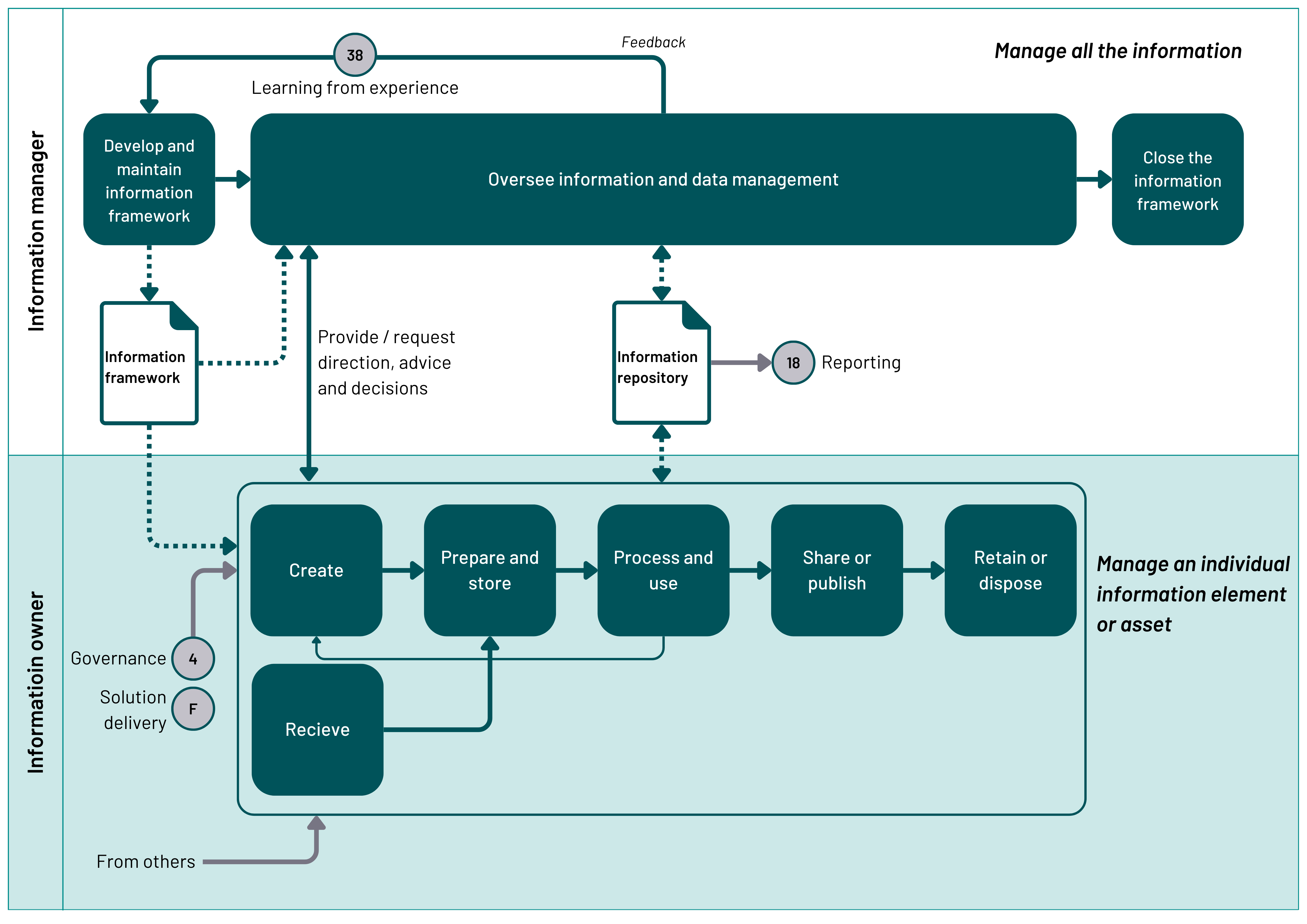
The information management framework forms part of the overall governance and management framework for the work. The development should start with the requirements identified in preparation and set out how information and data are to be managed through the life cycle of the work. It includes:
Back up and contingency arrangements should be considered, particularly where access is needed for business continuity.
The information management framework should be updated as and when needed, to keep it fit for purpose.
Overseeing includes:
Information or data created within the team should have an identified owner, usually the person creating it or for whom it is being created (for example, the senior responsible owner for a business case).
The team should use standard templates where possible, incorporating details about the creation and status of the information (known as metadata). For documents, this should include as a minimum:
Typically, a document should be:
Other information and data created, for example user data, survey data or web-scraped data, should be handled in line with data standards (see 24.6.1.4 on meeting data management standards). The quality of the data can be improved at source by validation rules and capturing appropriate metadata. For further guidance on data collection and validation, see the Government data quality framework.
Information and data received from outside the team should be registered on receipt, identified by date, originator and title, with the original or equivalent classification (if applicable) and other existing metadata retained.
Where information and data is received from outside, or generated from multiple sources, it can be less obvious who the information owner should be and a decision needs to be taken by the information manager to assign ownership, usually for particular types or bodies of information. The information or data should be checked for completeness, security and sensitivity considerations, and a decision made on who it needs to be distributed to.
Ensure that handling requirements are clearly indicated, so that team members understand what needs formal handling or particular care and what can be treated informally.
Once information or data has been created or received, validated and assigned an owner, it should be prepared for storage. The information owner should check that its status, security classification and provenance is clear, decide where, and in what format the information should be stored, and who should be able to access it, so that appropriate access controls can be applied in storing the material.
Where sensitive information and data are involved, for example, user data or survey responses, the data might need to be anonymised, to reduce risk or to enable the data to be used more easily.
Check for duplication and consistency issues should also be carried out.
Information and data should then be stored by, or with the agreement of, the information owner.
All documentation relating to the work should be stored in the main information repository, other than where security or data handling requirements require material to be stored elsewhere, for example in a more highly classified environment, in other organisational data repositories, or in physical storage. The appropriate access controls and traceability management should be applied.
The reliability of the information and data should be checked and made available so it can be used appropriately in undertaking the work and making decisions. This can involve exploration, analysis, and further processing using specialised tools and software, with information and data feeding directly into the work and solution (for example, in 4D or 5D design, planning software, and digital twins) as well as supporting the production of the business case, plans and reports, statistical outputs and performance information.
The information owner should ensure that appropriate standards and practices are followed in processing and/or using information and data. This includes ensuring that known issues with quality or reliability are understood and that the information or data is used appropriately. Where necessary, a risk assessment should be carried out on whether to use the data and if so, how to respond for known risks.
Any information or data that is subject to change should be regularly monitored for its data quality to ensure it continues to be fit for purpose.
Consideration should be given to how and with whom, information and data should be shared to support the conduct of the work, decision-making and communications. Sharing of information and data must meet the government’s legal obligations (see 24.6.1.3 on meeting legal and regulatory requirements) and security requirements (see 24.6.1.5 on protecting information and data security), as set out in the information management framework.
Information and data should be retained in accordance with the organisation’s data retention policy and legal requirements. Where information and data are not transferred to the service owner or operator at the end of the work, the information owner should determine, from the policy, whether it should be retained or archived elsewhere within the sponsoring organisation, or destroyed.
Specific legal requirements apply to the retention of public records including their retention by the organisation and eventual transfer, where appropriate, to the National Archives. Legal requirements also apply to the retention of contractual records, typically at least 6 years. For further information see the Code of practice on the management of records. Where necessary the chief data officer within the sponsoring organisation should be consulted.
Where superseded by a newer version, the information or data should be withdrawn and clearly marked as such. It is, however, important to ensure withdrawn versions are retained so that they can be referred to if necessary in future, including for traceability, control and audit purposes or possible legal disputes.
Where information or data relates to the design, development and implementation of the solution, it is essential that this is retained and, where possible, handed over to the future service owner or operator, to support use and disposal of the solution in future. Specific requirements apply in building information modelling and digital twin approaches, and these should be followed.
Where information and data are to be archived, the information owner should ensure that material is held in an appropriate format so that its integrity is maintained, and any relevant metadata or contextual information can be retained alongside.
When the work is completed, the information manager should ensure that information and data held in relation to the work has been reviewed and:
The information and data management framework and repository should then be closed.
Added the Programme and project data standard as a requirement for information managers, with compliance included in the minimum actions list. Updated the description of the UK Building Information Management Framework to reflect its new name, the Information management initiative framework. Added a glossary definition for knowledge asset. Updated the ‘Further reading’ list to add Nima’s Information management initiative framework, remove the UK BIM Alliance entry, and update attribution for the Government data quality framework and Data ethics framework. Updated the reference to the Health, safety and security chapter from Chapter 8 to Chapter 7. Added the role of ‘data owner’ for the senior responsible owner and ‘data steward’ as an alternative term for information owner. Moved the definition of personal data from section 24.5.1.3 to section 24.4.
Page permissions updated for public launch.
First published for closed beta consultation.