6.6.1 Overview
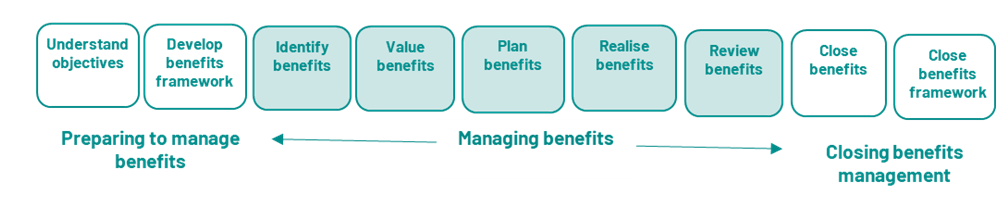
Developing a benefits management framework means setting out what and who is involved in benefits management through the life cycle of the work. The framework should be clear and concise, and should fit within the wider governance and management framework.
Start by understanding the organisational context for benefits management. Agree the approach, roles and responsibilities based on the nature, scale, complexity, and life cycle of the work, and where it sits in the organisation.
This forms the basis for drafting the framework.
Once the framework is final, it should be approved and saved as the baseline version. Track changes clearly so that updates can be reviewed and audited. Review the framework at agreed points during the life cycle of the work.
You should develop the framework early in the work, even if not all details are known. It’s fine to start with a basic version and update it as more information becomes available. What matters is having a clear structure in place to support benefits management from the start.
6.6.2 Identify organisational frameworks and tools
Check if there are any frameworks, tools or templates that could be helpful or should be used. It’s important to understand the wider context and make sure your approach supports benefits management at portfolio, organisation level and government level.
Using an existing framework or template can save time and help you think through what’s needed. A simple benefits management framework can be found in the benefits management toolkit. But don’t just copy and paste. The framework should be tailored to the specific needs of the work and show clear thinking behind it.
6.6.3 Agree the approach to benefits management
It’s helpful to agree the approach to benefits management early on. This provides an opportunity to consider what arrangements are needed, and how best to manage them. For example:
- a new rail scheme might require an extensive public consultation exercise and specialist expertise to identify, value and track benefits, managed by the benefits team through external contracts
- an internal digital transformation programme might need an iterative approach to benefits identification and realisation, with ongoing involvement of users and business change specialists, co-ordinated by the benefits manager
Agreeing the approach is often done through a benefits management workshop, going through the different areas to be covered in the framework. The discussion also helps people understand what benefits management will involve, so they can feed it into wider planning.
6.6.4 Agree roles and responsibilities for benefits management
Alongside agreeing the approach, discuss and agree roles and responsibilities for benefits management. These are described in Section 2.
Information on roles and responsibilities is usually set out in a RACI matrix, which shows who is responsible, accountable, consulted or informed, as shown in Figure 6.1. The matrix should be included in the benefits management framework.
Try to agree the names of the people carrying out each role as early as possible. Add these to the framework or list them separately. Keep this information up to date to maintain a clear view of responsibilities and avoid gaps.
Benefits owners are usually agreed later and recorded separately.
Benefits management roles should also be included in the wider governance and management framework for the work.
Table 6.1 Example of a RACI matrix for benefits management
Key: BM – benefits manager, BCM – business case manager, BO – Benefit owner, ET – evaluation team, PfD – portfolio director, PfO – portfolio office, PfM – portfolio manager, PM – programme or project manager, RT – reporting team, SRO – senior responsible owner
| Activity |
Actions |
Responsible |
Accountable |
Consulted |
Informed |
| Understand objectives |
Agree objectives/outcomes |
PfM/PM |
PfD/SRO |
Stakeholders |
BM |
| Map objectives/ outcomes to potential benefits |
BM |
PfM/PM |
Stakeholders |
PfD/SRO |
| Develop framework |
Identify organisational frameworks and tools |
BM |
PfM/PM |
PO |
PfD/SRO |
| Agree benefits approach |
BM |
PfM/PM |
ET |
PfD/SRO |
| Agree roles |
BM |
PfM/PM |
Team |
PfD/SRO |
| Draft framework |
BM |
PfM/PM |
Team |
PO |
| Gain approval and baseline |
BM |
PfM/PM |
PfD/SRO |
PO |
| Review/update framework |
BM |
PfM/PM |
ET, PfD/SRO |
PO |
| Identify benefits |
Agree stakeholders to consult |
BM |
PfM/PM |
ET, PfD/SRO |
Team |
| Identify benefits |
BM |
PfM/PM |
Stakeholders commercial, team |
ET |
| Agree long list of benefits |
BM |
PfM/PM |
Business case manager |
ET |
| Categorise benefits |
BM |
PfM/PM |
Team |
ET |
| Develop benefits register |
BM |
PfM/PM |
Team |
ET |
| Identify benefit owners |
BM |
PfM/PM |
Team |
PfD/SRO |
| Value benefits |
Agree methods |
BM |
PfM/PM |
BOs, ET |
Team |
| Develop profile template |
BM |
PfM/PM |
PfO |
BOs |
| Develop benefit profiles |
BM & BOs |
PfM/PM |
Stakeholders |
ET |
| Do benefit modelling |
BM & BOs |
PfM/PM |
BCM |
ET |
| Validate modelling |
BCM |
PfM/PM |
Expert analysts |
BM, ET |
| Appraisal for business case |
BCM |
PfM/PM |
BM, ET |
PfD/SRO |
| Plan benefits |
Plan benefits realisation activities for solution |
BM & BOs |
PfM/PM |
Planning & change teams |
Team |
| Develop realisation plan |
BM |
PfM/PM |
Planning, change, ET |
BOs |
| Develop tracker/reports |
BM |
PfM/PM |
RT, PfO |
BOs, team |
| Realise benefits |
Track benefits realisation |
BM & BOs |
PfM/PM |
RT |
Team |
| Report on realisation |
BM & RT |
PfM/PM |
BOs, ET |
PfD/SRO, PfO, stakeholders |
| Review benefits |
Agree review activities / timing |
PfM/PM |
PfD/SRO |
BOs, BM, ET, team |
PfO, stakeholders |
| Interim benefits review |
PfM/PM & review team |
PfD/SRO |
BM, BOs, ET, stakeholders, |
Team, PfO, stakeholders |
| Final benefits review |
BM or manager responsible & review team |
PfD/SRO/business owner |
BOs, stakeholders, ET |
BOs, PfO, stakeholders |
| Final evaluation review |
ET |
PfD/SRO/business owner |
Bos, stakeholders, |
BOs, PfO, stakeholders |
| Document lessons learned |
BM or manager responsible |
PfD/SRO/business owner |
Bs, ET |
Team, PfO, stakeholders |
| Close benefits |
Agree criteria for closing |
BM |
PfM/PM |
ET, PfD/SRO |
BOs, PfO |
| Review case to close a benefit |
BO & BM or manager responsible |
BM or manager responsible |
BCT, ET |
PfD/SRO/business owner |
| Decision to close a benefit |
BM or manager responsible |
BM or manager responsible |
PfD/SRO/BO |
BO, RT, PfO |
| |
Close benefit |
BM or manager responsible |
PfD/SRO/BO |
BO, ET |
RT, PfO |
| Close framework |
Close benefits framework |
BM or manager responsible |
PfD/SRO/BO |
BOs, ET |
RT, PfO |
Key
BM – benefits manager, BCM – business case manager, BO – Benefit owner, ET – evaluation team, PfD – portfolio director, PfO – portfolio office, PfM – portfolio manager, PM – programme or project manager, RT – reporting team, SRO – senior responsible owner.
6.6.5 Draft the benefits management framework
Drafting the framework is usually an iterative process. You can often work on different sections in parallel.
Follow a clear and logical structure. This should usually reflect the sequence of benefits activities through the life cycle of the work. The framework should cover the following areas.
6.6.5.1 Context
Start the framework by describing the context for benefits management. This should cover:
- the nature, scale and complexity of the work, and where it sits in the organisation, for example, a portfolio, programme or standalone project
- what this means for the approach to benefits management, including any frameworks, tools, templates or software that must or could be used
- any other factors that may affect how benefits management is carried out
- how long the framework is expected to be in use, and when it should be reviewed
6.6.5.2 Objectives, outcomes and potential benefits
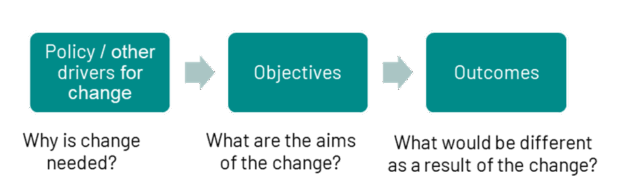
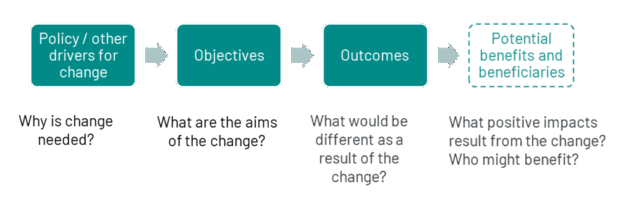
The framework should briefly summarise the main objectives and intended outcomes of the work. It should also outline the potential benefits that may be realised as a result.
This is often shown using a logic map. Update this as your understanding of benefits develops during planning.
For more on objectives and outcomes, see Section 5.
6.6.5.3 Identifying benefits
The framework should describe how a list of potential benefits is to be developed during feasibility or discovery. This should involve potential beneficiaries and other stakeholders. It should link to the stakeholder map, which should also be part of the governance and management framework.
Include a clear process for involving stakeholders, identifying potential benefits and developing the benefits map. Make sure this links to evaluation plans to avoid repeated or unnecessary consultation and to show how plans join up.
Tailoring the approach to the life cycle
The approach to identifying benefits should take account of the life cycle agreed for the work.
In a programme or portfolio, benefits are often identified iteratively, starting at project or work package level and building up to a broader view.
Some benefits, especially wider programme or portfolio benefits, might only be identified top-down or by taking a holistic view.
Thinking this through early helps ensure important benefits are not missed.
Classifying benefits
The framework should explain how benefits are to be classified. This should normally follow the approach set out in The Green Book and is explained in Section 7. You may also need to include other categories specific to the work, for example if some benefits are critical dependencies or enablers for other activity.
This analysis is usually shown in a matrix, which then forms the basis for the benefits register.
Setting up the benefits register
The framework should describe:
- what information is to be captured in the benefits register
- the format to be used
- any existing tools or templates to be used
For more on identifying and classifying benefits, see Section 7.
6.6.5.4 Valuing benefits
The framework should explain how benefits are to be valued, and how any modelling will be validated and assured. This should reflect the nature, scale and complexity of the work, and the types of benefit identified. It should also explain how this information feeds into appraisal and evaluation.
Valuing a benefit usually needs more detail to understand its impact and timing. The framework should set out what information is needed, typically captured in a benefits profile. Use existing tools or templates where possible and explain the format to be used.
Some sectors or organisations have specific methods for valuing certain types of benefit. The Green Book and Magenta Book provide more guidance on this.
For more on valuing benefits, see Section 8.
6.6.5.5 Planning and realising benefits
The framework should set out how benefits are to be planned and managed through to realisation.
The approach needs to be tailored to the relevant life cycle and the consequent timelines for planning and realisation, approvals and assurance, as appropriate. This is the basis for developing the benefits realisation plan.
For more on planning and managing benefits realisation, see Sections 9 and 10.
6.6.5.6 Tracking and reporting benefits
The framework should explain how benefits are to be tracked and reported. This provides an opportunity to think through what is needed from the outset and the basis for developing the benefits tracker and other reports.
This section of the benefits management framework should describe:
- at high level, what benefits information is to be tracked and reported, and to whom
- the tools to be used for benefits tracking and reporting, using existing tools or templates wherever possible
- the triggers for starting to track and report benefits, which might be during delivery or following transition of part or all of the solution into operations
- the data standards to be followed in collecting, analysing and reporting data
- the handling of variances to the targets or milestones in the benefits realisation plan, including any tolerances or confidence levels to be considered in analysing or reporting the data.
- the roles responsible for collecting, analysing and reporting data
The framework should briefly set out how data on benefits will be collected, validated, recorded, and stored. This includes specifying any software or tools to be used. The approach should link to the relevant data management and storage section in the wider governance and management framework.
For more on tracking and reporting, see Sections 9 and 10. For further detail. see also Chapter 18: Reporting and Chapter 24: Information and data management in The Teal Book.
6.6.5.7 Reviewing benefits
The framework should also describe how and when benefits are to be reviewed and how this contributes to evaluation. This should link to the arrangements for evaluation established for the work and supports development of the evaluation plan.
For more on reviewing benefits, see Section 11.
6.6.5.8 Closing benefits and the benefits management framework
The framework should set out arrangements for closing individual benefits, including the process for agreeing closure and who should be involved.
It should also set out arrangements for closing the benefits management framework, once all benefits have been closed.
For more on this, see Sections 12 and 13.
6.6.5.9 Roles and responsibilities
The list of roles and responsibilities should be included in the benefits management framework, typically as a RACI matrix included as an annex (see 6.6.4 above).
6.6.6 Secure approval and baseline the benefits management framework
The benefits management framework should be reviewed and approved by the portfolio director or senior responsible owner. Additional approval may also be needed from the relevant portfolio, programme or project board.
The framework should then be baselined, with any subsequent changes approved and managed under version control to ensure traceability.
6.6.7 Review and update the benefits management framework
Arrangements for periodic review of the benefits management framework should be agreed and documented in the framework document.
In a portfolio, this is typically on a cyclical basis, alongside the review of benefits, to feed into the next planning cycle.
In a project or programme, the framework should usually be reviewed as part of preparing for the next stage gate, or if the work changes significantly, for example requiring a reset.