We use some essential cookies to make this website work.
We'd like to set additional cookies to understand how you use the Government Project Delivery website, remember your settings and improve government services.
Guide to feasibility studies in programmes and projects (HTML)
Assess whether your programme or project is achievable and worthwhile before committing time and money.
From:
Government Project Delivery
Published: 01 April 2026
Last modified:
31 March 2026
This page is under consultation
1 Purpose
The purpose of a feasibility study is to assess whether a proposed change is likely to be achievable and worthwhile in practice. It tests the practicalities of a proposal before significant time, money and resources are committed.
Commissioning the study as early as possible strengthens its ability to shape realistic plans and avoid unnecessary cost or wasted effort.
2 Key points
Feasibility studies add most value at the start of the work but are also used at other times for specific reasons.
Their purpose should be clearly defined and the study design tailored accordingly.
Feasibility studies should be based on evidence and include independent input.
Initial feasibility studies are a requirement for new programmes and projects expected to join the Government Major Projects Portfolio.
They are also good practice for other work, particularly where this is of significant scale or complexity, or is novel or contentious.
3 Why conduct a feasibility study?
In government, HM Treasury’s ‘Managing public money’ requires accounting officers to ensure programmes and projects are feasible so they can be implemented accurately, sustainably, and to the intended timetable with the resources available and without incurring wasteful or nugatory spend.
Assessing feasibility is therefore the first stage of the project delivery life cycle. This involves a range of activities, feeding into development of the initial business case. A feasibility study brings these activities together into a structured assessment to provide an overall view.
Doing this at the outset makes sure the work is worth doing and plans are realistic, before committing more time, money and resources. It shows the scale, complexity and risk likely to be involved in the work, so decisions can be made on how best to proceed and action taken to avoid problems later.
Research shows that early planning is a critical factor in helping projects and programmes succeed. Feasibility studies play a key part in this.
4 What is a feasibility study?
A feasibility study is a structured assessment of whether a proposal is likely to be achievable and worthwhile in practice. It’s sometimes described as a ‘reality check’, testing the practicalities of a proposed change before time and money is spent on it.
Feasibility studies are used in many sectors, nationally and internationally, particularly in defence, energy, infrastructure and construction, and in health and local planning. They are a required element of the RIBA Plan of Work and in ‘front-end loading’ approaches used in the oil and gas industries. In defence, feasibility studies are conducted as part of the CADMID/T cycle.
Other sectors can use similar approaches to test feasibility before deciding to proceed. In digital work, the discovery phase tests the feasibility of delivering a new product or service, although the findings may not be presented in a formal study report.
Feasibility studies can also be carried out later for other reasons. This often happens in programmes, to look at the viability of individual projects through the life cycle. They can also be used to focus on particular aspects of the work, for example, technical or commercial feasibility, or to test whether a change of direction or reset is viable.
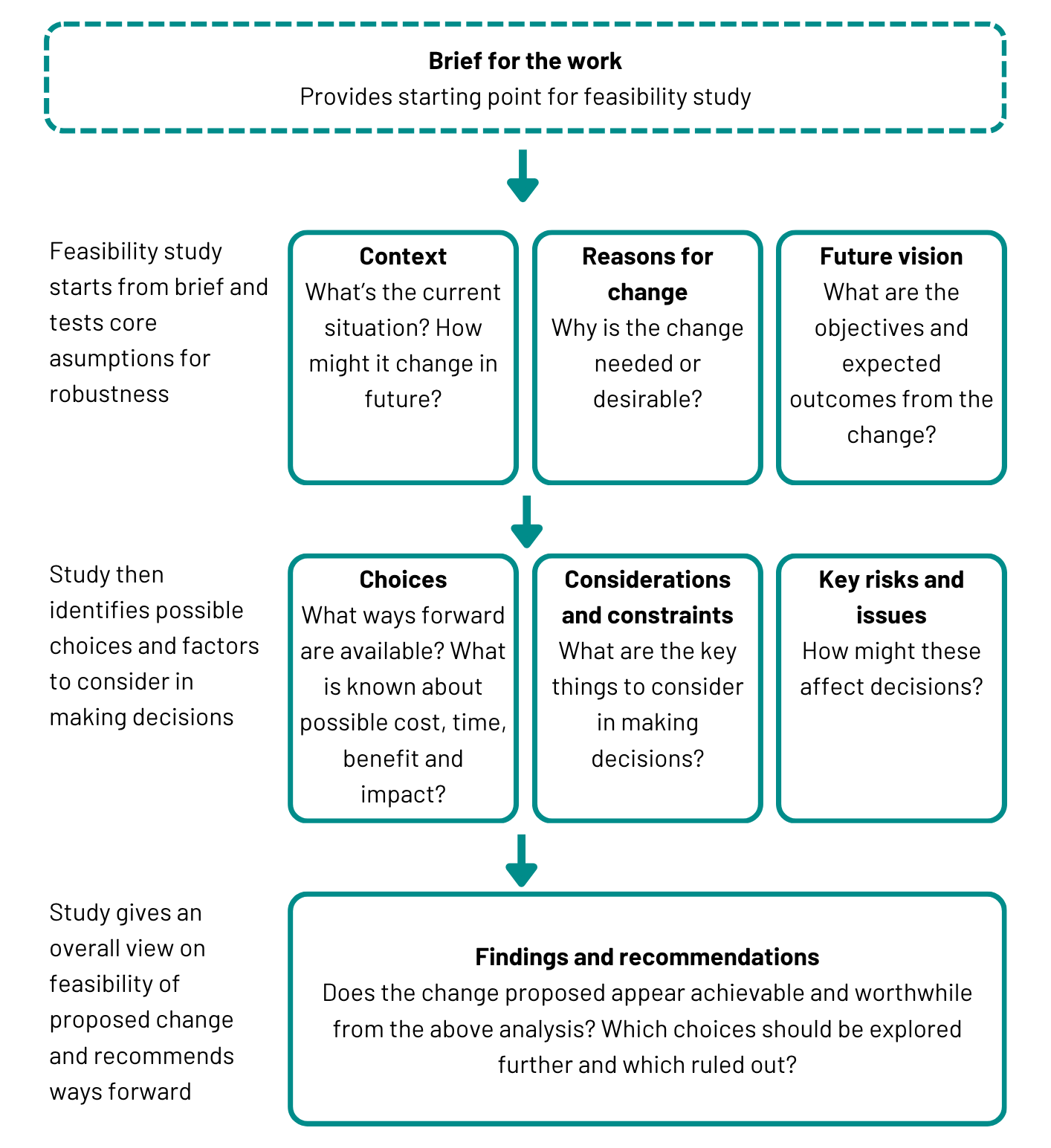
Most feasibility studies follow a consistent approach, working through a series of structured questions to provide an overall view, as shown below.
Key elements of a feasibility study
5 When is a feasibility study needed?
5.1 At the start of a programme or project (initial feasibility study)
An initial feasibility study tests whether a proposal for change is likely to be achievable and worthwhile before work starts to develop the business case.
An initial study may be conducted as part of policy development or, more often, after initiation. It should start from the brief or policy concept agreed for the work and look at how it can be delivered in practice.
At this stage, the study should not try to analyse solution options, costs and benefits in detail. The aim is to provide an initial view of whether there are viable ways of delivering a proposed change within the expected constraints, and so whether it is worth investing time, money and resources to explore the proposal further.
As well as providing an early view on feasibility, the initial study starts to build the evidence for the programme business case or strategic outline case. It helps identify critical success factors and risks, providing input into development and appraisal of longlist and shortlist options, as set out in HM Treasury’s Green Book.
The content of initial feasibility studies should be tailored and proportionate to the nature, scale and complexity of the work.
Initial feasibility studies for programmes and projects joining the Government Major Projects Portfolio (GMPP)
Feasibility studies are important for large and complex programmes and projects, because once they start, they quickly grow in commitment and cost.
All new programmes and projects expecting to join the GMPP are therefore required first to conduct an initial feasibility study. This should test whether the proposed programme or project is viable before detailed work begins on the programme business case or strategic outline case.
The feasibility study should follow a standard structure. It should be tailored to the scale and nature of the work and should cover the technical approach to delivering the key requirements or outcomes.
Project-level feasibility studies are often used to assess individual projects being delivered through the life of a programme. This means feasibility can be tested progressively as work is delivered and understanding increases.
These studies take place within the overall scope agreed for the programme. They are narrower and often more technical than initial feasibility studies.
A project-level feasibility study looks at whether a specific element of the work can be delivered in practice and whether it is worth investing the time, money and resources needed to do so when thinking about its overall contribution. It should consider:
how the project fits within the programme and what it will contribute
the choices and other factors to consider
whether the project is likely to be achievable and worthwhile
whether to proceed, change the brief, or end that element of the work
Project-level feasibility studies can be carried out individually, but also in groups. This helps show which projects are most likely to succeed and add value, and how best to plan them, for example, to bring forward benefits or spread risk. Following a consistent structure and approach allows for comparison across projects and supports sharing and learning across the programme as a whole.
5.3 After a change of direction
A feasibility study can be conducted following a significant change of direction or reset. Its purpose is to inform decisions on whether it is worth proceeding with a reset or better to end the work.
A reset study should focus on overall achievability and value. It should consider:
what has been delivered to date
why a change of direction is needed
how these impact on choices, achievability and value against the original brief
whether to proceed, change the brief or end the work
Where the reset concerns a programme or project in the GMPP agree the terms of the study with the National Infrastructure and Service Transformation Authority (NISTA) first.
5.4 For specific purposes
Feasibility studies can also be used to assess specific aspects of a proposal in depth. These studies are often more technical and use specialist sector expertise.
The requirements for such studies depend on the context and may be set by professional bodies or funding bodies. Some examples are below. Whatever their purpose, they should still start from the overall brief for the work, use evidence to identify and assess available choices, and recommend ways forward.
Construction
A construction feasibility study typically assesses possible sites in terms of physical and spatial features, statutory and planning requirements, legal title, health, safety, fire, and environmental, economic and social impacts. This usually follows stage 2 of the RIBA Plan of Work.
Defence
In defence, detailed technical and commercial feasibility studies are conducted as part of the concept and assessment stages of the CADMID/T cycle (concept, assessment, demonstration, manufacture, in-service and disposal/termination).
Digital
In digital work, the Government Digital Service recommends a discovery phase to test service demand, user needs, technical feasibility, cyber security, service operation and maintenance.
Engineering
An engineering feasibility study uses front end engineering design (FEED) or similar approaches to assess technical specifications and estimate costs and resource needs.
Healthcare
A feasibility study for a healthcare trial with patients may assess acceptability, demand, implementation, practicality and integration within the wider system, following the funding provider’s requirements.
6 Who is involved in conducting a feasibility study?
Accountability and responsibility for a feasibility study should be agreed and documented. Work should be overseen and managed in the sponsoring organisation, although external expertise and independent input are usually involved as well.
The senior responsible owner (SRO) should commission and own a feasibility study. Where an SRO is not yet in place, the accounting officer may delegate responsibility to another accountable owner, for example the policy owner.
The programme or project manager, or another manager if one is not yet in place, should oversee and manage the conduct of the study and preparation of the report. They should report to the SRO or other accountable owner as appropriate.
Typically, a feasibility study is conducted by a team of planners, analysts and other subject matter experts, for example with delivery, operational, commercial, digital, engineering, social policy, health or other expertise, depending on the work. These carry out the investigation and analysis and provide input into the study report.
The team should include one or more people with drafting and editorial skills to bring together, edit and finalise the study report, and administration skills to support the work, manage data and information, and handle communications and reporting.
7 How to conduct a feasibility study
7.1 What to consider
Feasibility studies can add much value but only if they are done well.
They are particularly useful where the proposed work is novel, complex or unfamiliar, where there is little previous experience to rely on. But this also means that the design of such studies needs particular care, so they test the right things and provide a balanced view, based on the best information available.
A poorly designed and executed feasibility study can lead to unrealistic expectations, wasted time and money, poor outcomes and reputational damage in the long term. So it’s worth spending time up front on getting the approach right.
Research shows the following factors are key to delivery of a robust feasibility study.
Being clear on what is to be assessed
A feasibility study should be designed to answer the key questions decision-makers have, so they can decide if work should go ahead and if so, on what basis.
The challenge is that things are often uncertain, particularly early in the work. A feasibility study can’t answer every question at this stage. But it can look at the overall picture, establish what is known, flag problems or areas where further investigation is needed, and so reduce uncertainty.
The scope of the study, and the specific questions to be asked, should be agreed by the SRO or other accountable owner and used as the basis for commissioning the work.
It’s important to tailor the scope and design of the study to its purpose and context, including any sector-specific requirements. This is often in the work needed to assess choices, considerations and constraints, where technical and delivery requirements can require very different forms of assessment.
Where extensive tailoring is needed, or there are specific sector requirements, it may make sense to organise the study differently. However, following a standard framework helps to ensure key questions are not missed and decisions are taken in the round.
Ensuring a balanced, objective view
Changes are proposed because people expect them to have a positive effect of some kind. At the start, there’s often a lot of optimism about what the future could be, and people are eager to press on with the work. That’s a good thing, but it can also mean unrealistic assumptions about what can be delivered, and a tendency to underestimate costs and time, and over-estimate benefits. This is known as optimism bias.
Feasibility studies provide a key opportunity for a reality check. To be effective, they need to provide an objective assessment, based on evidence, to counter the natural tendency for optimism in proposals for change.
A critical factor in this is creating a study team with the right balance of expertise skills and experience. A mix of internal and external knowledge, and expertise drawn from different professional disciplines and stakeholders, all help to create an informed and balanced team. Think about how to ensure a range of perspectives rather than a single dominant voice which could skew the study, and how to embed equality, diversity and inclusion within the work of the team.
It’s important too to bring in independent input to provide an outside view and provide robust challenge to avoid groupthink or the temptation to present too rosy a view. This is a key requirement for work expected to join the GMPP.
Independent input for feasibility studies expecting to join the GMPP
Initial feasibility studies for projects and programmes expecting to join the Government Major Projects Portfolio should have independent input
This should include at least two people from outside the organisation as part of the study team to provide external perspectives and bring robust independent challenge to the study. Suitable people might include one or more non-executive directors, people with relevant expertise and experience from another government organisation, and/or or expert external advisers.
Be aware of the potential for current or future conflicts of interest and ensure that any possible interests are identified and declared before appointment.
Building a credible evidence base
To be credible, a feasibility study needs to show that its analysis and findings are based on evidence.
Evidence can come from many sources. These can include operational data and management information, published data and academic research, physical surveys, pilots and prototypes, benchmarking and lessons from similar projects,
Draw on existing, independently validated data sources wherever possible. Where you supplement these — for example through stakeholder surveys — think carefully about how to get a balanced set of responses. Identify data limitations and gaps explicitly. Where there is no evidence, say so.
Looking at historical examples and data trends can help identify possible cost and time ranges and typical risks and failures. Be aware, though, that benchmarking data can be partial or skewed by the reference group chosen.
Follow recognised methods for assessment, estimation and analysis, explain how data was sourced and include references and/or data summaries in annexes. This helps stakeholders understand the analysis, builds confidence in the findings, and allows for comparison and review.
More help on benchmarking, and cost estimation is published by the National Infrastructure and Service Transformation Authority. Guidance on analysis is set out in the Aqua Book.
Thinking about the longer term
Thinking about the longer term, and how proposed changes might fare under different scenarios, is an important part of assessing their robustness and resilience to external events and trends. Consider:
how things may evolve over the life of the change such as public expectations, demand for services, skills availability, market trends, political shifts and environmental conditions
how these might affect the delivery or value of the change proposed
whether there are ways of building flexibility or resilience into the proposed way forward, for example through modular design or by enabling adaptation
Scenario planning techniques can help explore a wide range of possibilities and highlight future risks to the viability or success of the change. They can also show where not enough is known and more investigation is needed to support decisions.
Handling uncertainty and risk
Some proposals for change build on existing experience and follow a consistent pattern, allowing use of standard benchmarking and comparison techniques to understand feasibility and risk. Even so, there is always potential for uncertainty. For example, global markets may affect the cost of raw materials, or changing working patterns may reduce demand for a particular service.
Where the proposed work is novel, complex or unfamiliar, there’s much less experience and data to draw on, making it harder to assess feasibility.
Feasibility studies therefore need to consider handle uncertainty and risk in their design. The starting point is always to establish what is known and where there are uncertainties which need further investigation, whether as part of the study or later.
Site surveys, market testing, prototyping, benchmarking and scenario analysis can all help reduce uncertainty – or show it – and these may be included in the design of a feasibility study. High level modelling and estimation techniques can also help identify a range of possible scenarios, for example on cost, benefit and timescales.
In presenting analysis and findings, the study should identify areas of uncertainty or risk clearly. Present estimates in wide ranges or as rough order of magnitude figures (sometimes called t-shirt sizes, meaning broad categories such as small, medium or large). Be clear on limitations or things not known yet.
Initial feasibility studies should take care not to suggest cost, benefit and time estimates that could be seen as firm planning assumptions or commitments. The aim is to assess whether there are likely to be viable ways forward, not to provide authoritative estimates at this stage.
7.2 Preparing for a feasibility study
Understand the brief
Start from the agreed brief for the programme or project, or where the study comes before initiation, a summary of the policy proposal.
This should explain the context, drivers, objectives and outcomes for the proposed change, and normally includes a theory of change. The brief may also include other assumptions, for example on timing, funding routes and budget envelopes, and on possible risks or issues.
A risk potential assessment should also have been completed and should provide information on scale, complexity and risk.
Discuss the brief with whoever developed it to make sure you fully understand what is proposed. If there are gaps, agree how to fill them before proceeding.
Agree the scope and design
Once the context and brief for the work are clear, the scope and design of the study should be agreed and set out as part of the terms of reference. These should explain:
the purpose of the feasibility study
who commissioned the study
how it will be governed and managed
what to assess, how and who is involved
expected timescales and costs
how findings should be documented and shared
the scope of possible recommendations – normally broad for an initial study, narrowing for later studies
Consult key stakeholders before finalising the terms of reference. Where the work is of widespread public interest, this may involve a formal consultation exercise.
Draw up a plan showing the key activities, timescales and resources needed. Model expected costs and agree the schedule and funding for the study. Include these in the terms of reference.
The SRO or other accountable owner should sign off the final terms of reference and oversee the conduct of the study to ensure they are met.
Establish the study team
Appoint the study manager, so that planning for the team can start as soon as possible. This is often the programme or project manager, but responsibility may be assigned to someone else.
The study manager is responsible for appointing the rest of the team, in consultation with the senior responsible owner. Section 6 sets out likely roles and responsibilities, but these need to be tailored to the needs of the study.
Assembling the study team can take time. The nature of the work often means that people are engaged through short term contracts, loans or secondments, rather than as permanent employees. Bear in mind lead times for selection and appointment.
In selecting people, bear in mind requirements for balance and independence (see 7.1 on what to consider). Check for current or future conflicts of interest and make sure any possible interests are declared.
When people join, make sure they can start work quickly. Confirm working arrangements and practical requirements such as security clearance, building passes and equipment. Make sure everyone understands their role and what is expected of them. More on induction is in Chapter 39 of The Teal Book.
Set up governance and management arrangements
Governance arrangements can normally be light touch, but the right level depends on the scale and scope of the study.
Where a programme or project has been formally initiated, oversight normally sits with the programme or project board. Chapter 13 of The Teal Book sets out more on governance and management arrangements.
Where a study precedes initiation, set up bespoke arrangements, such as an oversight board chaired by the accountable owner, reporting to the accounting officer.
Agree how information is accessed, managed and stored
Feasibility studies can involve gathering, analysing and storing a lot of data, including personal data, and wider programme or project arrangements may not yet be in place.
Agree, document and maintain a disciplined approach for managing information and data during the study. This should cover:
what types of information and data are likely to be collected or generated
how they will be stored, accessed and managed
who owns each information and data asset
how legal and regulatory requirements on data protection and government requirements on cyber security will be met
Make sure that everyone in the study team is aware of their responsibilities in managing information and data appropriately and securely.
What’s involved in conducting a feasibility study can vary greatly, depending on the nature, scale and complexity of the work and the scope of the study.
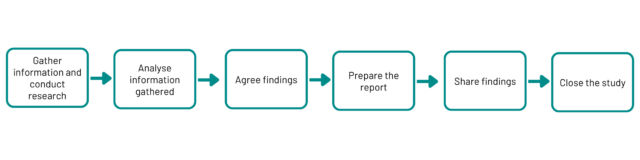
Typically, though, the work includes a series of activities, as shown below, with more detail in the following sections. Some activities may be carried out at the same time or repeated, for example where analysis shows the need for more information.
Figure 2 Key activities in conducting a feasibility study
Gather information and conduct research
The first phase of the study focuses on information gathering and research.
Start by exploring and testing assumptions about the context, the reasons for the proposed change, and the vision for the future in terms of objectives and outcomes. This typically involves discussions with stakeholders, questionnaires or surveys.
For large and complex programmes and projects likely to join the Government Major Projects Portfolio, hold an opportunity framing workshop with NISTA support, if one has not already been held.
Once the context, reasons for change and vision are clear, move to exploring ways of delivering the changes, and the associated considerations and constraints, risks and issues. This is likely to include:
discussions or workshops with subject matter experts to explore different delivery approaches and what else needs to be considered
commissioning supporting work, such as operational research, land or site surveys, legal searches, modelling, prototypes or technical trials
identifying evidence and lessons from other work, in published studies and academic research
researching possible comparators and benchmarking to gauge rough order of magnitude costs and benefits
scenario planning to look at how choices might fare under different future conditions and to surface risks and issues
These activities typically form the main part of the study and take the most time. Where several activities are running at the same time, co-ordinate carefully to capture and organise information as it comes in.
Focus on activities critical for initial decision-making, identifying where further work needs to be conducted later if the work proceeds.
Analyse the information gathered
Information gathering will generate a large volume of data and evidence. The aim of analysis is to assess what has been gathered and draw out answers to the key questions set out in the terms of reference.
Where possible, analyse data and evidence as the work progresses rather than leaving it all to the end. This allows the picture to build over time and can help focus further investigation — for example by narrowing down sites or solutions, or by modelling particular cost and impact scenarios.
Use data analysis tools such as charts, graphs and mapping tools to bring information into an overall picture. AI tools can help identify patterns in survey responses and summarise feedback.
use recognised estimation and modelling techniques
present data in ranges rather than as point estimates
identify areas of uncertainty, risk, limitation or gaps clearly
be explicit about things that are not yet known
Consider how the analysis can be assured to demonstrate it is robust. The Aqua Book provides further guidance on proportionate approaches to quality assuring analysis.
Some information gathered may not be relevant at this stage but could be valuable later. Store it appropriately rather than discarding it.
Agree findings and recommendations
Once analysis is complete, the team should review the evidence and draw out the key findings and recommendations. These should be focused on answering the questions in the terms of reference, and in particular:
whether the proposed change appears achievable and worthwhile, taking account of the choices available, possible costs and impacts, and risks and issues identified
whether analysis points to particular choices as viable ways forward or rules any out
what next steps are recommended, including areas needing further investigation
Check that findings and recommendations are grounded in evidence rather than opinion or assumption. Highlight areas of risk or uncertainty, and any conflicts, limitations or gaps in the analysis.
Remember that a feasibility study is not designed to sell a proposal. Its value lies not in what it finds, but in the fact that its findings are evidence-based, accurate and point to the best way forward in terms of public value.
There are normally three possible outcomes.
Feasible
If the change appears achievable and worthwhile — recommend proceeding, indicating which choices should be taken forward in developing the programme business case or strategic outline case.
Feasible but with significant risk
If the change may be achievable and worthwhile but carries significant risk — make this clear so decision-makers can weigh whether to proceed, change the brief, or end the work. If the study has identified ways to reduce the risk, set these out.
Unlikely to be feasible
If the change appears unlikely to be achievable or worthwhile — explain why and recommend not proceeding on the basis of the current brief. This may be disappointing, but it will avoid significantly greater waste of time, effort and money further down the line.
Prepare the report
The study report should summarise the evidence gathered, the analysis, and the findings and recommendations on the way forward.
It often helps to draft sections of the report as the study progresses. Leave the executive summary until last, when findings and recommendations have been agreed.
Where drafting is shared across the team, appoint an overall editor to bring the content together and ensure it reads as a clear, coherent and logical account.
Structure the report around the key elements set out in the terms of reference. Annexes should include the terms of reference, supporting data and evidence, modelling scenarios and benchmarking references.
When preparing the report:
present data visually where possible by using charts, diagrams, maps and other graphics, and provide text alternatives (such as applying alt text) that conveys the meaning of each visual
make the executive summary self-contained as people will often rely on it heavily, so it should provide a succinct account of the study, its findings and recommendations, with cross-references to the relevant sections for more detail
There are particular requirements for the presentation of feasibility studies for programmes and projects expecting to join the GMPP, as set out below.
Structure and content of feasibility studies for programmes and projects expecting to join the GMPP
Summarise the proposal for change and the study’s findings and recommendations.
Context
Set out the current situation and how it might change in future.
Reasons for change
Explain why change is needed or desirable, the evidence supporting this, and how it supports government objectives.
Future vision
Describe the objectives and expected outcomes from the change, and the theory of change supporting them.
Strategic choices
Outline the different choices available for achieving these objectives and outcomes, and what they would mean in practice. Explain what each would require in terms of technical delivery, and the possible scale of cost, time, benefit and other impacts.
Considerations and constraints
Identify the key considerations and constraining factors, and what they mean for different choices. These factors will depend on the nature of the work but consider:
finance
commercial
legal
technical and delivery requirements
capability and capacity, to deliver the change and operate it when delivered
health, safety and security
environment, biodiversity and sustainability
equality, diversity and inclusion
place-based, distributional and social impacts
Key risks and issues
Identify key strategic risks and issues to consider, and what they mean for decisions on choices
Findings and recommendations – bring together the analysis from previous sections and make recommendations on:
whether the changes and outcomes appear achievable and worthwhile, based on the choices, considerations, constraints, risks and issues identified
whether the analysis points towards one or more choices as ways forward
next steps, including any areas for further investigation or focus to reduce risk
Annexes
Set out supporting evidence, modelling and benchmarking data.
Share findings and agree the way forward
Once the report is complete, share it with the SRO or other accountable owner. Keep them informed as the study progresses so that the findings do not come as a surprise.
The SRO or other accountable owner should then share the report with stakeholders as agreed in the terms of reference. They may wish to handle this personally, particularly where findings are sensitive or contentious.
The report should normally go to the board overseeing the study for discussion and decisions on next steps. It may also be shared with the accounting officer and ministers as part of agreeing what happens next.
Where findings show the proposed change is feasible, the decision is normally to proceed with developing the programme business case or strategic outline case, building on the findings and evidence from the study.
Where findings show that the proposal is feasible but carries significant risk that cannot easily be mitigated, the decision is whether to accept the risk and proceed, change the brief or stop. This depends on the balance of risk across the organisation’s portfolio and its risk appetite and is normally a decision for the accounting officer.
Where findings show that the proposed change is unlikely to be feasible, the SRO or accountable owner should provide advice to the accounting officer (or their investment committee) on how to proceed, consulting ministers as appropriate. This could mean:
changing the brief, for example to extend timescales, simplify the work or reduce risk – if so, further work to check feasibility against the new brief may be needed
deciding not to proceed with the proposed work
Where a programme or project expects to join the GMPP, the findings of the feasibility study and the proposed way forward are then considered as part of evidence under the treasury’s approval process, as set out below.
Next steps after completion for feasibility studies of programmes and projects expecting to join the GMPP
When completed, the feasibility study should be submitted to the SRO or accountable owner to consider the way forward, consulting the accounting officer and ministers as appropriate.
If the decision is to continue, the feasibility study should be submitted with other required evidence to NISTA and HM Treasury in line with the approval process.
A summary of the study’s findings should be included in the programme business case or strategic outline case, and in the published version of the business case. For a mega project, a summary should also be included in the published strategy and delivery plan.
Once the report has been completed and shared, close the study.
Review what went well and what could have been done better with the team. Capture and share lessons learned as appropriate. These may be valuable for others conducting feasibility studies in future.
Thank everyone involved with the work for their contribution. Disband the study team and conclude any commercial contracts.
Ensure all relevant information and data are stored in appropriate formats for future use in line with the organisation’s information storage policies.