Beta

This is a new service and pages are being tested and improved.

About this guide

This guide summarises the key points in managing benefits in government, as set out in The Teal Book. It’s designed to help anyone involved in project delivery grasp the essentials quickly and know where to find more guidance and support.

This guide should be read alongside the government functional standard for project delivery and The Teal Book. The meaning of words is as defined in the glossary of The Teal Book or otherwise as by the Shorter Oxford English Dictionary.

Benefits management in government

Benefits management helps make sure government work leads to clear, positive results. It supports government objectives and creates value for the public.

Why manage benefits?

A benefit is a positive effect of change, as seen by one or more stakeholders, that can be measured in some way. In government, benefits should link to objectives and create value for society, as explained in the Green Book (requires sign in). Benefits management provides a step-by-step approach to help make sure this happens.

What is benefits management?

Managing benefits means identifying them, working out their value, planning for them, making sure they happen, and reviewing progress throughout a portfolio, programme or project. Benefits management ensures a clear line of sight between policy, planning, delivery and benefits, to help achieve the delivery objectives agreed.

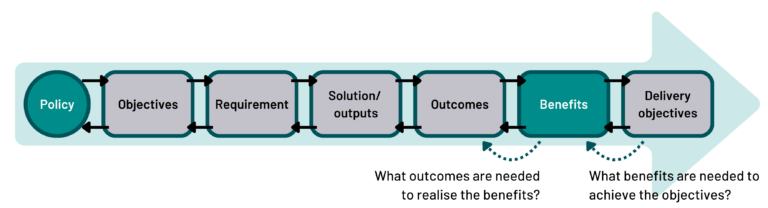
A flow chart illustrating the progression from policy to delivery objectives. It includes the following steps: Policy, Objectives, Requirements, Solution/Outputs, Outcomes, Benefits, and Delivery Objectives. The chart also includes questions about the relationships between outcomes and benefits and benefits and objectives.
How benefits link to objectives and outcomes in the policy to delivery chain
A flow chart illustrating the progression from policy to delivery objectives. It includes the following steps: Policy, Objectives, Requirements, Solution/Outputs, Outcomes, Benefits, and Delivery Objectives. The chart also includes questions about the relationships between outcomes and benefits and benefits and objectives.
How benefits link to objectives and outcomes in the policy to delivery chain

Thinking about benefits should start with policy development and continue throughout the project delivery life cycle.

Benefits are central to any business case because they describe the benefit to society of making a change so that this can be weighed against the cost of making it happen. If there are no benefits, the work should not normally go ahead.

Benefits management contributes to evaluation, but they are not the same thing. Benefits management focuses on delivering value from the work and is led by project delivery practitioners.

Evaluation is a systematic assessment of the design, implementation and outcomes of an intervention that emphasises value for money and results. Impact evaluation assesses the overall economic and social impact of a policy change and is usually led by analysts.

Benefits management applies across portfolios, programmes and projects, but the way it’s used can depend on the level and purpose of the work.

In a portfolio, the focus is usually on outcomes and objectives across the whole organisation or government. This means benefits management is focused on identifying and prioritising work that will have the biggest impact, and then on tracking progress. Portfolios focus less on how benefits are delivered in practice. That’s the role of programmes and projects.

In a programme or project, the focus is on understanding the benefits of proposals to support investment decisions. Teams then plan and deliver those benefits during delivery and into operations.

Because portfolios, programmes and projects are closely linked, their benefits management practices need to work together. Each level should tailor its approach to suit the type of work it does.

Who manages benefits?

Everyone working in project delivery in government should understand why benefits matter and how to manage them. But it’s also essential to have clear accountability for who does what.

The organisation sponsoring the work, through its accounting officer, is ultimately accountable for ensuring that the expected benefits are achieved.

The portfolio director, in a portfolio, or senior responsible owner, in a programme or project, is accountable for delivering the work needed to achieve the outcomes and benefits agreed with the sponsoring organisation.

The portfolio, programme or project manager develops and manages the benefits framework and oversees benefits management through the life cycle.

The benefits manager or a support officer can be given specific responsibility for benefits management, particularly in large or complex work. Otherwise, the portfolio, programme or project manager is responsible for managing the benefits.

Benefit owners are responsible for making sure individual benefits are realised and reported. They often sit in operations as managers who can track progress over the longer term on behalf of the sponsoring organisation.

Other roles also support benefits management. For example:

  • analysts help design and manage evaluation
  • business case managers lead on options appraisal
  • finance managers help identify financial impacts and efficiency savings
  • change managers manage organisational and societal change

Teams should agree roles and responsibilities early in the work and set them out clearly, so everyone knows who is doing what.

What’s important in managing benefits?

Focusing on public value

Explaining how public investment benefits society is an important part of being open and accountable to Parliament and the public.

Linking benefits to objectives

There should be a clear link between the objectives of the work, the outputs and outcomes it delivers, and the benefits it aims to achieve

Considering all types of benefit

Try to measure benefits using numbers where possible. For example, you might quantify estimated cost savings or time saved. Benefits that can’t be measured in numbers, like improved wellbeing or trust, are also important. The Green Book explains how to assess different types of benefits.

Planning for benefits over time

You should plan for when benefits will be delivered. Some benefits can be short-term and appear during the work. Others may be delivered at the end or over a longer period, sometimes many years, as new services and assets are used.

Connecting benefits to wider policy impact

Measuring benefits helps show the real impact of government policy. It provides important evidence for policy evaluation and helps teams learn lessons for future work.

What are the key steps in managing benefits?

Benefits management involves a sequence of activities which can be carried out once or many times, depending on the work and how it is organised, for example as a portfolio, programme or project. The practitioner workbook explains more about this and how benefits management fits into the reference project life cycle and business cases.

Who does the activities and who oversees them varies, depending on how big and complex the work is. Roles should be agreed in advance and set out clearly.

However roles are organised, benefits management always includes the key steps below.

Understand objectives

Benefits management starts with a clear understanding of the objectives and outcomes of the work. These, with any related theory of change, should guide how you identify and plan for benefits.

Develop the framework

Establish and maintain an effective benefits management framework that fits the work. Use the right methods and tools to identify and manage benefits effectively.

Identify benefits

Identify the possible benefits by exploring the impacts of the proposed changes. Group them into types and show how they link to outputs, outcomes and objectives using a benefits map. Record each benefit in a benefits register.

Value benefits

Agree an owner for each benefit. Work with them to build a benefits profile and assess its potential value over the solution’s life. Use this information to help compare options and choose the best one for the business case or support portfolio prioritisation.

Plan benefits

Update the benefits register after the way forward has been decided so all benefits and owners are included. Create a benefits realisation plan, linking this to other delivery and transition planning. The plan should show:

  • how each benefit will be delivered
  • when it will be delivered
  • who is responsible

Realise benefits

Start work to deliver and realise benefits. Create a benefits tracker to monitor progress and act if benefits are at risk. Make sure the benefits data:

  • follows government data standards
  • is included in reporting and evaluation

Review benefits

Check progress on benefits throughout delivery and before closing the portfolio, programme or project. After closure, agree:

  • when future reviews will happen
  • how findings will support evaluation and learning

Close benefits

Close benefits once they’ve been achieved. If realising benefits continues after the portfolio, programme or project ends:

  • agree who owns each benefit in operations
  • agree who will oversee and report on benefits in the sponsoring organisation to support evaluation of investment outcomes

Hand over the benefits management framework, benefits register, benefits profiles and the benefits realisation plan to support ongoing delivery in operations as necessary.

Close the framework

When all benefits have been realised, produce final reports on benefits achieved and lessons learnt. Close the benefits register and framework.

Store these and other key documents in the sponsoring organisation for future use and share relevant information with the National Infrastructure and Service Transformation Authority as appropriate.

Benefits products in a project life cycle

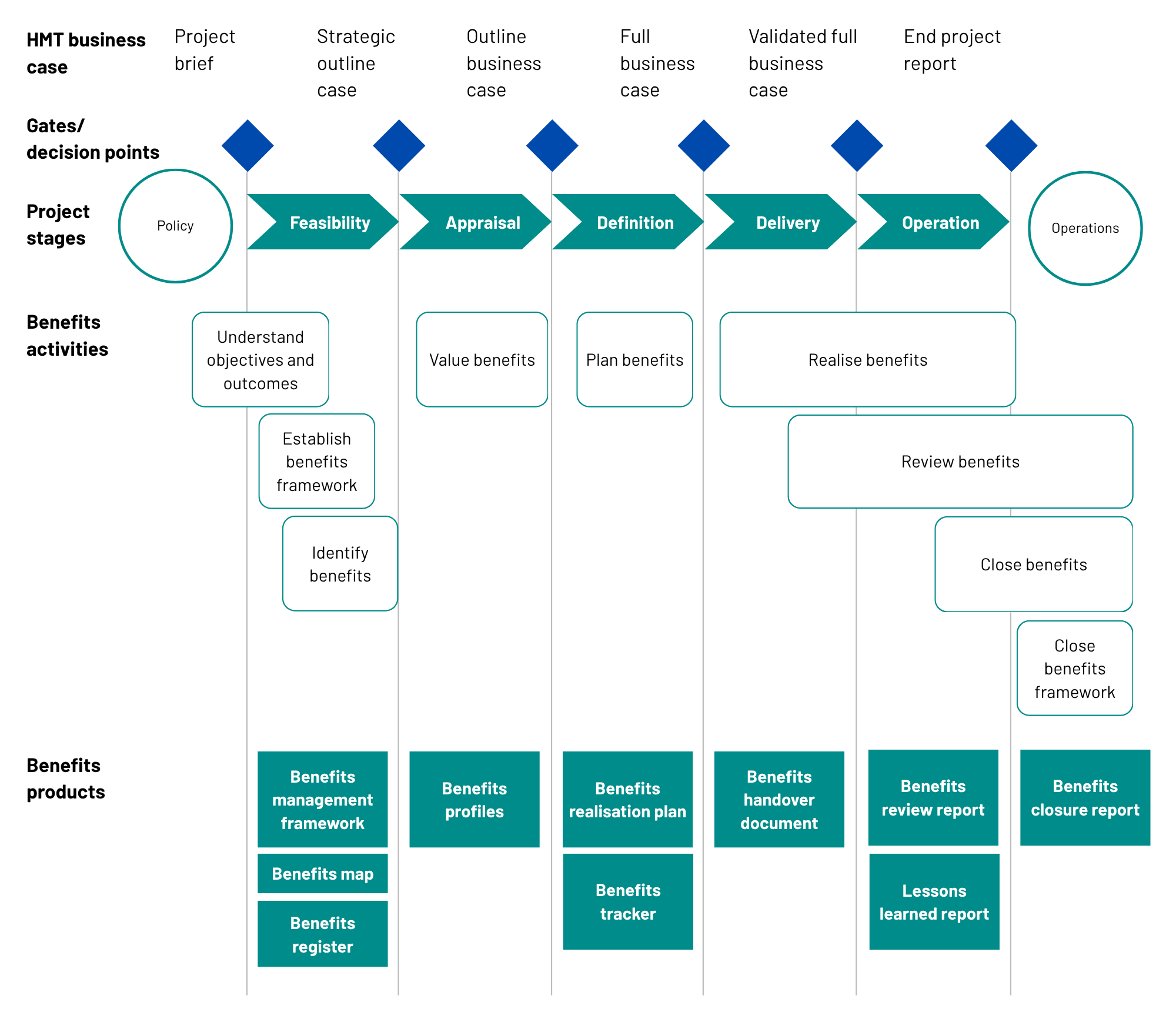
The figure below shows the benefits activities and products developed throughout a typical project life cycle.

In a programme, benefits products are managed at programme level, adding data on what projects contribute progressively through the life cycle.

Benefits products across a project lifecycle. During the project brief stage, benefits products are a Benefits management framework, Benefits map and Benefits register. At the outline business case stage, a Benefits profile is produced. At the full business case stage, a Benefits realisation plan and Benefits tracker are created. At the validated full business case stage, a Benefits handover document is produced. During operation, Benefits review and lessons learned reports are produced. At project closure, a Benefits closure report is completed. The products support benefits activities that progress from identifying and planning benefits through to realisation, review and closure.
Benefits management activities mapped to the reference project life cycle in the Government Functional Standard for Project Delivery
Benefits products across a project lifecycle. During the project brief stage, benefits products are a Benefits management framework, Benefits map and Benefits register. At the outline business case stage, a Benefits profile is produced. At the full business case stage, a Benefits realisation plan and Benefits tracker are created. At the validated full business case stage, a Benefits handover document is produced. During operation, Benefits review and lessons learned reports are produced. At project closure, a Benefits closure report is completed. The products support benefits activities that progress from identifying and planning benefits through to realisation, review and closure.
Benefits management activities mapped to the reference project life cycle in the Government Functional Standard for Project Delivery

Further information

More information on benefits management is set out in Chapter 19 of The Teal Book and in the benefits management in government collection, which includes:

  • an in-depth practitioner workbook
  • tools and templates
  • case studies
  • a data standard for benefits management

For more information on investment appraisal, analysis and evaluation, see:

Checklist

Policy / concept

Before the work begins, ensure:

  • objectives and outcomes are clearly defined
  • users and stakeholders are identified and involved
  • outcomes are supported by an agreed theory of change

Feasibility

When identifying options for a solution, ensure:

  • a benefits management framework is in place and being used
  • roles and responsibilities for benefits are defined
  • benefits processes, methods, tools and techniques are agreed
  • objectives, outcomes and enabling outputs are mapped to potential benefits
  • benefits are categorised in line with Green Book guidance
  • benefits are recorded in a benefits register

Appraisal

When identifying a preferred solution, ensure:

  • a benefit owner is assigned for each benefit
  • benefit profiles are agreed
  • benefits are quantified where possible and qualitative ones are also included
  • assumptions, dependencies and risks are recorded
  • benefits are assessed alongside costs in the options appraisal
  • sensitivity analysis is carried out to support decision making

Definition

When defining the solution and procuring suppliers, ensure:

  • owners are confirmed for all benefits
  • owners have agreed final benefit profiles and tracking metrics
  • activities needed to realise benefits are identified
  • a benefits realisation plan is part of the integrated delivery plan

Delivery

When delivering outputs and preparing for change, ensure:

  • benefits realisation is part of delivery and operational activities
  • benefits tracking is in place and meets data standards
  • progress is tracked against the plan and the benefits register updated
  • corrective action is taken if benefits are off track
  • benefits ownership and responsibilities are included in the transition plan and acceptance criteria

Operation

When using the solution as business as usual, ensure:

  • reviews are scheduled to assess benefits against objectives
  • ongoing benefits have owners and are tracked, reported and recorded in the benefits register to support evaluation
  • closure of benefits is agreed with the benefits manager and benefit owner
  • the benefits management register and framework are closed when all benefits are delivered
  • final reports on benefits achieved and lessons learnt are produced and shared
  • the final reports, register, framework and other key documents are stored by the sponsoring organisation for future use
Back to top