Blog
How HM Land Registry piloted the programme and project data standard

Earlier this year, HM Land Registry (HMLR) was in the process of setting up a Centre of Project Delivery Excellence (CoPDE). Our aim was to establish consistent ways of working across all programmes and portfolios which would support our project delivery practice and improve our data and reporting capability.
At the same time, we heard that the National Infrastructure and Service Transformation Authority (NISTA) wanted volunteers to participate in a pilot of their forthcoming ‘Programme and project data standard‘ (the standard). This was ideal timing, as we were able to use our participation in the standard pilot to support the development of apps and automated reporting.
The assessment process and staff engagement
Our CoPDE team completed a review of the quality of our existing project data, how it was captured and managed, and where it was stored. Based on our findings, we discovered there were multiple areas that were already aligned to the proposed standard. Therefore, adopting the standard was a fantastic opportunity to standardise our data.
We introduced the pilot to our project delivery practice during one of our scheduled ways of working sessions. We also briefed our programme support officers, risks and benefits teams, to make them aware of the standard and explain our plans for adopting it.
How the standard was used
Our vision is to provide as much automated reporting as possible. The standard has helped ensure we are being consistent across different areas of project delivery.
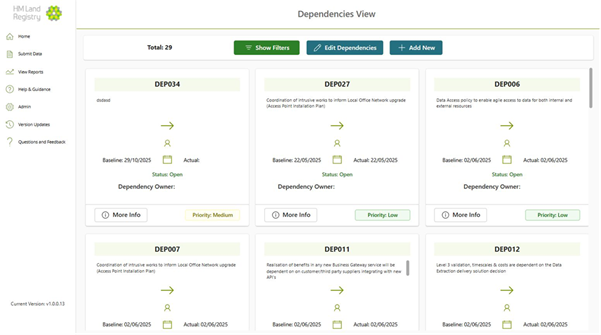
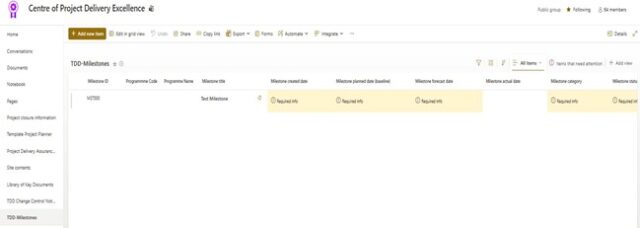
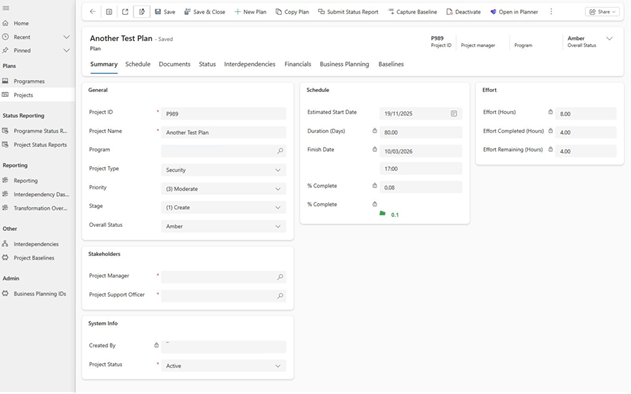
The standard has influenced the data structure for our dependency data collection app (Figure 1), milestone SharePoint list (Figure 2), and project/programme information collection (Figure 3).
The benefits of applying the standard
Introducing the concept of the standard has involved a change in mindset, increasing awareness of the value and power of good quality data across the organisation and wider government. It has meant looking outward and not just within the programme delivery structure. The theory has been an easy sell, but it has been much more challenging to practically apply the standard, particularly in well-established programmes, for example, one person’s deliverable is another person’s milestone.
From a technical perspective, the standard has and will continue to help with the communication of our needs related to building new tools and designing data structures. When discussing with developers and system owners, we can point to the standard rather than personal preferences.
We know that introducing the same process makes data collection easier and helps us identify when things change from our baselines. Using the standard makes it easier to talk about our project delivery data needs with our stakeholders.
Lessons learned
It is easier to start using the standard in newly formed projects and programmes.
Using the standard as a reference reduces any potential confusion when requesting changes to systems or templates, since we can point to agreed definitions rather than “our interpretation.”
Build in governance and monitoring. Without checks fields can drift away from the standard over time. Technical validation rules and automated checks can help embed consistency.
Identify your stakeholders and involve colleagues from other departments to help with implementation and monitoring benefits. Plan stakeholder communications and provide opportunities for feedback and discussion before, during and after implementation. There can never be enough awareness of this.
Use the support and advice that is offered by NISTA, particularly the resources that they provide, they are very helpful when presenting to stakeholders.
Advice for others and next steps
Just do it! Don’t wait to build agreement. As a profession we can take responsibility for implementing the standard and we should feel empowered to do it.
Consistency is key. Make sure you build in monitoring the application of the standard and support the process of embedding it – you need to invest in it until it becomes second nature.
Get ahead of the curve, with so much emphasis on data across government the standard is becoming mandatory.
Author
Lesley Jones
HM Land Registry
South West