The purpose of learning from experience is to avoid repeating the same mistakes and help spread improved practices to benefit current and future work.
Previous
Chapter 37: Use and disposalThe Teal Book: Part F

Orders are open until 31 December 2026.
The purpose of learning from experience is to avoid repeating the same mistakes and help spread improved practices to benefit current and future work.
Project delivery is challenging. Even in well-run portfolios, programmes and projects, mistakes happen, things go wrong or aspects could be improved on. Work can also go smoothly, or better than planned, with innovative approaches emerging. Capturing and learning from these experiences helps future work run more effectively and efficiently.
Learning from experience can also reduce the risk profile for the work. Real-life examples help identify risks or show how best to mitigate them.
Teams can include civil servants, public servants, secondees, consultants, people from professional services and contingent labour so turnover can be high and teams change frequently. Without a structured approach to capturing and sharing learning, it can be lost.
Learning from experience in project delivery is about taking an organised approach to identifying, capturing and sharing lessons learnt from the conduct of the work.
The Project delivery glossary defines lessons learnt as:
The practice of continuous improvement based upon organisational learning in a risk management context.
Everyone in the team should understand how to find and learn from previous lessons, and how to contribute to the lessons process.
Practices vary according to the nature, scale and complexity of the work, but there are some core elements. Learning from experience involves:
Each lesson record should combine:
When starting and planning work, team members and stakeholders should look for and apply relevant lessons from previous experience, whether from other work in the same portfolio, programme or project or from another organisation.
People in a project delivery role should know how to recognise a potential lesson and where to direct their improvement suggestions and feedback. This should be defined within the governance and management framework and reviewed regularly to check it is being used and is effective.
The portfolio director, in a portfolio, or senior responsible owner, in a programme or project, is accountable for learning from experience. They own the framework for learning lessons, ensuring that it is effective for capturing relevant experiences from previous work in a way that improves how future work is done.
The portfolio, programme or project manager, as appropriate, is responsible for ensuring that lessons are being captured and shared effectively as they manage the governance and management framework, which is where the ways or working are defined. In practice, this is often done by a support officer designated as the lessons manager. For simpler programmes or projects, the programme or project manager, as appropriate, would undertake the role themselves. For large work packages, the work package manager could undertake the role, particularly for specialist delivery approaches.
Each lesson is assigned to a lessons owner. This is a named individual responsible for addressing a lesson or group of related lessons. Depending on the scale of the work, this role could be undertaken by the lessons manager or someone in their team. A lesson owner needs to be someone who can manage a lesson either due to their position, authority or technical experience. To keep learning from experience effective, too many lessons should not be allocated one owner. As a lesson can develop as more information becomes available, ownership can be reassigned to a more appropriate person if necessary.
At the start of the work it is good practice to research similar work that has been done before and what can be learned from it. This can include looking at experience from other countries, sectors (within and outside government) and work that uses different delivery approaches. Learning and innovative practices are often transferable, even across different sectors.
Useful sources of learning include:
Look out for talks, blogs and special interest groups about relevant experience, or consider setting one up. People tend to share more colour about their experience and the lessons they have learnt when talking directly, and are often willing to provide support if you need advice on a particular issue. The Government Project Delivery website is a good place to start.
Negativity bias means it is often easier to focus on failure. However, understanding the factors that made something successful is equally important, if not more so.
Some lessons can be identified from physical sources such as risk and issue registers. Others are embedded in tacit knowledge, which makes them harder to find. Do not rely solely on formal reporting of lessons or on set-piece workshops at the end of a phase. Capture lessons as the work proceeds, for example as part of team discussions on improving an aspect of work, assurance activities, resolving an issue or dealing with a new risk.
If something in the governance and management framework looks wrong or needs better explanation, the owner of that documentation should be told, with suggested amendments or ideas to address the issue. Do not wait for a formal review meeting.
Not all suggestions for improvements are relevant. The situation might be unique and not generally applicable. Suggestions are not always right: the terms used could differ from those used in the standard documentation, the suggestion might place something in the wrong context, or it could conflict with other practices.
Changes to baselines or established practices need care. Work to implement lessons learned should be managed under change control, like other changes (see Chapter 22: Change control). As with other changes, the lessons manager and owner should consider all proposed changes carefully and only introduce changes after appropriate scrutiny. This includes deciding whether a lesson needs to be raised and with who.
Lessons should be assigned to the person best placed to act on them. If a lesson relates to any of the practices in The Teal Book, it is a project delivery lesson. If it relates to a specialist delivery method, technique or process, the professionals who own those approaches are responsible for it.
If the right person is not chosen, the lesson could be lost or misinterpreted. For example, a digital delivery specialist should address feedback on digital matters, while a commercial specialist should own any commercial lessons arising from a procurement.
Recording a lesson in a register or adding to existing documentation does not mean people will read it. As documentation grows, people are less likely to engage with it. Team members can also feel threatened by lessons, experience change fatigue, have concerns about the skills needed to implement them, or face increased workloads.
Consider other ways of sharing and adopting lessons, for example through informal updates at team meetings, more formal briefings or more creative communications at organisational or functional level. New content, case studies and stories can be built into induction and training (see Chapter 39: Training and development).
Lessons are also being shared more widely across government, for example through video diaries and case studies on the Government Project Delivery website, or in learning repositories on some major programmes.
If lessons need to be addressed, particularly those resulting from failures or crises, people need to be able to identify them without fear of blame or retribution. Admitting something could have been done better can be interpreted as a weakness and may be hidden. Often such lessons emerge as issues (see Chapter 21: Issue management).
Learning from experience is about moving forward. Lessons should be captured and communicated in a way that avoids revisiting conflicts and simply states what should be done in future.
By default, the record of lessons should be open. Care should be taken when writing up and sharing lessons that could be sensitive due to commercial, technical, physical, or people reasons.
Done in the right way, learning from experience can be a safe way to help people move on from a difficult experience, which can improve psychological safety in the team.
On a small project, the project manager can manage lessons as part of normal workload. For large portfolios, programmes and projects, the role should be given to a dedicated lessons manager or a member of the support office (see 38.5 on who manages learning from experience).
On portfolios and large programmes and projects, defining categories of lessons makes them easier to find and manage. Categories can be based on the practices in The Teal Book. Categories for specialist delivery or outputs should be decided on a case-by-case basis. Owners of organisational project delivery approaches could also define categories to help consolidate lessons from across a portfolio of work.
Each entry in a lessons register should include:
A lessons register can vary from a simple spreadsheet to a set of features in an information management system. Additional fields are often added to reflect the needs of the work and team.
Learning from experience involves a set of related activities, shown in Figure 38.1. These may happen in sequence or be repeated throughout the work.
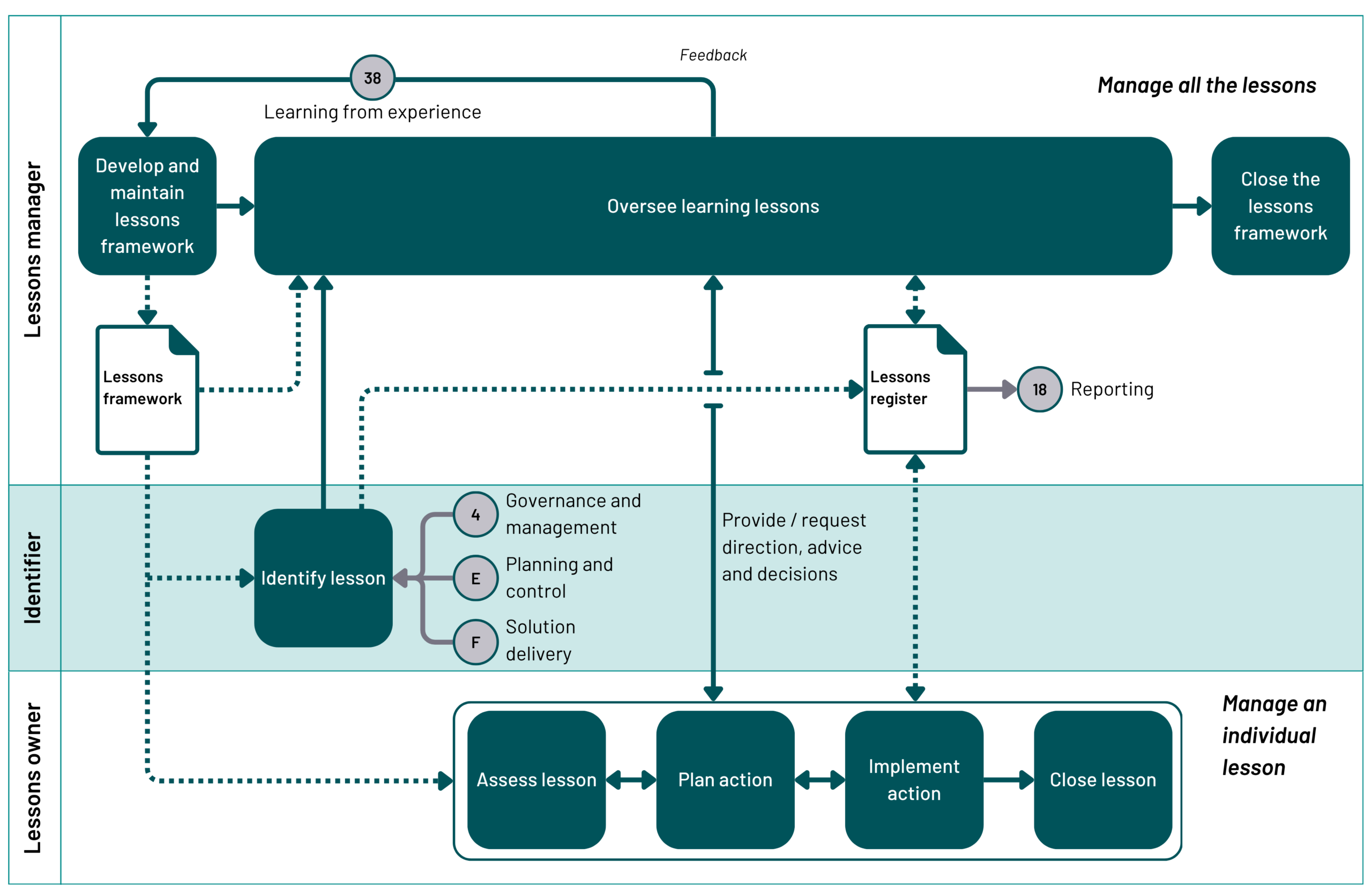
The important aspects of this activity are discussed in more detail in 38.6.2.
The learning from experience management framework should be developed at the start of the life cycle and should describe:
The framework should be maintained to address relevant feedback from its use and should form part of the governance and management framework for the work.
As each lesson is identified, it should be verified and formally registered by the lessons manager and an appropriate lesson owner assigned. This could mean combining or splitting actions, or reassigning owners.
The lessons manager should make sure that learning from experience continues to meet the needs of the work by:
Leaving a lesson on a register without further action is unlikely to have any future benefit. The lessons manager should provide regular reports on identified and implemented lessons to show that continuous improvement is being taken seriously.
The context and nature of the work can change throughout the life cycle. Therefore, the learning from experience framework should be under continuous review to ensure it remains effective.
A lesson could be raised formally or informally, for example as a result of an issue occurring, a threat being avoided, or an opportunity being exploited.
Lessons can also come from reviewing existing knowledge repositories, discussions with colleagues or reviewing reports and case studies. Workshops such as retrospectives, pre-mortems and peer assists can also help (see 38.6.1.1 on learning from other work and other sectors).
Once identified, the lesson should be assigned to a lesson owner.
Each lesson should be assessed to understand aspects such as:
It should be assessed whether to act on it now, in the future, or not at all. If the lesson is not fully understood there is a risk that the impact of the lesson could be incorrectly deduced and the wrong actions might be taken.
The lesson should be classified as defined in the management framework (see 38.6.2.2 on defining categories). The level of assessment needed depends on the nature of the lesson. Guidance on techniques for determining impact can be found in the Government Functional Standard for Analysis and in the Aqua Book (requires sign in).
The lesson owner should agree with the lessons manager on who should take action and what the action should be.
If the action sits within the team that identified the lesson, define it fully through to completion.
If the responsibility for addressing the action is with another team, such as the owner of a higher-level delivery approach, the action could be to transfer the lesson to that team.
If the actions are significant, such as implementing a new tool, activities and milestones should be included within the plan (see Chapter 16: Planning), together with any identified assumptions and risks.
The actions identified in 38.6.3.6 should be tracked to their conclusion.
A lesson should be closed once it has been implemented and no further monitoring is required, stating when and by whom. Keep closed lessons on the register.
Once the work has been completed, close the framework after any outstanding lessons and actions have been completed or cancelled. Information should be retained in accordance with the delivery and sponsoring organisation’s information retention policy (see Chapter 24: Information and data management).
Consider whether the lessons should be shared widely, for example as a case study on the Government Project Delivery website or as part of a learning legacy repository. Do this as part of closing the work.
Added accountability for learning from experience at portfolio director and senior responsible owner level, added a definition of lessons learnt from the Project delivery glossary, added detail on what each lesson record should include, added guidance on assessing lessons including reference to the Government Functional Standard for Analysis and the Aqua Book, updated the list of useful sources of learning, and added information about barriers to adopting lessons such as change fatigue and concerns about skills.
Page permissions updated for public launch.
First published for closed beta consultation.