The purpose of induction and training is to make sure team members can work effectively as soon as possible by briefing them on the context of the work and the working practices in use.
Previous
Chapter 38: Learning from experienceThe Teal Book: Part F

Orders are open until 31 December 2026.
The purpose of induction and training is to make sure team members can work effectively as soon as possible by briefing them on the context of the work and the working practices in use.
People working in project delivery need to have the skills and competencies to carry out their roles. Good processes and guidance only work if people know how to use them.
The Government Functional Standard for People expects new employees to be working effectively as soon as possible, with induction covering organisational context and the new joiner’s work.
Project delivery teams are temporary, change frequently and may include suppliers and contingent labour who do not have access to the sponsoring organisation’s learning and development. Local induction and training makes sure everyone understands the way work is done on the specific portfolio, programme or project.
Induction means briefing a new team member on the context for the work and the working practices to be used. It should also cover health, safety and security.
Following the appointment to a role, induction is often the joiner’s first contact with the team, setting an important first impression. Induction should be provided to everyone joining the portfolio, programme or project, tailored to whether they are:
Plan induction before a person joins the team. It should take place in the first few working days. All new joiners should have a documented induction plan. It is also good practice to offer new joiners a buddy, an informal contact or mentor, while they are settling in.
See 39.6.2.4 for an example induction plan.
In most cases, Civil Service and organisational training should meet most learning and development needs. However, on large programmes or where innovative approaches are used, specialist training might be needed to supplement induction. This should be planned and carried out in accordance with the Government Functional Standard for People, drawing on the government professions and organisational training and development expertise, where needed.
Training could cover any aspect of the work, such as:
The portfolio director, in a portfolio, or senior responsible owner, in a programme or project, is accountable for induction and training. They own the framework for training, ensuring that it is effective in giving people the skills and competencies to carry out their roles.
The portfolio, programme or project manager, as appropriate, is accountable for developing and managing the induction plan and training management framework, including its processes, tools, techniques, and for ensuring that it remains effective through the life cycle.
The team’s lead manager is responsible for induction, as induction manager. This could be a portfolio, programme, project or work package manager. For larger work, a support office may handle the general parts of induction, with the team manager covering the detail specific to the role and team. Specialists can support induction where needed.
The portfolio, programme or project manager, as appropriate, can act as the resource manager who should identify any specialist training needs, working with other senior team managers to develop a strategy to meet these needs (see Chapter 28: Resource management). Depending on the scale and complexity of the work, there could be a dedicated resource manager (often from a support office) with responsibility for overseeing training on behalf of the portfolio, programme or project manager. They should draw on the government professions and people specialists where appropriate.
Wherever possible, they should use training courses that already exist across government. Where no existing course meets the need either from government or externally, a training manager leads work on developing and delivering the content locally.
On a small project, the project manager may handle both induction and training. For large-scale or complex work, a wider team may be needed to develop a full curriculum.
Where a defined project delivery approach is in place, say at organisational level, the owners of that approach should provide the necessary training.
Induction and training on a specific portfolio, programme or project should be focused on what is different in that portfolio, programme or project.
The term ‘training’ used throughout this chapter covers all of these learning approaches.
One-to-one training tailored to a person’s needs, such as on-the-job training, coaching and mentoring. It can include hands-on tuition on equipment and processes. This approach works well for induction or specialist roles where group training would not cover the specific need.
Group training delivered in person, virtually or as a hybrid. It allows for discussion and peer learning in a focused setting away from workplace distractions. This approach works well where a group of people need the same training and would benefit from learning together.
Online courses or modules that can be accessed at any time and from any location. They make it easier for people to fit training around other work, though they do require some self-discipline to complete.
Self-directed learning where people set goals and study at their own pace, without a formal course structure. It helps develop independent thinking and self-management skills. This approach works well for motivated learners, and benefits from clear objectives and regular check-in points.
Structured training that takes place in the workplace using real tasks, equipment and processes. It allows people to apply what they learn straight away, which is helpful where skills are best picked up by doing rather than in a classroom setting.
Recorded content such as demonstrations, walkthroughs or case studies, watched individually or as a group with discussion afterwards. Visual explanation can make complex processes or tools easier to understand. This approach works best when combined with other methods, as it is passive on its own.
Presentations or panel discussions from subject matter experts, delivered in person, virtually or as a hybrid. They give people access to expert insight and current thinking, and create space for questions and sharing ideas across teams.
Once it is understood how the project delivery work is to be directed and managed and how that differs from any higher-level approaches, a training needs analysis can be developed. This is only likely to be needed for larger work and can be simplified for simpler portfolios, programmes and projects.
A training needs analysis identifies the training needed for individuals working on a specific portfolio, programme or project. It includes:
A training strategy provides a high-level outline of the training needed on a specific portfolio, programme or project. This is only likely to be needed for larger scopes of work and can be simplified for simpler portfolios, programmes and projects, if needed at all.
The strategy should build on the training needs analysis and typically include:
Before a new joiner starts, make sure the topics to be covered are agreed and that the right people are available to deliver them. An induction plan can help and acts a checklist to make sure everything is covered.
Induction typically involves one or more briefing sessions, typically a collective briefing session, often conducted by a member of the support office, followed by sessions with a line manager. Other activities can also be included, such as meetings with other team members, site visits or work familiarisation activities.
Induction should typically cover the topics in Table 39.1.
| Topic | Description |
|---|---|
| Introduction | Background to the portfolio, programme, project and team the person is joining. |
| Their role on the work | The organisation structure, their role and responsibilities within it, and line management or reporting arrangements. |
| Working practices | The project delivery and other working practices to be used, described in the governance and management framework (see Chapter 4: Governance and management). |
| IT and network access | Access to IT systems, including their sign in details. |
| Applications | Any non-standard applications the person needs. |
| Materials or equipment | Any special equipment or materials the person needs. |
| Building and office access | Locations and times of access needed, including government and third-party sites. |
| Mandatory training | Mandatory training requirements, such as for compliance and security. |
| Specific training | Any other training needed. |
| Health and safety | Local information such as health and safety, fire exits, first aiders, accident reporting and local rules, especially if site-based or overseas (see Chapter 7: Health, safety and security). |
| Security | Security pass and security arrangements. No one should be assigned to a team without the required security clearance (see Chapter 7: Health, safety and security). |
| Workplace expectations | Dress code, behaviours and values (see 4.6.6 on behaviours and leadership). |
| Accessibility | Ensure any disabilities are recognised and identify any specialist equipment or adjustments needed. |
| Support and buddying | Where to find practical help and support in the first weeks. |
| First week and month activities | A list of activities, including training courses, to complete after induction. |
The activities for induction and training are summarised in Figure 39.1. They can be formal or informal, as appropriate to the scale and complexity of the work and hence training needed.
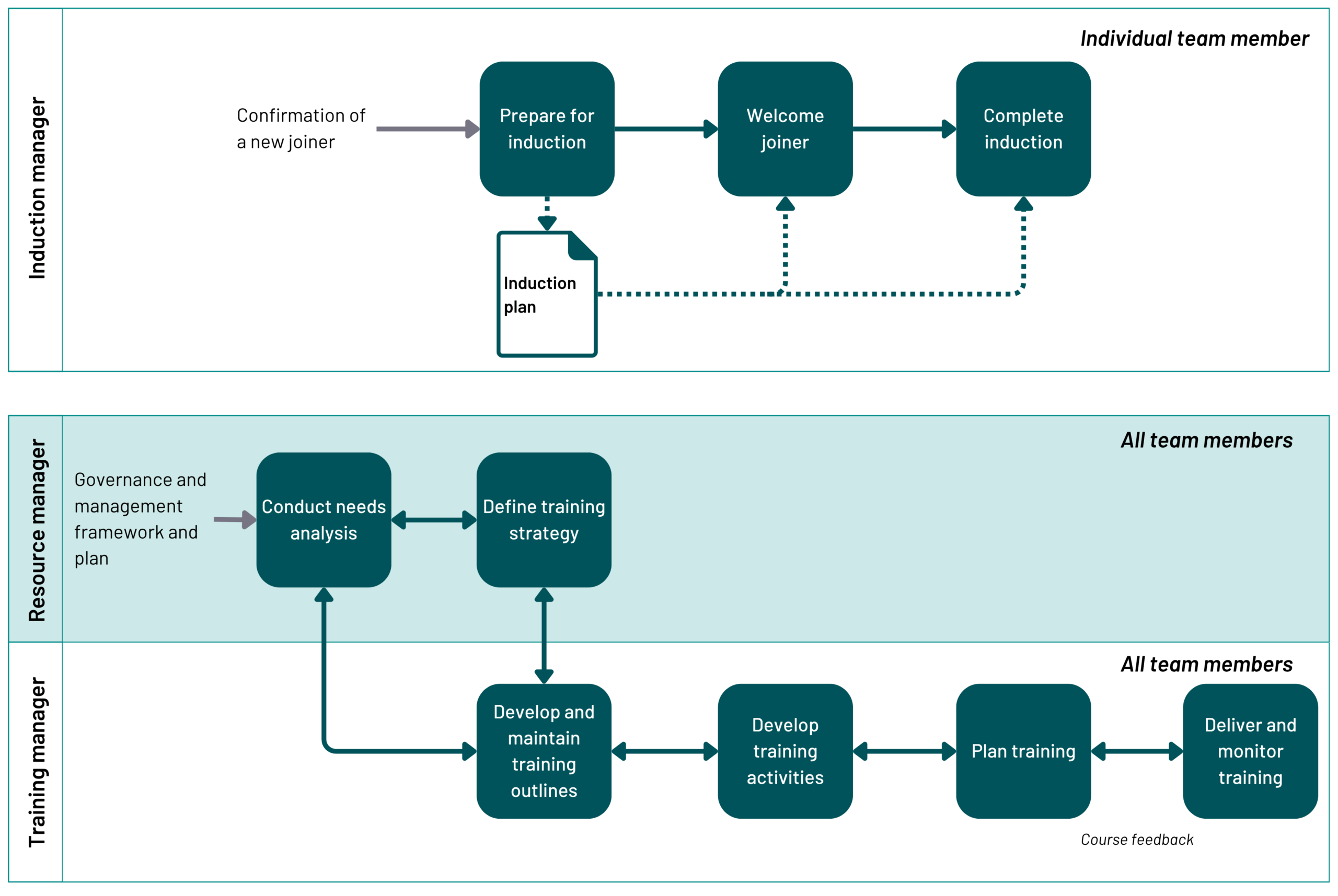
Confirm the joiner’s details and agree a meeting date and time. If applicable, book the closest induction course to their start date.
Prepare or complete a personalised induction plan setting out what needs to be covered (see 39.6.2.3 on preparing for induction). Raise specific requests for equipment, software and any special requirements. This could also include arranging introductory meetings with all team members and other key contacts and appointing a person to act as a ‘buddy’ to help the joiner complete induction tasks.
Welcome the joiner and provide them with general background to the work and their role. If in person, take the joiner on a tour of the work area and make introductions.
Refer to the induction plan and ensure the joiner is briefed on each topic covered in the plan. Book specific follow-on training courses, if any.
If required, undertake a training needs analysis (see 39.6.2.1 on undertaking a training needs analysis).
The training management framework should be developed at the start of the life cycle and should include:
The framework should be maintained to address relevant feedback from its use and should form part of the governance and management framework for the work.
Working with the relevant manager and other stakeholders, and using the needs analysis as a basis, prepare the training strategy. Ensure those sponsoring, delivering and supporting training activities are consulted (see 39.6.2.2 on preparing a training strategy).
The context and nature of the work can change throughout the life cycle. Therefore, the training strategy should be under continuous review to ensure it remains effective.
Working with those expected to deliver training activities, prepare an outline for each, using the approach defined in the training strategy. Monitor feedback from activities and update the outline, if necessary.
Develop the training activity, considering both format and content. Ensure it is reviewed by those who are sponsoring the activity, subject matter experts and those delivering.
If appropriate, pilot the activity to validate its effectiveness, refining the format or content as necessary based on the feedback.
Confirm that those delivering activities are available to do so. Schedule activities, book the venues, arrange support and accommodation, as required. Ensure expected participants are aware of and have been invited to attend, in-person or virtually as appropriate. Where the timing of the activity is decided by the participant, set a time window within which the training is to be completed.
For classroom and event-based training, manage the bookings, dealing with any enquiries, cancellations and moves. For other activities, check arrangements are in place and are working. Provide a contact to help resolve any issues.
Deliver training activities in accordance with the outline. Collate feedback and update the training outline or documentation, if needed. Evaluate the effectiveness of the training to show whether knowledge has been retained and used.
Once the work has been completed and training management is no longer needed, the training management framework should be merged into the management framework for the solution or closed, transferring any training solutions if necessary, and retaining information and data in accordance with the sponsoring organisation’s information retention policy (see Chapter 24: Information and data management).
Updated accountability for induction and training to include the portfolio director and senior responsible owner, and added information on the training management framework, including how to develop, maintain and close it. Updated the reference to the Government Functional Standard from GovS 003: Human Resources to GovS 003: People. Removed the reference to GovS 002: Project Delivery from further reading.
Page permissions updated for public launch.
First published for closed beta consultation.