Beta

This is a new service and pages are being tested and improved.

2.1 Policy

Public policy represents the government’s role in improving the welfare, security and prosperity of the nation. It ranges from designing public services and improving education and health, to assessing the infrastructure needs for different parts of the country, ensuring the UK is on track to achieve net zero carbon emissions and strengthen the economy. Policy work centres around 3 pillars defined in the Policy profession standards:

  • strategy, using evidence and analysis to understand context and develop strategies
  • democracy, supporting good UK governance through robust advice to inform decisions
  • delivery, designing, overseeing and evaluating policy interventions

Policy interventions can take many forms including passing legislation, enforcing existing laws, tax changes, providing grants, effecting voluntary agreements, providing education and awareness raising and encouraging behavioural change. Many of these interventions can be sufficiently extensive and complex to warrant being managed using project delivery techniques.

For this reason, where an intervention is managed as a portfolio, programme and project, evaluation should be planned and managed as part of project delivery, involving policy makers and project delivery professionals working together as a team.
2.2 Developing and delivering policy

Policy development involves 4 activities:

  • idea generation, identifying the root of the problem government wants to solve by analysing evidence, including evaluations and lessons learned (see Chapter 38: Learning from experience) to generate ideas for investigation and begin developing of a theory of change
  • design and planning, investigating the options further together with how they might become a proposal or plan, and assessing their potential impacts under statutory public sector duties (for example on equality, biodiversity and the environment) and typically completing a theory of change until a preferred solution is chosen
  • implementation, implementing and managing the delivery of the chosen solution and carrying out the groundwork for the realisation of the policy
  • evaluation, using hard evidence to determine whether the policy is likely to be achieved, or is achieving the desired outcomes, and whether the policy needs to be adapted, improved or stopped

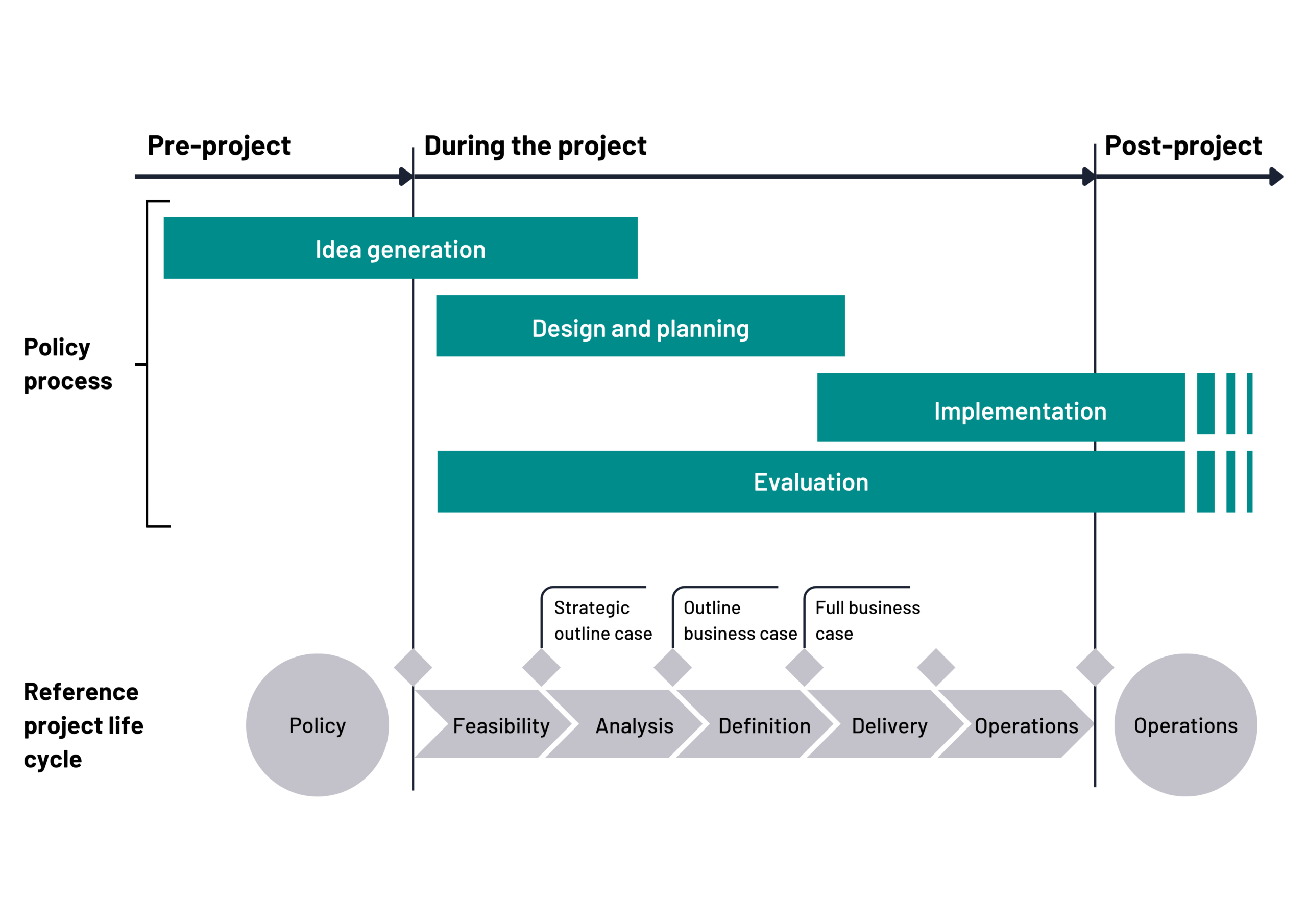
Where it is appropriate that the development and implementation of policy is managed as a portfolio, programme or project, the 4 policy development activities need to be integrated with the project delivery life cycle and its activities. The way this is done should be decided on a case-by-case basis. Figure 2.1 shows an example of how the activities in the policy process can be aligned to the stages in the reference project life cycle from the Government Functional Standard for Project Delivery and business cases in the Green Book (requires sign in) (see Chapter 4: Governance and management and Chapter 13: The governance and management of programmes and projects).

a timeline showing how the four policy process activities — idea generation, design and planning, implementation, and evaluation — overlap with the reference project life cycle stages of policy, feasibility, analysis, definition, delivery and operations. Idea generation runs through pre-project into feasibility. Design and planning spans analysis and definition, with strategic outline case, outline business case and full business case marked at the transitions. Implementation runs from delivery through operations and beyond. Evaluation runs throughout the project and continues post-project.
Figure 2.1 An example of how the policy process can be aligned with the reference project life cycle
a timeline showing how the four policy process activities — idea generation, design and planning, implementation, and evaluation — overlap with the reference project life cycle stages of policy, feasibility, analysis, definition, delivery and operations. Idea generation runs through pre-project into feasibility. Design and planning spans analysis and definition, with strategic outline case, outline business case and full business case marked at the transitions. Implementation runs from delivery through operations and beyond. Evaluation runs throughout the project and continues post-project.
Figure 2.1 An example of how the policy process can be aligned with the reference project life cycle

The policy process, being a ‘process’, can be iterative while a project life cycle is driven by time. In the example in Figure 2.1:

  • idea generation starts before the project begins, and at some point, triggers the request to formally authorise the project to start, and continues until a long list of options has been created
  • design and planning starts at project initiation until a solution is chosen
  • implementation starts when the delivery phase commences and continues until the solution is no longer in operation
  • evaluation is shown throughout the project and beyond, which mirrors the principles in the Government Functional Standard for Project Delivery for verifying policy and strategic fit (see 1.2.1 for principle 1) and continuing justification (see 1.2.3 for principle 3)

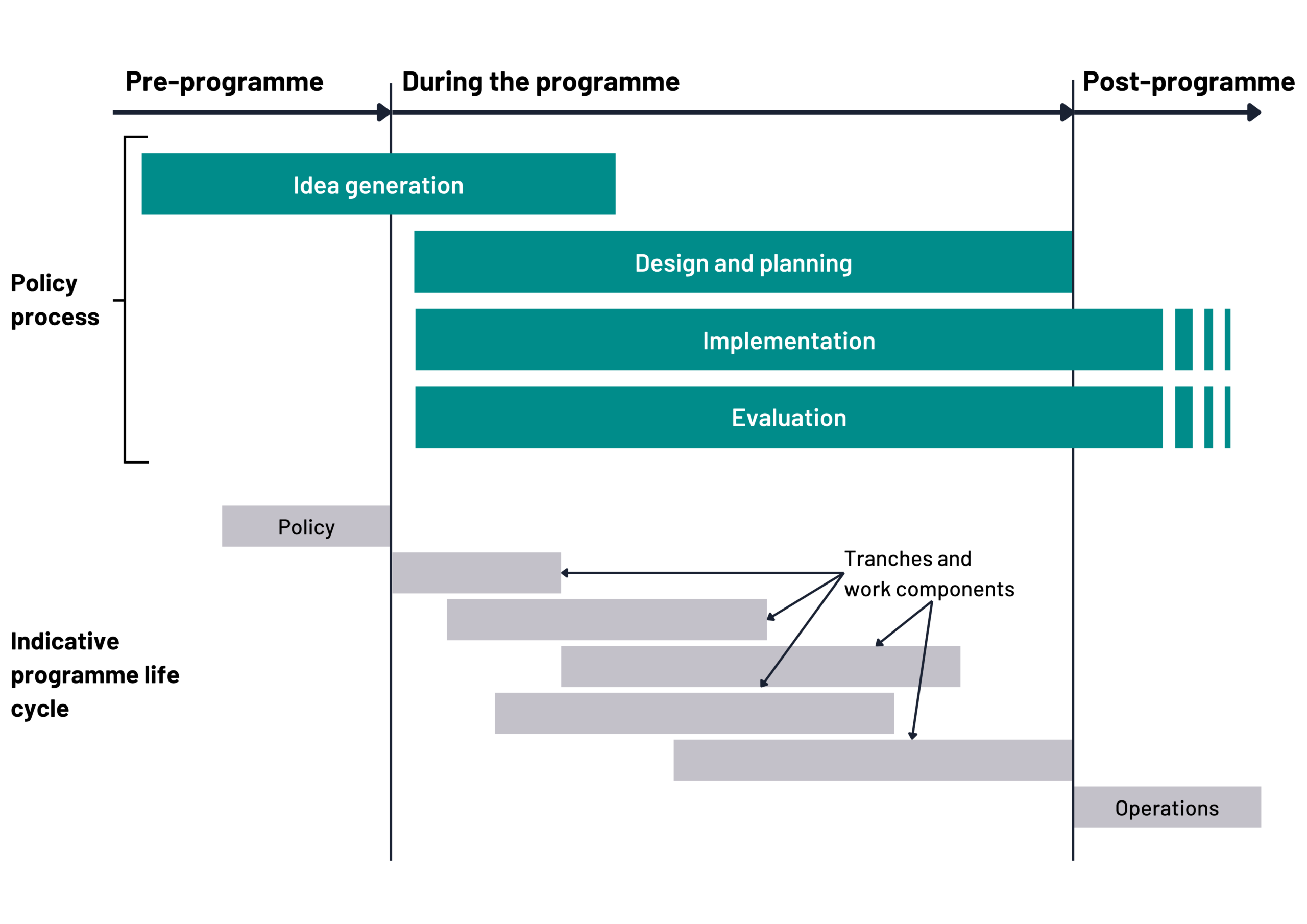
The same approach can be taken for programmes, although, as described in Part D: Managing programmes and projects, the varied nature of programmes means that there can be no ‘reference’ life cycle to align to and so has to be determined in each case. Figure 2.2 shows an example.

A timeline showing how the four policy process activities — idea generation, design and planning, implementation, and evaluation — overlap with an indicative programme life cycle. Idea generation runs through pre-programme. Design and planning, implementation, and evaluation all run across the programme, with implementation and evaluation continuing post-programme. The programme itself is shown as overlapping tranches and work components rather than fixed stages, reflecting that programmes have no single reference life cycle.
Figure 2.2 An example of how the policy process can be aligned with a programme
A timeline showing how the four policy process activities — idea generation, design and planning, implementation, and evaluation — overlap with an indicative programme life cycle. Idea generation runs through pre-programme. Design and planning, implementation, and evaluation all run across the programme, with implementation and evaluation continuing post-programme. The programme itself is shown as overlapping tranches and work components rather than fixed stages, reflecting that programmes have no single reference life cycle.
Figure 2.2 An example of how the policy process can be aligned with a programme

2.3 Evaluation

2.3.1 The purpose of evaluation

The purpose of evaluation is to support:

  • transparency and accountability, to demonstrate that government organisations have fulfilled their accountabilities with respect to the impact and wider outcomes from policy interventions
  • learning, to understand what works for whom, when and why, informing decisions on future interventions, lessons for improvement, how to minimise risks, and whether to continue current interventions

2.3.2 Why evaluation?

Robust evaluation has an important role to play in maximising the value, understanding the ongoing viability and likelihood of success delivered from public spending and improving outcomes for citizens, as set out in the Public value framework.

High quality evaluation evidence can enable decision-makers to better target their intervention, reduce delivery risk, maximise the chance of achieving the desired objectives and increase understanding of what works. Without robust, defensible evaluation evidence, government cannot know whether its interventions are effective or even if they deliver any value at all. Evaluation is particularly useful for novel and complex, high risk and high cost interventions.

2.3.3 What is evaluation?

Evaluation is a systematic assessment of the design, implementation and outcomes of an intervention that emphasises value for money and results. It involves understanding how an intervention is being, or has been, implemented and what effects it has, for whom and why. It identifies what can be improved and estimates its overall impacts and effectiveness in terms of costs, benefits and social value.

Evaluations should be carried out in accordance with the Magenta Book (requires sign in). There are 3 main types of evaluation:

  • process evaluation, discovering what can be learned from how the intervention is being or has been delivered to benefit future policy development
  • impact evaluation, discovering what difference the policy intervention is making or has made
  • value for money evaluation, determining if the intervention is a good use of public money

Government Major Projects Portfolio and evaluation

Programmes and projects in the Government Major Projects Portfolio, are required to log their evaluation plans and outputs on the Government evaluation registry.

See the Magenta Book (requires sign in) and Guidance on using the evaluation registry for more information.

Further, evaluation is mandatory for certain interventions, such as regulatory policies subject to post-implementation review, sunset, or ‘duty to review’ clauses, and international development.

2.3.4 Who is involved in evaluation?

The accounting officer has a duty to inform ministers, Parliament and the public about the outcomes and value of the initiatives they put in place, as well as contributing to spending reviews and responding to scrutiny and challenge from bodies such as the National Audit Office. As such, they are the primary beneficiary from evaluation.

In a project delivery context, the responsibility for evaluation is placed on the sponsoring body or the senior responsible owner for the work being undertaken in a programme or project, and the portfolio director in a portfolio. Once a portfolio, programme or project is complete, responsibility for evaluation passes back to the accounting officer, or their representative, in the sponsoring organisation as the formal project delivery roles are stood down. 

Some aspects of evaluation can be managed by the portfolio, programme or project team as part of normal project delivery practice, for example where the change proposed is small-scale and internally facing. In most other cases, however, specialist analysis is required to supplement the team. This needs to be decided on a case-by-case basis and defined in the programme’s or project’s governance and management framework and plan. Undertaking an evaluation, although a simple concept, can be a very technical and complex task to do well. 

There is a large evaluation community, and a number of specialist techniques and conceptual frameworks that can be used. As a result, evaluation is something that can be best designed, overseen and managed by individuals and teams with specialist expertise. In government, evaluation is typically designed by specialist evaluators or analysts from the social research, economics, statistics and operational research professions, working closely with those designing and implementing an intervention, such as policy and project delivery professionals. Additional advice might be needed from the chief analyst of the organisation for the most complex evaluation. More often than not, the actual evaluation itself, collecting existing and new data and analysing and interpreting findings is contracted out to independent specialists.

2.3.5 What to consider in evaluation

2.3.5.1 Planning evaluation as early as possible

Planning for evaluation should start before project delivery is initiated and continue throughout the life cycle, considering the organisation’s evaluation strategies if applicable. See examples of Evaluation strategies from UK government departments.

This helps ensure that analytical and evaluator specialist costs are included in planning and can be mobilised when needed. It also means data can be collected at the appropriate point and in the most cost-effective way.

On closure, arrangements for further evaluation should be agreed and recorded with responsibility for ensuring evaluation takes place and transferred to the sponsoring organisation.  

Where programmes or projects exceed an organisation’s delegated authority limit, set precedents, are novel, contentious or repercussive, evaluation should be planned so that findings can support the Treasury approval process for projects and programmes (requires sign in).

2.3.5.2 Developing a theory of change

Policies operate within specific contexts. Policymakers should consider the environment, stakeholders, and external factors that impact policy effectiveness, identifying what success or failure looks like with respect to the desired outcomes and objectives. Understanding this context helps choose and tailor evaluation methods and identify relevant metrics.

Developing a theory of change helps identify what needs measuring. The theory of change should set out how an intervention is expected to work, the objectives, desired outcomes, key stakeholders, assumptions made, critical success factors and the wider contextual factors (see the Magenta Book (requires sign in) for more information) – can also help identify external factors that might influence policy success or failure, typically, represented as a diagram accompanied by an explanation. Ideally, a theory of change should support project delivery initiation, but if one has not been developed, development should start as soon as possible after initiation. 

2.3.5.3 Piloting and validation

Piloting an intervention before full-scale implementation can be valuable. Such validation enables policymakers to assess the feasibility, cost-effectiveness, and potential challenges of the intervention and can be considered in the delivery approach. They can also be used to test out the most suitable evaluation and data collection methods. 

Evaluation generates evidence on policy interventions which is crucial for informed decision-making. It becomes especially valuable when:

  • the intervention is novel or uncertain
  • risks are associated with the policy
  • the policy involves significant costs or social change

2.3.5.4 Collecting the required data

Identifying what type of data is needed for an evaluation and how it can be collected should be understood early. This understanding will help to:

Situations where it is difficult to collect data may require innovative data collection methods or data sharing agreements to be implemented which can take more time to arrange, for example, when it is difficult to engage with user groups.

2.3.5.5 Aligning evaluations with assurance reviews and significant decisions

Evaluation, like assurance reviews, aims to ensure good decisions are made. Therefore, the timing needs to be decided so that decision makers can be provided with information that informs their decisions. Care should be taken not to duplicate work, and where possible, activities relating to evaluation should be integrated with mainstream project delivery work.

Updates

Page permissions updated for public launch.

First published for closed beta consultation.

Back to top