We use some essential cookies to make this website work.
We'd like to set additional cookies to understand how you use the Government Project Delivery website, remember your settings and improve government services.
The purpose of controlling the work is to ensure that the outcomes are delivered and benefits realised within the constraints defined in the portfolio plan (for portfolios), business case (for programmes and projects) or work plan (for a work package).
17.2 Key points
Collect the data needed to monitor and control the portfolio, programme or project, focus on information that is known to be useful.
Don’t forget to monitor what is happening external to the work, outside influences and changes in context need tracking alongside internal progress.
Act on variances and deviations and change the plan if necessary.
Verify the information used to track progress.
Apply controls proportionately depending on the project delivery hierarchy.
17.3 Why control the work?
Work needs to be controlled; otherwise, the sponsoring body and, where relevant, the delivery body, the portfolio director and senior responsible owner cannot have confidence that their objectives are likely to be met, in terms of outcomes delivered and benefits realised.
Controlling work ensures:
outcomes and benefits can be achieved
funding is appropriately allocated and used
the proposed solution can be delivered and is likely to fulfil its purpose
stakeholders are being engaged effectively
issues are addressed to keep the work on plan
resources are used efficiently
threats to the objectives are addressed
opportunities are exploited, where appropriate
Control needs not only to be exercised in practice, it also needs to be exercised as part of accountability for use of public funding. Managing public money (requires sign in) states that ‘acting within the authority of the minister(s) to whom they are responsible, the accounting officer shall ensure that the organisation, and any arm’s length bodies it sponsors, operates effectively and to a high standard of probity’. This includes the management of an organisation’s portfolios, programmes and projects.
In project delivery ‘effective operation and probity’ includes complying with the functional standards and developing and using a compliant governance and management framework. ‘Controlling’ is central to making sure that work is progressing as planned and that problems are addressed without undue delay. Defined working approaches, coupled with good control, are an essential aspect of assurance (see Chapter 4: Governance and management).
Any action taken by management, the board and other parties to manage risk and increase the likelihood that established objectives and goals will be achieved.
Control should also be forward-looking, with the aim of prompting action to keep the work on course to meet the defined objectives, addressing issues, taking advantage of opportunities and reducing the impact of threats, whilst verifying what has already happened.
Central to controlling is the concept of tolerance. The Project delivery glossary defines tolerance as:
The agreed deviation above and below a plan’s baseline without escalation to the next level of management.
Figure 17.1 shows the control cycle which can be applied at every level in the project delivery hierarchy and to every practice in The Teal Book. Work is undertaken in accordance with the plan using the delivery approaches defined in the governance and management framework. Progress is tracked using appropriate measures. The progress information is assessed and analysed and, if appropriate, collated into reports which may be periodic or by exception. Action is then taken to address any variances or problems which have been identified.
Figure 17.1 The control cycle
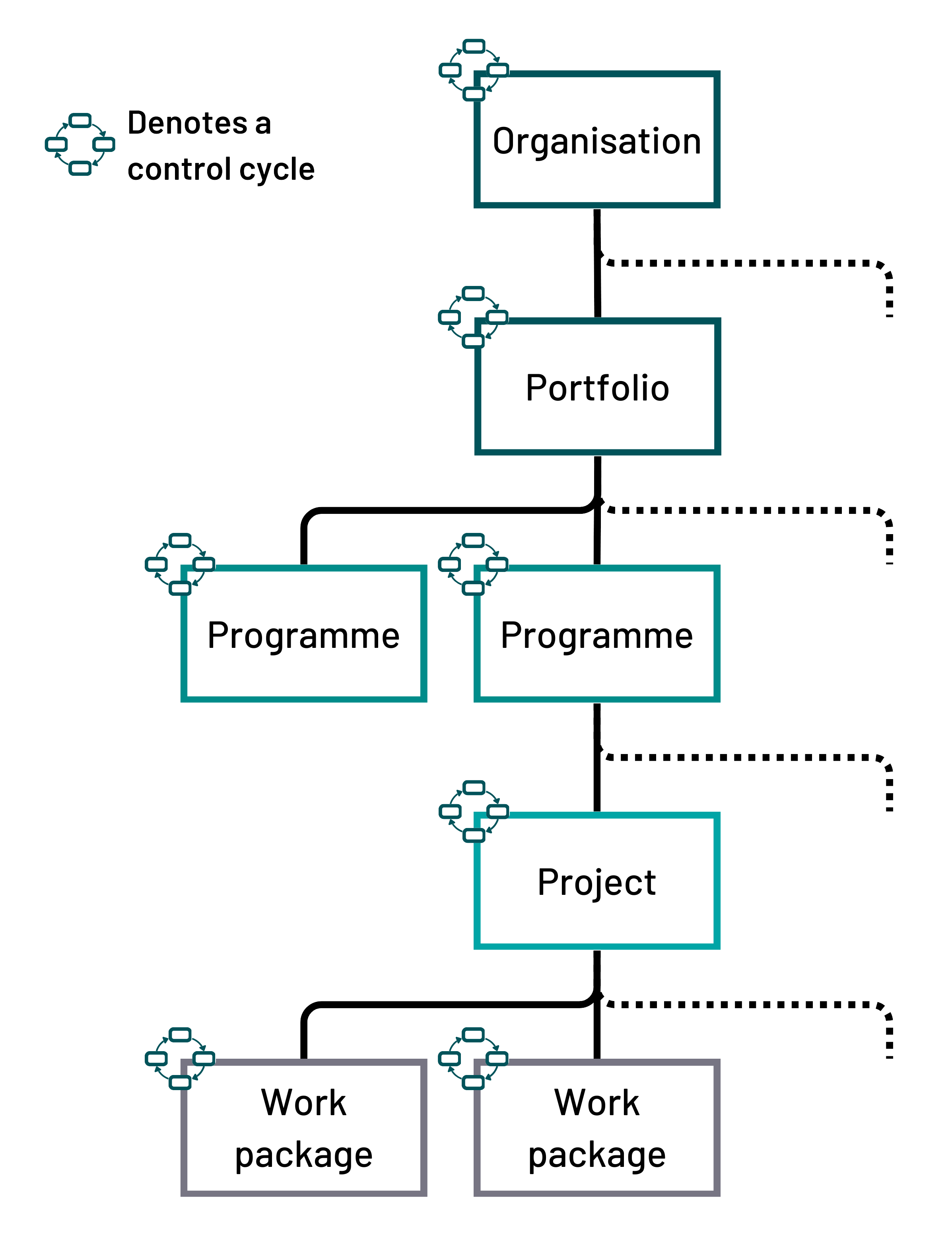
The frequency of the cycle should be both informal, with managers reacting to day-to-day circumstances, and also formal, for example synchronised with the reporting cycle. The further up the project delivery hierarchy, the more holistic and wide ranging the analysis should be. For example, when used at programme or portfolio level the additional perspectives needed can include:
outside influences
interdependencies among work components
robustness of operation when the solution is being used
17.5 Who controls the work?
The portfolio director, for a portfolio, and the senior responsible owner, for a programme or project, is accountable for ensuring an effective control framework is in place and being used.
A single person cannot control everything that needs controlling except on the smallest work item. The work therefore often needs dividing up between work package managers and members of a support office in order to have adequate coverage.
Each level of the project delivery hierarchy should be controlled by its controlling manager: for example, a project manager controls a project. They are accountable to the next higher-level controlling manager, such as a programme manager, who oversees the lower level controlling manager, and controls their own work. Similarly, that higher-level controlling manager is accountable to the next higher-level controlling manager and so on, up the project delivery hierarchy.
17.6 How to control the work
17.6.1 What to consider when controlling the work
17.6.1.1 Understanding the appropriate control regime
Not all activities need the same level of control as, even with a large team, there is often not enough time or management resource to watch everything all the time, and it is not an efficient use of resources. It is therefore important to focus on those activities which are most important, and/or which present the greatest threat to achieving the objectives, such as:
stakeholders’ attitudes
the delivery of the outputs within cost, schedule and quality constraints agreed
the likelihood of the outcomes and benefits being realised
On a practical level this often means focusing on:
activities on the critical path or in the critical chain
deliverables expected from other teams or organisations
work which is about to start soon
activities which cost a lot, or take a long time
activities which are difficult to measure progress on
activities which have a degree of uncertainty in terms of deliverables, schedule or cost
The focus can change as the work moves through its phases or when identified risks need watching with greater vigilance.
17.6.1.2 Building the plan to facilitate control
Having an achievable and logical plan is fundamental to effective control (see Figure 17.1). If the plan does not make sense in terms of logic and realism, controlling the work can be impossible. It is also important that the plan is baselined, otherwise terms such as late, early or over budget have no meaning. This does not necessarily mean the plan has to be highly detailed. The plan only needs to be detailed enough for measures of achievement to have real meaning.
17.6.1.3 Learning how to recognise the important information
Team members can be drawn from many business areas, from the contingent work force or from suppliers. They might have different ways of working in their ‘home’ business areas. They might also use different terminology. Whilst having a good governance and management framework and induction on using it helps, the level of experience of team members can vary. The practices in The Teal Book are in separate chapters, but in day-to-day work they are often inseparable; and information does not always come with a label attached, especially if people use different terms. For example, an issue might not be introduced as an ‘issue’ in a conversation, email or report; it might be a sentence in an email, a line in a spreadsheet or a verbal comment made in passing. It is often up to the manager to recognise and synthesise the information, make sense of it and treat it accordingly.
17.6.1.4 Recognising instability
Progress information should not only be looked at solely in relation to its ‘date’ but also in relation to trends, including in the supply chain. This is particularly important in complex programmes and projects where multiple suppliers are involved. Is progress accelerating or slowing? Are costs escalating? Are the attitudes of stakeholders swinging away or becoming more positive? Such trends can prompt risks or issues to be raised and action taken. Similarly, the data might have no pattern and yet be outside expected or acceptable limits. This can represent instability, which again needs addressing. In the early phases, one of the more important indicators is how stable the user needs and requirements are. Regardless of the delivery approach taken, user needs and requirements need to have reached a degree of stability before follow-on activities can be started with confidence; for example, when producing a high-level design or signing a contract.
17.6.1.5 Choosing an appropriate control cycle
The choice of frequency for the formal control cycle is often tied to the reporting cycle (see Chapter 18: Reporting), but it does not have to be. For example, a report from one level of the project delivery hierarchy to another could be monthly, but the manager could hold weekly progress meetings with the team. The frequency can be different for every component in the hierarchy, with faster-moving or riskier work needing a shorter control cycle. Some delivery approaches define the frequency; for example, the Scrum method has a daily frequency in the form of a ‘daily stand-up’. Generally, the further down the hierarchy, the more frequent the control cycle. At a limit, if information on work is captured as it happens and available ‘live’, such as in finance systems, the requisite information (or part of it) can be drawn on as and when needed. It can also be continuously analysed using automated routines, such as in some software testing approaches. Greater use of reliable artificial intelligence applications is likely to prompt faster, real-time analysis of available data and lead to the use of the control cycle on a continuous basis, with exceptions being flagged when relevant.
Figure 17.2 The control cycle can be different for each work component
17.6.1.6 Choosing methods to assess and analyse the status of the work
The assessment and analysis of the work can range from very simple to extensive (as in formal evaluations, see Chapter 2: Policy and evaluation). The methods used need to reflect the work being done as well as why the information is needed. The overall aim, however, is to choose methods that highlight variances from plans and deviations from expected behaviour. Presentation is therefore important as poorly analysed and presented information can hide real problems. For example, if costs are less than planned for a particular date it doesn’t necessarily mean the work is behind schedule. Figure 17.3 shows an example of a method known as earned value management, combining views of schedule, cost and scope to show that while an underspend is partially due to work being late, the work is also costing less than planned. If the work is going exactly to plan, the planned, actual and earned value lines would coincide.
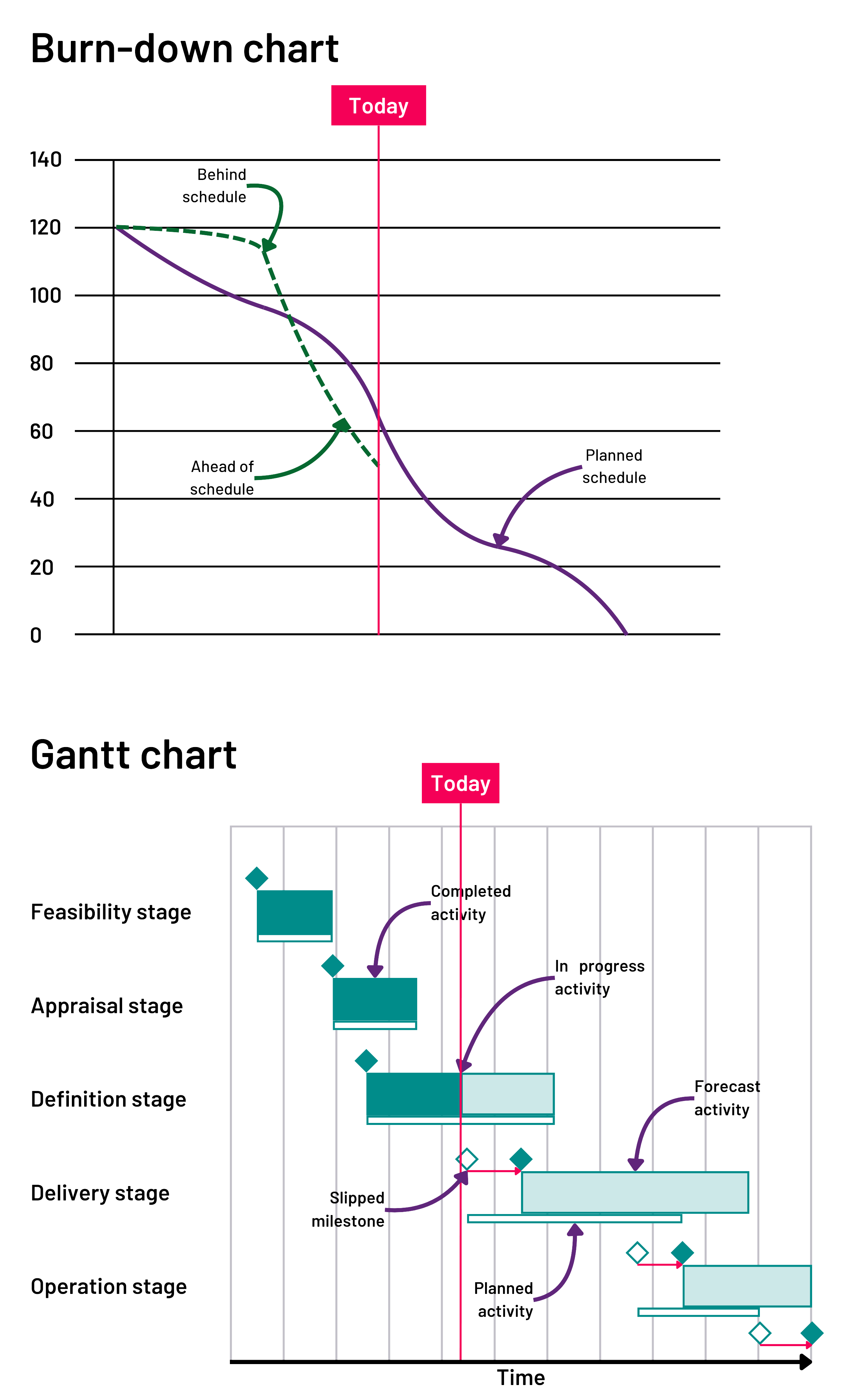
Graphical presentation, such as in Figure 17.3 is a good way to show trends. Figure 17.4 shows more examples relating to schedule. The burn-down chart is often used, notably in software development to track how many function points are left to be completed as opposed to the number which were planned to have been completed at a point in time. The units can be for any measure, such as miles of fibre rollout, volume of concrete, percentage of activities digitised or user satisfaction. The Gantt chart shows milestones and activities plotted against time. In this case a comparison between the planned dates and actual/forecast dates is immediately apparent. This example shows the gates and stage in the reference project life cycle but can be used at any level of detail in the project delivery work breakdown hierarchy, from portfolio to activity within a work package.
Figure 17.3 An example of earned value management used on a project
Figure 17.4 An example of graphical representations
Further information on methods to support assessment and analysis is provided in guidance for infrastructure projects on earned value management and project control.
17.6.1.7 Verifying the information
Check. Does the information presented make sense? Has it changed since the last report? When was it actually updated? Don’t just rely on the formal information channels. Talk to people, listen to people. Gauge whether what they say really reflects what is being reported. Look at physical progress to see if it reflects the information provided. Be visible and available for people to talk to informally; don’t wait for them to come to you.
17.6.2 Preparing to control the work
17.6.2.1 Define the control framework
Before starting to control the work, it is important to define the approach to be used. This should match the nature, scale and complexity of the portfolio, programme or project, and the expected delivery approach.
Controlling in government should also take account of central government and organisational requirements, particularly in relation to spending reviews, annual business planning, and department-specific HM Treasury delegated limits, and with the wider approach to functional controls set out in the department’s memorandum of understanding with HM Treasury.The Green Book (requires sign in) and its supporting guidance set out requirements for investment appraisal and business case development which apply to all programmes and projects involving central government expenditure.
In defining the approach to controlling, it is also important to consider how control is organised: what activities are needed and when, who carries them out, and how the outputs of these activities and other control products are to be structured, managed and stored (see 17.6.2 on preparing to control the work for more detail).
17.6.2.2 Determine what needs to be controlled
Not everything needs to be fully controlled, all the time. Decide, based on the current life cycle phase, type of activities being worked on and the prevailing risks, what needs to be controlled and therefore the information that needs to be gathered. This can change through the life cycle. For example, in a programme or project requirements are likely to be more prominent at the start but activities in later phases, such as data migration or embedding organisational changes, would not need monitoring until later. The control information should result directly from doing the work wherever possible, as this improves accuracy and reduces additional work for the team. Do not collect information on the basis that it might be useful; focus on information that is known to be useful.
17.6.2.3 Understand who needs the control information and why
Information provided by work package managers needs to be collated at project level by the project manager and passed up the project delivery hierarchy to programme, portfolio and up to organisational levels. It is therefore necessary to understand not only the issues facing those providing the information needed for effective control at one level in the hierarchy, but also what information the managers need at the higher levels.
17.6.2.4 Decide what measurement units to use
Having understood who needs information and why, choose the appropriate units for measuring the progress and status of the work. Make sure the units are explicit. For example, costs measured as cashflow are different to those measured for statutory financial reporting. The units should relate directly to the work where possible. However, proxy measures might need to be used if direct measures cost too much, take too long to collect, or are burdensome. Timely information is necessary if prompt action is to be taken. Tracking measures should be the same as used for planning to ensure they are comparable. Take care not to choose measures to micro-manage the lower-level managers; this can be demotivating and lead to management burn-out.
17.6.2.5 Determine the frequency of the control cycle
Having understood what needs controlling, determine how frequently the progress and status information needs to be collected for analysis. Continuous? Daily? Weekly? This can change through the life cycle of the work as well as by component in the project delivery hierarchy (see 17.6.1.5 on choosing an appropriate control cycle and Figure 17.2). For portfolios, the information needed, and frequency is likely to be more stable as it is drawing on information from its work components. It is also more likely to be based on financial years rather than the life cycle, as in the case of a programme or project.
17.6.2.6 Decide how to present the progress and status data
It is important to spot variances from the plan and deviations from expected performance early so that corrective or preventative action can be taken. Choose the way progress and status information is presented which makes it easy to identify the problem areas. Often the same presentation can be used for both monitoring and reporting, although monitoring data can sometimes need simplifying for reporting purposes.
17.6.3 Key activities in controlling the work
The activities for controlling are summarised in Figure 17.5. These are iterative, with similar activities repeated through the project delivery hierarchy, and can be applied to every practice in The Teal Book.
Figure 17.5 An overview of the key controlling activities and their primary relationships
17.6.3.2 Develop and maintain the control framework
The approach to controlling the work should be defined including any processes, methods, tools and techniques to be used. This forms part of the overall governance and management framework for the work (see Chapter 4: Governance and management). The important aspects of this activity are discussed in section 17.6.2 on preparing to control the work.
The framework should be maintained to address relevant feedback from its use. It is not important whether the higher-level controlling manager or the controlling manager develops the framework as long as the arrangements are appropriate and proportionate to the work being undertaken.
17.6.3.3 Oversee controlling
The higher-level controlling manager should ensure they are receiving the information they need, whether informally, as reports or by drawing them off management information systems when needed. They are likely to be dealing with information relating to a large number of work components and should make sure that the information is consistent and usable. They should look for overall trends both with individual work components but also across work components,
It is essential to maintain an overall view of how effective the control activities are at reflecting the progress being made on the work.
17.6.3.4 Do the work
Work should be undertaken in accordance with the plans and using the delivery approaches and controls defined in the governance and management framework.
17.6.3.5 Track progress
The progress of the work should be tracked using the measures and frequencies prescribed in the control framework, ensuring that the information is timely and reflects observable progress where physically apparent. Information should be drawn on from each relevant Part E: Planning and control and Part F: Solution delivery practice and verified to ensure it is sufficient for a reliable view to be taken regarding the current status of the work.
17.6.3.6 Assess and analyse status
The status of the work should be assessed and analysed, using the defined approaches. Material variances and deviations, and inconsistencies in information should be noted together with understanding the reasons for them, for example using root cause analysis techniques. Update the risk and issue register, as necessary. This information can be used to populate formal reports (see Chapter 18: Reporting). The Magenta Book (requires sign in), the Government Functional Standard for Analysis and the Aqua Book (requires sign in) include, or refer to, a range of analysis methods for different situations.
17.6.3.7 Take action
After gaining an understanding of the situation, decide what action, if any, needs to be taken. This can include responding to a risk or issue or submitting a change request. Informal actions can also be taken and noted, say on an action list for the work component.
17.6.3.8 Close the control framework
Once the control framework is no longer needed it should be closed. For a portfolio, this is unlikely unless the portfolio ceases to service its purpose. Closure of the framework can be progressive throughout a programme or project as each work component comes to an end.
Added definitions of ‘control’ and ‘tolerance’ from the Project delivery glossary. Updated the key points in section 17.2. Added information about HM Treasury delegated limits and departmental memoranda of understanding in section 17.6.2.1. Removed two further reading references: the Infrastructure and Projects Authority guides on project controls and earned value management.