We use some essential cookies to make this website work.
We'd like to set additional cookies to understand how you use the Government Project Delivery website, remember your settings and improve government services.
The purpose of governance and management is to define how project delivery is to be overseen, directed and managed. It includes activities such as prioritising, authorising, directing, overseeing, decision making, planning, leading, assuring and reviewing performance, in pursuit of government policy.
4.2 Key points
Governance and management frameworks define how work is to be done.
The governance of project delivery should align to that of the sponsoring organisation.
Governance is more than a structure or process as it includes roles and behaviours.
A portfolio is governed through its portfolio plan.
Programmes and projects are governed through a business case.
4.3 Why have governance and management?
Effective governance and management ensure that project delivery is aligned to policy and strategy, is delivered effectively, remains viable and is controlled. If the governance of project delivery is not integrated with the governance of the wider organisation, the portfolio, programme or project can become disconnected from the ultimate decision makers whose objectives the work should be delivering. In particular, effective governance and management brings:
greater impact, aligning programmes and projects with strategic goals maximises desired outcomes
assured viability, assuring the sponsoring organisation’s leadership that the programme or project remains viable and highly likely to achieve the desired outcomes and realise the required benefits and objectives
enhanced stakeholder confidence, transparency and accountability inspire trust and buy-in
reduced risk, strong governance identifies and mitigates potential pitfalls before they impact progress
increased effectiveness, streamlined decision-making and clear roles prevent confusion and delays
improved resource utilisation, optimised allocation ensures resources are used efficiently
4.4 What is governance and management?
4.4.1 Overview
Governance and management play related but distinct roles in organisations, portfolios, programmes and projects.
Governance defines relationships and the distribution of rights and responsibilities among those who work with and in the organisation. It determines the rules and procedures through which the organisation’s objectives are set, and provides the means of attaining those objectives and monitoring performance. Importantly, it defines where accountability lies throughout the organisation.
In project delivery, governance includes prioritising, authorising, directing, empowering and overseeing management, and assuring and reviewing performance.
Management is focused on the day-to-day work. This includes planning and resource allocation, team leadership, monitoring performance and progress, and addressing risks, issues and change requests.
As governance bodies can delegate to those undertaking management activities, and management can refer to governance bodies, the boundary between the 2 concepts is not always clear. As such it is important to design both together, ensuring that they work together. This is why, in The Teal Book, they are often considered together as ‘governance and management’.
4.4.2 Governance and management in government
Governance in government takes place within the UK’s system of parliamentary accountability.
The minister in charge of a government department is responsible and answerable to Parliament for the exercise of the powers on which the administration of that department depends. He or she has a duty to Parliament to account, and to be held to account, for all the policies, decisions and actions of the department, including its arm’s-length bodies.
The departmental accounting officer is personally responsible and accountable to Parliament for the organisation and quality of management in the department, including its use of public money and stewardship of its assets, as set out in Managing public money. More on the role of the accounting officer is set out in Chapter 29: Finance.
Managing public money requires every public sector organisation to establish governance arrangements appropriate to its business, scale and culture. The structure should combine efficient decision-making with accountability and transparency. Central government departments should be guided by the Corporate governance code for central government departments, and arm’s length bodies are encouraged to adopt similar principles.
Governance and management of the organisation and its resources – finances, assets, people – take place within this accountability framework. The role of the accounting officer is to ensure the effective implementation of government policies and delivery of public services within the resources granted by Parliament, in line with Managing public money. In doing so, they should also act at all times in compliance with government functional standards, The Civil Service code and the Parliamentary and Health Service Ombudsman’s Principles of good administration.
Programmes and projects in the Government Major Projects Portfolio are subject to particular governance, assurance and approval arrangements, set out in Part D: Managing programmes and projects.
4.4.3 Governance and management in project delivery
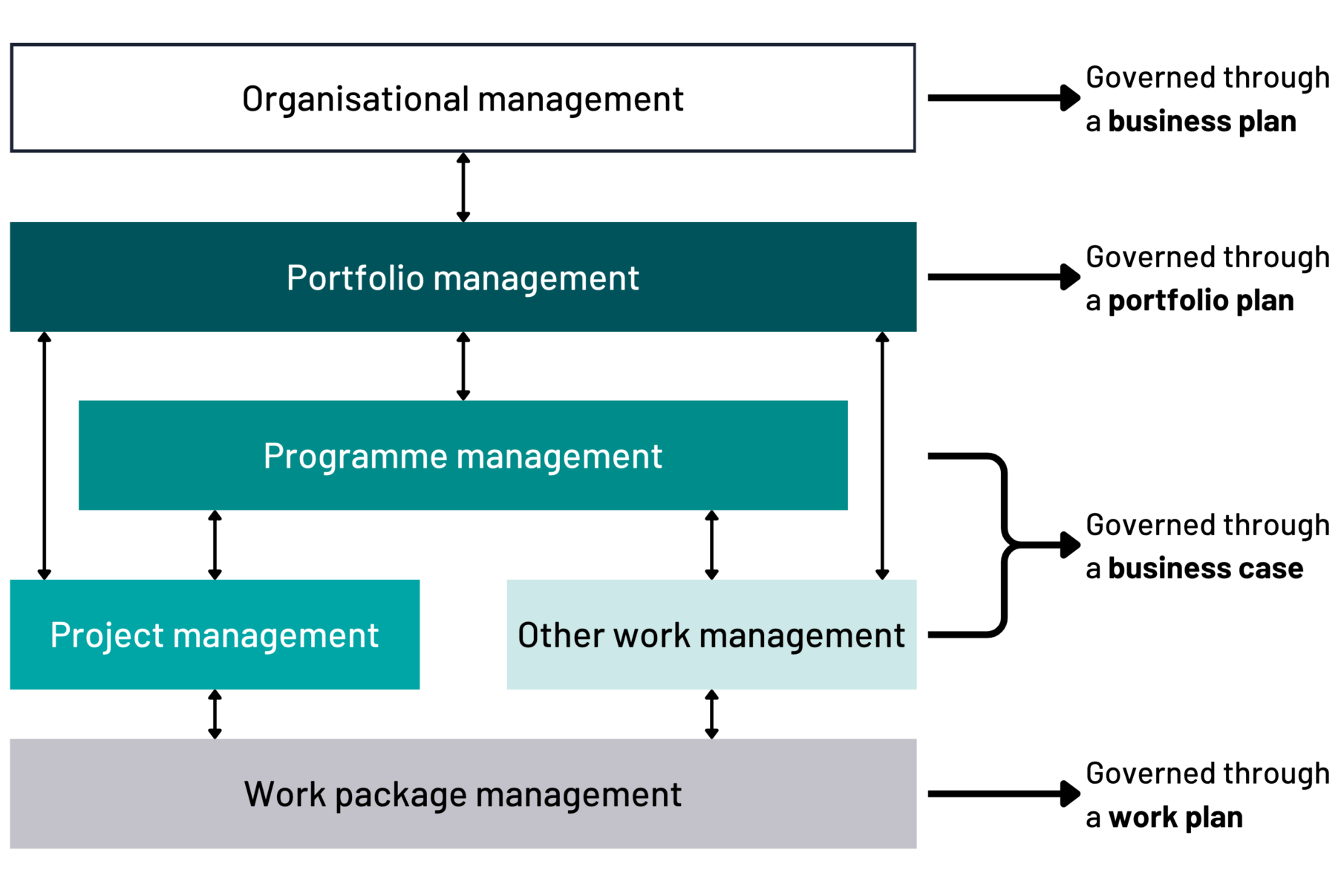
Project delivery should be an integrated part of the overall governance for the organisation and not treated separately. The functional standard for project delivery sets the requirements for this governance and management, providing a consistent baseline for how portfolios, programmes and projects are directed, controlled and assured across the organisation. A way of achieving this is for governance always to be undertaken within the context of a higher-level organisation and its governance (see Figure 4.1), for example:
a project’s governance should operate within the context of the governance of the programme it is part of (or portfolio, if standalone)
a programme’s governance should operate within the context of the governance of the portfolio it is part of
a portfolio’s governance should operate within the governance of the organisation’s project delivery function
Figure 4.1 Accountability follows a hierarchy, with portfolios governed through portfolio plans, programmes and projects through business cases and work packages through work plans
Figure 4.1 illustrates how accountability flows through the governance hierarchy. To support consistent application of the functional standard across this hierarchy, organisations can use the Continuous improvement assessment framework for project delivery (see 9.4.8 on using the continuous improvement assessment framework) to assess current practice, identify areas of misalignment, and prioritise improvements to governance and management arrangements.
Governance is often misunderstood or equated with bureaucracy. The characteristics of effective governance, described in Table 4.1, are as much about behaviours and attitudes and need to work together.
These characteristics also help show that governance:
is not a structure, although structure is a vital element
is not a process, although processes are a vital element
is not just about decision-making, although decision-making is a vital activity
Taken together, these characteristics emphasise that effective governance depends on capable behaviours as well as proportionate structures and processes.
Setting the vision, values and objectives which are compelling, realistic and take a long-term view of achieving the government’s or organisation’s objectives.
Knowledge
Understanding the business of the organisation or the policy intent of government and the political, economic, social and technological context they operate within.
Behaviour
Promoting desired behaviours in terms of culture, ethics, reputation and integrity.
Process
Enabling the right level of control, delegation, operational efficiency and effectiveness.
Structure
Having the right tiers, lines of accountability and appropriate structures for decision-making.
4.5 Who is involved in governance and management?
The accounting officer is ultimately responsible to their minister and Parliament for project delivery in their organisation. In government departments and their arm’s length bodies, the accounting officer may delegate the responsibility for the management of project delivery to a senior officer (see About the function and profession). This role is usually called the chief project delivery officer. However, everyone involved in the delivery of a portfolio, programme or project has a part to play in ensuring that work is effectively governed and managed.
For a portfolio, a portfolio director, supported by a board and portfolio manager, is accountable for the direction and governance of the portfolio, for optimising the required benefits at an acceptable level of risk, and who owns the portfolio’s vision and strategy. See Part C for a fuller description of roles.
For a programme or project, a senior responsible owner, supported by a board and programme or project manager, is accountable for a programme or project meeting its objectives, delivering the required outcomes and realising the required benefits. The senior responsible owner owns the business case, is the primary risk taker and is accountable for governance. See Part D for a fuller list and description of roles.
4.6 Key aspects of governance and management
4.6.1 Overview
Every chapter in The Teal Book is a part of and relevant to the governance and management of project delivery. Part C: Managing portfolios describes the governance and management of portfolios in more detail and Part D: Management programmes and projects does the same for programmes and projects. However, 5 aspects are particularly relevant to all of project delivery and so are described here:
the governance and management framework
business cases, portfolio plans and work plans
decision-making
assurance
behaviour and leadership
4.6.2 The governance and management framework
4.6.2.1 The purpose of a governance and management framework
The Government Functional Standard for Project Delivery requires portfolios, programmes and projects and the project delivery function overall to have a defined governance and management framework. These frameworks should be integrated and should align to and work with the organisation’s framework for governance and management.
4.6.2.2 Why is a governance and management framework needed?
A well-defined governance and management framework provides consistency in the way work is done which in turn provides assurance that the work is done properly with the aim of avoiding problems and errors (see 4.6.5 for assurance). Further, a consistent approach provides clarity on governance and management arrangements for the work and is the basis for improving working methods.
4.6.2.3 What is a governance and management framework?
A governance and management framework sets out the authority limits, decision-making roles and rules, degrees of autonomy, assurance needs, reporting structure, accountabilities and roles, together with the appropriate management practices and associated documentation needed to meet this standard.
As work progresses and more information becomes available, the approaches adopted might need to change. It is important that the governance and management framework is maintained and updated as work proceeds to reflect the phase of the work, changes and improvements from any lessons learned from using it (see Chapter 38: Learning from experience).
4.6.2.4 Who is responsible for a governance and management framework?
While the portfolio director and senior responsible owner have accountability for ensuring an effective governance and management framework is in place, the responsibility for defining, establishing and maintaining of the framework lies with:
for a portfolio: the portfolio manager
for a programme or project: the programme or project manager
for a work package: the work package manager
4.6.2.5 What to consider when developing a governance and management framework
When defining the governance and management framework it is important to avoid it becoming a large and unwieldy set of documentation which is rarely used or updated. Organisations which have an enterprise level project delivery framework, such as a project management method can avoid this problem as each portfolio, programme or project manager needs only to cross reference and document what is different. This usually results in a much slimmer set of documentation which is more likely to be used in practice.
The larger the piece of work, the more data and information generated which needs to be stored and which can be retrieved reliably when required. Having a reliable approach for holding documentation is therefore essential to effective management. Simple projects can be managed in shared folders but anything larger is likely to need a formal document management tool. See Chapter 24: Information and data management for relevant information.
For all but the smallest pieces of work, specialist tools are often needed. Choosing which tools to use and to what extent they are used is an important decision when defining the governance and management framework.
Not every person working in the delivery of a programme or project is likely to be an experienced project delivery professional, and many will come from different professions. The governance and management framework has to be usable by the people involved in the work and designed accordingly. Work package managers need particular consideration, with induction and support provided if needed (see Chapter 39: Project delivery team induction and training).
4.6.3 Portfolio plans, business cases and work plans
4.6.3.1 The purpose of portfolio plans, business cases and work plans
The purpose of a portfolio plan, business case and work plan is to have a firm basis to justify undertaking the work and upon which to make decisions.
4.6.3.2 Why are portfolio plans, business cases and work plans needed?
Unless the work within a portfolio, programme or project is defined it is not possible to have any clarity on what is required nor to measure progress or performance. Further, there is no basis against which decisions can be made.
4.6.3.3 What is a portfolio plan, a business case and a work plan?
The Government Functional Standard for Project Delivery requires that work is governed through a defined and approved document. The type of document used and the approvals required depends on the type and scale of the work being delivered, as shown in Figure 4.1.
For portfolios, the work is governed through a portfolio plan in accordance with the Government Functional Standard for Project Delivery. A portfolio plan is a subset of an organisation’s business plan and sets out the portfolio’s goals, the approach for achieving them, resources needed, financial projections and risks. A portfolio plan is usually reassessed annually as part of organisational business planning, with quarterly reviews to assess progress and enable realignment if needed.
For programmes, projects and other related work, the work is governed through a business case or equivalent document (for example, a single justification case) in accordance with HM Treasury’s requirements as described in the Green Book and its accompanying guidance.
The justification for an organisational activity (strategic, programme, project or operational) which typically contains benefits, outcomes, timescales, costs and risks against which continuing viability is tested.
The business case justifies the expenditure over the life of the project or programme and should be used as the basis for planning, taking into account the full benefits stream and operational and disposal costs which result from using the solution (see Part F: Solution delivery). The business case should be reviewed and refreshed if needed before significant decision points (gates) in the life cycle of the work to verify the work is still justified.
For work packages, the work is governed by a work plan which defines the information to deliver a specified output or outcome. It generally includes the scope and the anticipated constraints such as time, cost and resources, together with the working methods to be used.
4.6.3.4 Who is responsible for portfolio plans, business cases and work plans?
Responsibility generally follows the project delivery hierarchy (see Figure 3.1):
the portfolio director owns the portfolio plan
the senior responsible owner owns the programme’s and/or project’s business case
the work package manager owns the work plan.
Each is accountable to the next higher level of authority in the project delivery hierarchy. Each document should be aligned with that above but usually includes more detail. It is not necessary for each level to have its own document if the content can adequately be covered in the higher-level document. For example, a project or other work within a programme may be covered under the programme’s business case and may not need to be justified separately.
4.6.3.5 What to consider when developing a portfolio plan, business case or work plan
The 5 case model is a framework for developing business cases. It covers the main considerations when preparing a programme or project business case but is also generally applicable for portfolio plans. These are summarised in Table 4.2.
Work plans should be concerned with the detailed definition of the work, the scope of the work and the constraints imposed on it such as the budget and deadlines.
Table 4.2 Primary considerations for portfolio plans and programme or project business cases
Portfolio plan
Programme or project business case
Mission, strategy and objectives
Provides strategic fit and is supported by a compelling case for change.
Public value and outcomes
Maximises public value to society through the selection of the optimal combination of components, products and related activities, focusing on options appraisal and the identification of the preferred option.
Supply and commercial approach
Is commercially viable and attractive to the supply side, focusing on the development and procurement of the potential solution or its parts.
Affordability
Is affordable and fundable over time, focusing on the whole-life costs of the proposed solution.
Deliverability and risk
Can be delivered successfully by the organisation and its partners, focusing on the implementation arrangements for the proposal.
4.6.4 Decision-making
4.6.4.1 The purpose of decision-making
The purpose of decision-making is to make effective decisions on future intent that are focused on the objectives, take account of risks and communicated to those with a need to know.
4.6.4.2 Why should some decision-making be formal?
While informality can foster nimble action and quick responses, certain situations demand the structure and accountability of formal decision-making. Formal processes bring clarity and focus. They ensure relevant information is gathered, diverse perspectives are considered, and established criteria guide the choice. This reduces bias, builds trust, and fosters transparency, especially when dealing with complex issues or decisions impacting large groups. Additionally, formal documentation acts as a record, to support future actions and decision-making and safeguarding against accusations of non-propriety or unfairness (see Chapter 24: Information and data management). While formality might seem cumbersome for minor choices, and should always be proportionate, it becomes essential for decisions with significant consequences, ensuring responsible, well-considered outcomes.
Decisions involve making choices, and there are several things that can help. Individually, mind maps can organise ideas and pros and cons lists can offer a balanced view of options. In group settings, brainstorming can generate possibilities, and scoring matrices can help weigh options against predefined criteria.
Decision trees map out potential consequences of each choice. A strength, weakness, opportunities and threats (SWOT) analysis examines internal strengths and weaknesses against external opportunities and threats. Stakeholder analysis identifies interested parties and their concerns, and techniques like using the 6 thinking hats encourage diverse perspectives.
When facing uncertainty, simulation modelling (such as the Monte Carlo technique) or scenario analysis can help investigate various outcomes, and pilots offer real-world validation before full commitment.
the government organisation’s own delegated authority limit and internal scheme of delegation and controls
4.6.4.5 What to consider when making decisions
In government, decisions on portfolio, programmes and projects should seek to optimise the social value produced through using public resources, taking account of the four standards of regularity, propriety, value for money and feasibility set out in Managing public money. All options, including ‘do nothing’, have inherent risks and these can be influential in choosing the course of action take.
Decisions do not have to be absolute but can be conditional or phased to manage risk. Some decisions can also be changed if more information becomes available; the phased approach to managing work facilitates this. The phased approach to programmes and projects described in Chapter 14 is a primary way of managing risk.
Decisions relating to project delivery should be made in a way that is timely, communicated and in consultation with stakeholders and subject matter experts. Decisions should be made by assessing options against defined criteria, in accordance with the Green Book (requires sign in)and the Government Functional Standard for Analysis.
Effective systems and processes need to be in place to support formal decision-making so that there is an efficient flow of information to the decision makers. This does not mean setting up any separate processes, but ensuring that information, data, reporting and communication are built into the working approaches for managing project delivery. It should be determined who can make a decision when there is a conflict of priority or other need for escalation.
It is important that everyone understands the decision that has been made and so it should be noted that the meaning of approval and authorisation are different:
Approval indicates that a deliverable is acceptable to the decision makers.
Authorisation gives an individual or group the authority and permission to do something, typically with defined constraints or conditions attached.
An example of this is the approval of a project plan; this simply means that the plan presented is acceptable but on its own does not give any authority to proceed. Authorisation would also be needed to proceed with any work. Being clear and deliberate with the use of language when making decisions will help stop confusion.
Similarly, agreement means that 2 or more parties have come to a consensus on a topic. It neither implies approval nor authorisation.
4.6.5 Assurance
4.6.5.1 The purpose of assurance
The purpose of assurance is to provide, through a systematic set of actions, confidence to senior leaders and stakeholders. This confidence comes from providing evidence that work is controlled and supports the safe and successful delivery of policy, strategy and objectives.
Senior leaders cannot see and check everything for themselves and yet are accountable for the delivery of their assigned objectives, often overseeing hundreds, if not thousands of people. Assurance is about providing those leaders with the confidence that the right objectives are being addressed, work is proceeding according to plan and their objectives are highly likely to be achieved. This can be achieved through:
employing skilled and experienced people
using trusted processes and methods with the right level of scrutiny, challenge, verification, and validation
A general term for the confidence that can be derived from objective information over the successful conduct of activities, the efficient and effective design and operation of internal control, compliance with internal and external requirements, and the production of insightful and credible information to support decision-making. Confidence diminishes when there are uncertainties around the integrity of information or of underlying processes.
Organisations should have a defined and established approach to the assurance of project delivery, integrated with their overall organisational assurance framework as described in the Orange Book (requires sign in). Typically, assurance should be on at least 3, and sometimes 4 or more, separate levels.
How this works varies according to the context and organisation, in project delivery, an example of this could be:
first line assurance by or on behalf of managers who own and manage the risks directly, for example the programme or project manager, to provide assurance to the senior responsible owner that the appropriate standards and practices are being met
second line assurance by or on behalf of the sponsoring organisation, for example led by the central portfolio, commercial, digital or finance function, to provide assurance to the accounting officer that the first line assurance is properly designed, in place and operating as intended
third line assurance, by a body external to the organisation, for example the National Infrastructure and Service Transformation Authority on behalf of HM Treasury, or another regulatory body, to provide the government with an objective opinion on the effectiveness of the first and/or second line assurance
fourth line assurance, by a body external to the organisation, for example the National Audit Office, on behalf of Parliament to provide an objective opinion on the effectiveness of organisational or systemic governance, risk management and controls
This model helps delegation and coordination of assurance roles, responsibilities and activities within and across organisations. The accounting officer, their board and senior leadership are not considered lines of assurance as they are the primary stakeholders the model serves, seeking rather than providing assurance.
The level of assurance is always relative to those being assured. In project delivery, the portfolio director and the senior responsible owner are the ones seeking assurance. They in turn have to assure the sponsoring organisation, which form an additional line above that of the portfolio, programme or project’s leadership team.
The hierarchy of the portfolio, programme and project can also create additional, lower-level lines. For example, an assurance manager in a programme could cover all the work within it, or a large project within the programme might have its own quality assurance team. This depends on the extent of delegation within the hierarchy (see Figure 3.1).
the accounting officer, supported by their board and audit and risk assurance committee at an organisation level
the portfolio director at portfolio level
the senior responsible owner at programme or project level
Under the assurance model, the first 2 levels are covered by the design and use of the governance and management framework; everyone involved in the portfolio, programme or project has some part to play. The third and fourth levels can be undertaken by bodies which are internal or external to government such as:
the National Infrastructure and Service Transformation Authority
inspection bodies
the Government Internal Audit Agency
the National Audit Office
4.6.5.5 What to consider when planning for assurance
The prime consideration, as with all aspects of managing project delivery, is that the level of assurance needs to be appropriate to the nature and complexity of the work being undertaken and proportionate to the level of risk exposure.
Verification and validation are important aspects of assurance and often incorporate reviews (see Chapter 34: Verification and validation). These reviews can take many different forms depending on the context of the work and can include:
peer review of deliverables
technical assurance from, for example, parts of the solution selected and built
point-in-time assurance reviews of a portfolio, programme or project
internal or external audits
Assurance reviews usually add significant value but can be disruptive if not planned well. They need to be scheduled to inform major decisions and aligned with any planned evaluation (see Chapter 2: Policy and evaluation). Assurance reviews typically include a period of desk research, as well as follow up interviews and meetings. If the management records and documentation are not kept up to date, they can generate more questions, taking up more management time and reducing the value of a time-bound review.
4.6.6 Behaviour and leadership
The governance of portfolios, programmes and projects, and their delivery overall, involves the coming together of a team of people who have different interests, styles and ways of working. However, for the governance of project delivery to be effective, people need to genuinely demonstrate the right behaviours. No matter how good the processes, methods and tools are, poor behaviours are likely to threaten morale and the success of the work.
Project Delivery Capability Framework includes a set of 10 behavioural and leadership competencies which are aligned to Civil Service behaviours. These are shown in Table 4.3.
Table 4.3 The behavioural and leadership competencies from the Project delivery capability framework
Behavioural or leadership competence
Description
Related Civil Service behaviours
Visible leadership
The ability to engage, motivate and coach others. Acts as a role model and inspires and empowers others.
Leadership
Credible action
The ability to promote the wider public good in all actions and to act in a morally, legally and socially appropriate manner at all times. Challenges unacceptable behaviour.
Leadership
Working with ambiguity
The ability to work in an environment of uncertainty and continual change. Feels comfortable making decisions and setting direction without having the full picture, and refocuses as details emerge. Applies knowledge and techniques to reduce ambiguity.
Making effective decisions
Collaboration
The ability to establish and develop productive relationships with internal and external stakeholders, bringing people together to benefit the project.
Working together
Influencing
The ability to influence, change and impact decisions with both internal and external stakeholders.
Communicating and influencing
Conflict resolution
The ability to recognise, anticipate and effectively deal with existing or potential conflicts at an individual, team or strategic level.
Working together
Leadership
Inspiring others
The ability to create and present a compelling vision and set clear direction that motivates others to work towards a common goal.
Leadership
Resilience
The ability to adapt to changing circumstances and adverse situations whilst remaining calm, reassuring others and maintaining performance.
Delivering at pace
Innovation
The ability to think of, research and apply new ideas and ways of doing things. Encourages and supports innovation from others, is willing to experiment and follows ideas through to implementation.
Changing and improving
Culture change
The ability to plan, lead and effect positive cultural change, securing commitment and buy‑in and promoting a positive long‑term vision. Recognises when broader cultural change is necessary to deliver a project.
Seeing the big picture
Changing and improving
4.6.7 Other aspects to consider
The above topics are the primary aspects for governance and management. How a governance and management framework is designed, however, can be influenced by and needs to take account of many other aspects.
4.6.7.1 Roles
Ensure people know what they are accountable for and to whom they are accountable. The work breakdown structure normally defines the reporting line and so is fundamental to accountability and decision-making. The governance and management framework should explain the roles, and who is responsible, accountable, or to be consulted or informed in decision-making, usually in a table known as a responsible, accountable, consulted, informed (RACI) matrix.
Ensure the work achieves the quality of outputs and outcomes needed and that the specified quality meets the stakeholders’ needs (see Chapter 30: Quality management).
4.6.7.3 Contracts with suppliers
Ensure suppliers know and meet their obligations and that the government does the same, knowing explicitly who is accountable for each contractual obligation and formal approval required (see Chapter 25: Procurement and contract management).
4.6.7.4 Meetings
Define who the core members and other attendees are, their terms of reference and what authority they have as individuals and as a group.
4.6.7.5 Codes of conduct and ethics
The Government Functional Standard for Project Delivery requires that all public service codes of conduct and ethics are upheld, including those from associated professions. As project delivery is multidisciplinary, consideration should also be given to those working on portfolio, programme or project teams from other government professions, not just the project delivery profession
Added a formal definition of governance from the Project Delivery Glossary, a formal definition of a governance and management framework from the Project Delivery Glossary, a formal definition of a business case from the Project Delivery Glossary, and a formal definition of assurance from the Project Delivery Glossary. Updated the description of the Continuous Improvement Assessment Framework and added references to its use in assessing governance practice. Updated the section on who is responsible for decision-making to reference the Treasury approvals process for projects and programmes. Updated the further reading list to include Managing public money, the Treasury approvals process for projects and programmes, the Civil Service code, Success profiles: Civil Service behaviours, and the Green Book: UK government guidance on assurance. Removed the reference to ‘Projects in the Government Major Projects Portfolio’ and replaced it with ‘Programmes and projects in the Government Major Projects Portfolio’. Updated the description of the Senior Responsible Owner’s role in section 4.4 to remove the description of their programme or project responsibilities.