Portfolio, programme and project management is an integrated way of meeting the government’s policy ambitions, driving better decisions and increasing the likelihood of successful outcomes.
Previous
Chapter 2: Policy and evaluationThe Teal Book: Part A

Orders are open until 31 December 2026.
Portfolio, programme and project management is an integrated way of meeting the government’s policy ambitions, driving better decisions and increasing the likelihood of successful outcomes.
The Project delivery glossary defines project delivery as:
Collectively, portfolio, programme and project management are referred to in government as project delivery.
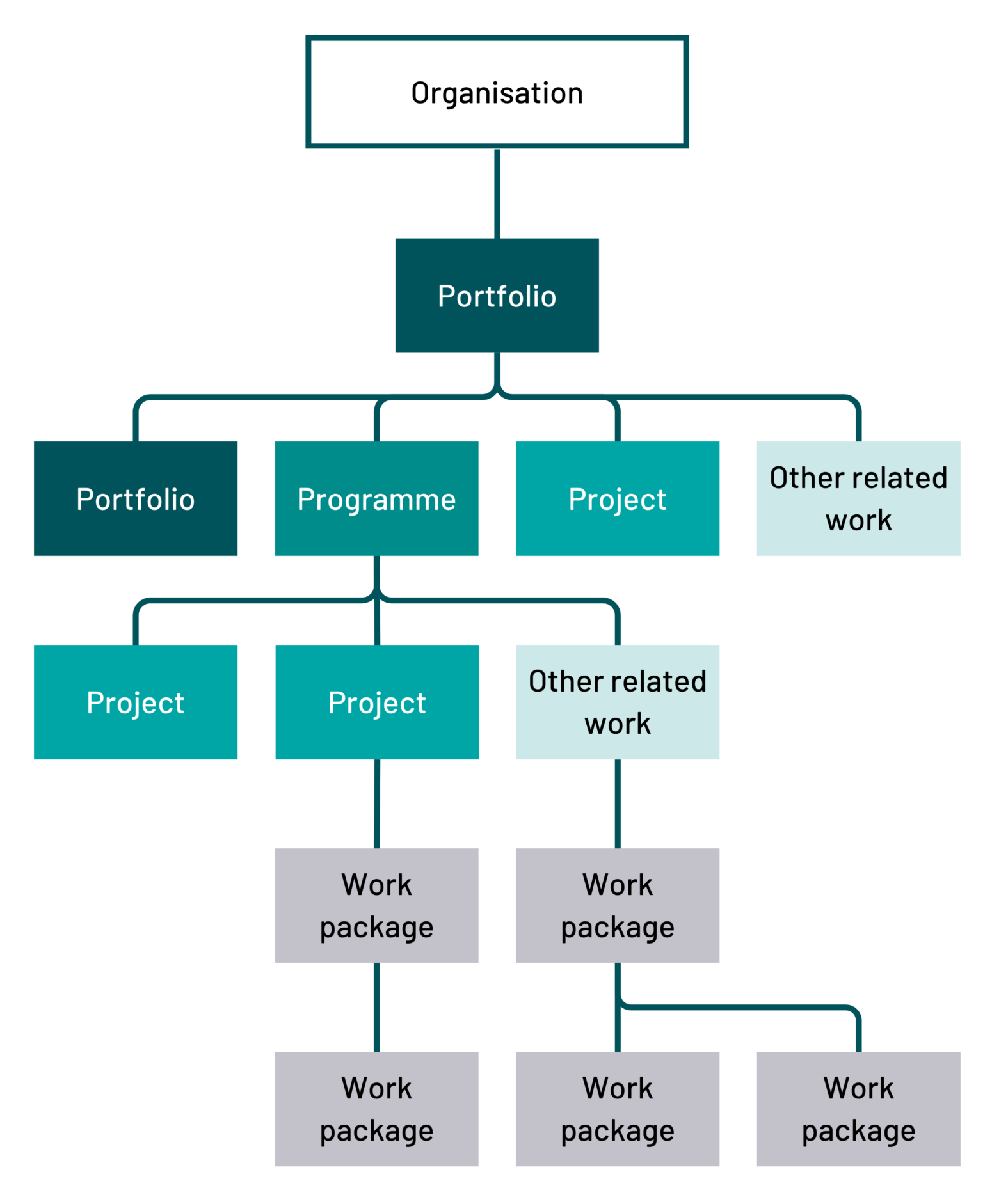
When starting to understand what project delivery in government involves, it is essential to recognise what distinguishes a portfolio from a programme from a project and how this influences how they are managed. There is a relationship between these work components in the project delivery hierarchy, as shown in Figure 3.1, where each component comprises all of the connected lower-level work components.
The Project delivery glossary defines a portfolio as:
Part or all of an organisation’s investment required to achieve its objectives.
Governed through its portfolio plan, a portfolio comprises work components, such as other portfolios, programmes, projects and other related work. A portfolio can represent the entirety of the organisation’s investment. In larger organisations or those with multiple, distinct objectives, the organisation can choose to have a number of portfolios, each targeted at their respective objectives. A portfolio is managed on a continuous basis with no defined end point and is usually funded through annual budgets.
When used to its full extent, a portfolio provides a broad, enterprise-wide view as it includes not only the change initiatives (programmes and projects) but also improvement initiatives not managed as projects, and business-as-usual. Benefits from change initiatives usually start towards the end of a project, while in a portfolio new benefits start to be realised as soon as the first programme or project within the portfolio puts its outputs to use.
The focus for portfolio management is ensuring that all activities including the programmes, projects and other related work deliver the desired outcomes and overall benefit, regardless of how individual components perform. By having a holistic portfolio, change initiatives and business-as-usual can be managed together so a shortfall in one can be compensated by making changes in the other. Portfolios, by their nature, are often open-ended and evolve over time.
A portfolio director is accountable for the direction and governance of the portfolio. This includes optimising the required benefits at an acceptable level of risk and owning the portfolio’s vision and strategy. The portfolio manager is accountable to the portfolio director for day-to-day management. The portfolio director and portfolio manager are usually supported by a board or management team.
Chapter 4 looks at governance in more detail and Part C looks at portfolio management in particular.
The Project delivery glossary defines a programme as:
A programme is a unique, temporary, flexible organisation created to co-ordinate, direct and oversee the implementation of a set of projects and other related work to deliver outcomes and benefits related to a set of strategic objectives.
Programmes usually have a life that spans several years and can be undertaken in one or more tranches, each of which is usually structured around distinct step changes in the solution being delivered and the benefits being realised.
The Project delivery glossary defines a project as:
A project is a unique, temporary management environment, undertaken in stages, created for the purpose of delivering one or more business objectives.
As Figure 3.1 shows, projects can be standalone within a portfolio or part of a programme. Projects are undertaken in stages which are preceded by a gate (a decision point) to authorise the start of the next stage and commit resources and funding.
In government, projects, as well as programmes, can deliver outcomes and realise benefits, not just outputs. Outcomes are what make the difference, whether for organisational or societal change and so as a result a project should not be considered complete until an outcome has been achieved. That means that a project should ensure enough change has happened and enough benefits have started to flow to know that the objectives are likely to be met before a project is closed. This is built into the reference project life cycle (see Chapter 14: Programme and project life cycles).
A senior responsible owner is accountable for a programme or project meeting its objectives, delivering the required outcomes and realising its benefits. The senior responsible owner owns the business case, is the primary risk taker and is accountable for governance. A programme or project manager (usually known as a programme or project director for those in the Government Major Projects Portfolio) is accountable to the senior responsible owner for day-to-day management. The senior responsible owner and programme or project manager may be supported by a board or management team.
Chapter 4 looks at governance in more detail and Part D at programme and project management in particular.
The Project delivery glossary defines other related work as:
In the context of project delivery, other related work comprises work within a portfolio or a programme which is not managed as a project.
Other related work includes:
The management of other related work is addressed in Part D.
Projects and other related work in a programme comprise work packages.
The Project delivery glossary defines a work package as:
A group of related activities that have a defined scope, deliverable, timescale and cost, contributing to the required outputs and outcomes.
A work package represents the most granular level of work, where the activities that directly produce outputs and deliverables take place.
Figure 3.1 shows the hierarchical relationship between work components, with each higher-level component comprising the sum of all connected lower-level components. In this way every work package should be traceable to the project or programme it is a part of. A work package cannot be ‘shared’ between different projects. If 2 projects are relying on the outputs, the work package should be managed in one and treated as an interdependency which the other relies on.
The management of work packages is addressed in Part D.
The terms portfolio, programme and project, as described in this chapter, are used as the basis for the rest of The Teal Book. While it is important that government develops and maintains a common understanding of project delivery, it is also important to understand that these definitions describe the characteristics of each management structure, not a set of rules that must be followed. It is the nature, or characteristics, of what is to be delivered that should drive the choice of how to structure the work.
Frequently, whether something is a portfolio, programme or project is obvious but there are also times when it is not clear (see Figure 3.2). It is these situations that can cause people a lot of difficulty and this is usually driven by starting at the definitions first.
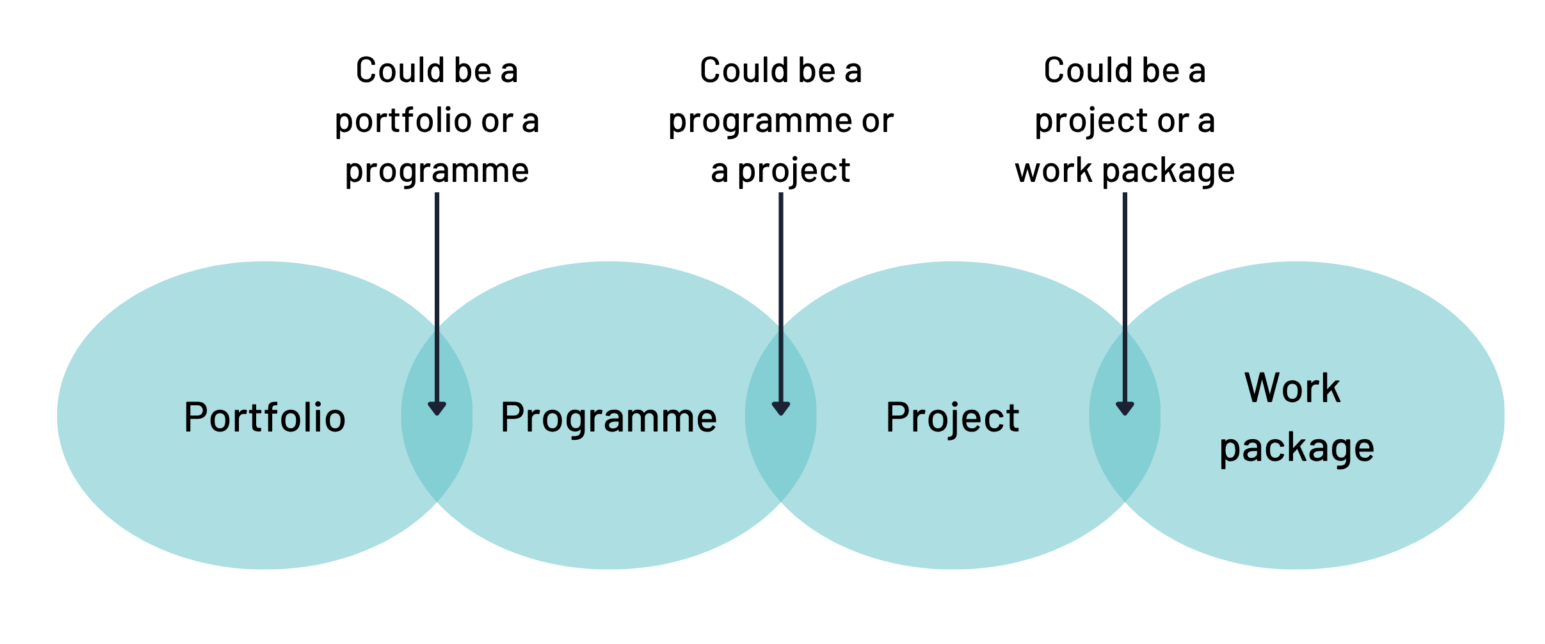
Instead, it is important that the context and work needed is explored first and to use this to decide the most appropriate management approach to apply. This helps to stop the mindset of thinking in terms of whether something is a portfolio, programme or project and instead to start thinking in terms of whether something is best managed as a portfolio, programme or project.
A good starting point to help understand how best the work should be managed is to develop the life cycle which draws out the phasing, assurance reviews and decision points needed (see Chapter 4: Governance and management). It is also important to respect the project delivery hierarchy in Figure 3.1. The question is not simply whether it should be a portfolio or a programme, a programme or a project, or a project or a work package, as in government:
When determining the management structure for the work, it should be remembered that there are clear differences between how portfolios, programmes and projects are managed. Designating something as a programme, for example, means that it should be managed as a programme with all that entails.
The title given to the work should clarify whether it is being managed as a portfolio, programme or project. However, this is not always a reliable way of identifying how something is being managed. Similarly, how a supplier chooses to manage their work could be different to how government manages it; they are working to different objectives and have different viewpoints. Finally, an initiative could start off as a project and, later, a decision could be taken to manage it as a programme, for example because further projects or work packages have been added.
Updated definitions for portfolio, programme, project, other related work and work package to reference the Project delivery glossary, and updated the definition of a project to refer to ‘business objectives’ rather than ‘business products or outcomes’. Updated the definition of a work package to describe it as ‘a group of related activities that have a defined scope, deliverable, timescale and cost’. Updated the further reading reference from ‘The Green Book: appraisal and evaluation in central government’ to ‘Green Book: UK government guidance on appraisal’.
Page permissions updated for public launch.
First published for closed beta consultation.