Beta

This is a new service and pages are being tested and improved.

Overview

Benefits are positive, measurable impacts of change seen by stakeholders. In government, the improvements delivered by a portfolio, programme or project are expressed in terms of benefits. Government policies aim to improve lives, through public services, economic growth, social change or international work. The overall impact of these changes is known as social or public value, as set out in the Green Book.

Most policies are delivered through portfolios, programmes and projects. Their success depends on identifying, planning and realising benefits.

Thinking about benefits should start with policy development and continue through delivery and evaluation. If a change has no clear benefits, it should not normally go ahead.

What benefits management does

Benefits management links objectives, outcomes and benefits. It helps:

  • decide whether to invest public money
  • plan, manage and track delivery
  • evaluate success

It’s essential for business cases, investment decisions and measuring long-term value.

Managing benefits in government can be complex. It needs clear ownership, good data and a system-wide view. It’s not just about justifying investment — it’s about making sure change delivers real, lasting value.

Managing benefits ensures that they are clearly identified, planned and realised throughout the work to deliver the changes and in operations. It plays a key role, therefore, in achieving government objectives and value from change.

Why benefits management matters in government policies are designed to deliver change for the public good. These can impact:

  • directly, for example through public services
  • indirectly, through wider social, economic or environmental changes, or through international work which contributes to growth, stability and security

The impacts of such changes are understood in terms of their public value, or social value, as set out in The Green Book (requires sign in).

Most government policies and changes are delivered in practice through projects, programmes and/or portfolios. The measurable positive impacts they have are known as benefits. Benefits management is therefore a critical discipline for portfolios, programmes, and projects and is central to their success.

Why benefits management matters

In government policies are designed to deliver change for the public good. These can impact:

  • directly, for example through public services
  • indirectly, through wider social, economic or environmental changes, or through international work which contributes to growth, stability and security

The impacts of such changes are understood in terms of their public value, or social value, as set out in The Green Book.

Most government policies and changes are delivered in practice through projects, programmes and/or portfolios. The measurable positive impacts they have are known as benefits. Benefits management is therefore a critical discipline for portfolios, programmes, and projects and is central to their success.

When to use benefits management in government

Thinking about benefits starts with policy and runs through planning, delivery and evaluation.

Benefits management links the objectives, outcomes and benefits to be delivered by a policy or change. It is central to decisions on whether to invest public funding and resources in change, and how best to do so. As such it plays a key role in investment planning and business case development.

Once investment decisions are taken, benefits management provides the framework for managing and tracking the realisation of benefits, reviewing delivery against the business case, and evaluating the success of the intervention against the agreed objectives.

Managing and realising benefits can be complex and challenging, but it need not be. What matters is to take a step-by-step approach and stay focused on the objectives of the change and how best to achieve them.

The sections in Part A explains more about how benefits management works in government. It covers four areas.

What is benefits management? (Section 1)

This section looks at how benefits and benefits management are defined and managed in government, the standards expected and what else to think about. It also looks at the differences between benefits management and evaluation, and how the two work together.

Who is involved in benefits management (Section 2)

This section looks at the different roles involved in benefits management, including the roles of governance and assurance.

Benefits management in portfolios, programmes and projects (Section 3)

This section looks at how benefits work in government portfolios, programmes and projects, and their respective life cycles. It also describes the role benefits play in business cases.

Some common challenges (Section 4)

This section sets out some common challenges in benefits management and suggests ways of tackling them.

1 What is benefits management in government?

Benefits are the measurable improvements seen by stakeholders from a portfolio, programme or project.

Benefits management is about making sure that the value and positive impacts from the work are not just identified but actually delivered.

It means thinking carefully about what changes you want to see, planning how to achieve them, and then tracking progress to make sure those benefits are realised.

Benefits management is not a one-off task. It runs through the whole life cycle, from the first idea to realising benefits in operations, and reviewing what has been achieved.

1.1 Why manage benefits?

Benefits management is about making sure public money is spent well. It links the practical things portfolios, programmes and projects deliver (outputs) to the positive changes people want to achieve (outcomes and objectives) by describing them in measurable terms.

These positive impacts can then be weighed against costs to decide if an investment of public funds is justified and to show what difference it makes.

Good benefits management:

  • builds a clear case for investment
  • guides decision-making at every stage
  • tracks whether promised changes are actually happening
  • supports accountability and transparency
  • provides evidence for future spending decisions
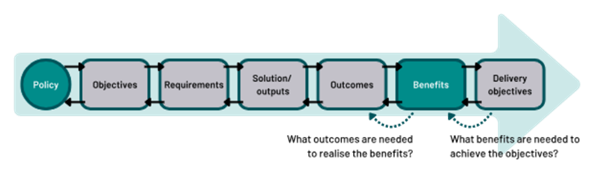
A horizontal flowchart shaped like an arrow, illustrating a process from left to right. The stages are: Policy (circle, teal), Objectives, Requirements, Solution/outputs, Outcomes, Benefits (rectangle, teal), and Delivery objectives. Each stage is connected by arrows, showing progression. There are also curved arrows below linking Outcomes to Benefits, and Benefits to Delivery objectives, indicating a feedback loop. The arrowhead points right, signifying forward movement towards delivery and benefits.
Figure 1.1 Mapping benefits to objectives and outcomes within the policy to delivery chain
A horizontal flowchart shaped like an arrow, illustrating a process from left to right. The stages are: Policy (circle, teal), Objectives, Requirements, Solution/outputs, Outcomes, Benefits (rectangle, teal), and Delivery objectives. Each stage is connected by arrows, showing progression. There are also curved arrows below linking Outcomes to Benefits, and Benefits to Delivery objectives, indicating a feedback loop. The arrowhead points right, signifying forward movement towards delivery and benefits.
Figure 1.1 Mapping benefits to objectives and outcomes within the policy to delivery chain

In practical terms, benefits management gives you a consistent framework and proven tools for identifying and managing benefits.

This helps you to:

  • keep benefits aligned with planned outputs, outcomes and objectives
  • describe benefits in clear and consistent terms, supporting prioritisation, business cases and investment appraisal
  • maintain a consolidated register of benefits, with assigned owners, to support planning and realisation – right through transition into use
  • recalibrate benefits if policy objectives, priorities or delivery plans change
  • review progress on benefits realisation, linking this back to outputs, outcomes and objectives to support evaluation and learning

1.2 What is benefits management?

Benefits management is the process of making sure that the benefits expected from a change are achieved. It covers all the activities needed to identify, value, plan, realise and review those benefits in practice.

You can apply benefits management at any level — portfolio, programme, project or work package. It is most effective when used consistently across an organisation and built into governance and management frameworks.

To manage benefits well, you need a clear, systematic approach. This is usually set out in a benefits management framework (sometimes called a benefits management strategy). This should be part of your overall governance and management framework, and should link to business case development, reporting, assurance and evaluation.

What does benefits management involve?

Benefits management is not a single step, but a cycle of related activities.

A figure showing the ten activities involved in benefits management as a sequence, aligned to three phases: preparing to manage benefits, managing benefits and closing benefits management.
Figure 1.2 A simple view of benefits management activities
A figure showing the ten activities involved in benefits management as a sequence, aligned to three phases: preparing to manage benefits, managing benefits and closing benefits management.
Figure 1.2 A simple view of benefits management activities

The main activities in benefits management include:

  • using standardised benefits mapping and analysis techniques to identify, classify, value and appraise benefits
  • recording of benefits in a benefits register, with more detailed benefits profiles where needed
  • developing a benefits realisation plan to guide delivery and review of benefits throughout the life cycle
  • using tracking and reporting tools to monitor benefits realisation, share progress and support evaluation

These steps follow on in sequence in projects, but may be repeated or refined in programmes, portfolios or in work using agile methods. Many people may be involved, depending on the type and complexity of the work. Roles and responsibilities are covered in Section 2.

Core benefits management practices are similar across portfolios, programmes and projects and should be applied consistently, tailored to the scale and complexity of the work. Some differences do exist, and these are discussed in Section 3.

1.3 What are the standards for benefits management in government?

Benefits management standards are set out in the Government Functional Standard for Project Delivery. This standard applies to portfolios, programmes and projects undertaken within or across government departments and their arm’s length bodies.

The specific requirements for benefits management in the functional standard are below.

Requirements for benefits management in the functional standard

The relevant stakeholders’ expectations regarding the benefits to be realised should be understood by the team developing the solution.

Benefits should be identified, analysed, defined, planned and tracked and included in the overall plan for the work. Forecasts of benefits should take into account negative impacts.

Benefits should be assessed for a number of options before a solution is chosen and included in a business case, in which potentially conflicting pressures, such as costs, benefits, schedule, quality, scope, performance, and risk are balanced. Options shall be assessed in accordance with the Government Functional Standard for Analysis.

Each discrete benefit should be assigned to an owner who has responsibility for forecasting and monitoring it.

Project delivery should be reassessed throughout the duration of the work as new benefits might emerge as the work progresses and expectations might change.

Benefits trigger points should be included in schedule plans. Once triggered, actual benefits realisation should be tracked against the plan.

There should be two-way traceability between benefits, outcome, solution, outputs, requirements and objectives.

The continuous improvement assessment framework explains how organisations can move from meeting the ‘good’ standard for benefits management to achieving ‘better’ and ‘best’ practice. The Teal Book also provides more detailed guidance to support these standards. Both are covered in relevant sections of this workbook.

1.4 What else is important in managing benefits?

Explain why benefits matter

Benefits management is sometimes seen as a specialist task, mainly used for preparing business cases or supporting delivery planning and control. These matter, but benefits management should be much more than that. It should act as a ‘golden thread’ running throughout the work, giving a clear line of sight from objectives to outcomes and their value to society. Building a shared understanding of the central role benefits play through the life cycle is key to realising them in practice.

Focus on social value

Government portfolios, programmes and projects exist to deliver value for the public, using funds entrusted by Parliament. Benefits management helps make sure that public investment delivers the greatest possible value to society. It is also central to evaluating public policy and to maintaining transparency and accountability.

Link benefits to objectives

Every benefit should connect clearly to the objectives for the work, and to the outputs and outcomes you plan to deliver. Sometimes unforeseen benefits appear, and these are important too, but your main focus should always be on delivering what government is trying to achieve.

Consider all types of benefit

Benefits can take many forms. Some, like improvements to security or quality of life, can be hard to measure but still matter. Quantify benefits wherever you can, but don’t ignore those that are harder to measure — these qualitative benefits are also important to capture and track. The Green Book explains how to consider different types of benefit in a business case. This includes positive impacts, which are treated as social benefits, and negative impacts, which are treated as social costs. Section 8 of this workbook has more ideas for managing different typed of benefit within a business case.

Plan for benefits over time

Not all benefits appear at the end of a project, and they don’t always stay the same once realised. Some benefits are time-limited, some are continuous, and some may grow or shrink due to external factors. The type and quantum of benefits might be influenced by the delivery plan. Benefits can be realised during delivery, at completion, or over a long period afterwards. Understanding when and how benefits are realised is key to planning and managing their delivery.

Connect benefits to policy evaluation

Benefits provide important evidence for assessing the impact of government policies and interventions, and for learning lessons for the future. Make sure this is recognised from the start and built into the approach to reporting and evaluation.

1.5 How does benefits management link to evaluation?

Benefits management and evaluation are closely linked. Both focus on understanding the impact of a portfolio, programme or project, and on showing whether planned outcomes and objectives have been achieved. But they are distinct disciplines, each with its own approach and purpose.

Benefits management is a core project delivery practice, usually led by project practitioners. It involves:

  • identifying and valuing specific benefits to support investment decisions
  • planning, managing and tracking the realisation of those benefits throughout the project delivery life cycle

Evaluation is a core practice in policy and analysis, usually led by economists and/or other analysts. It involves:

  • assessing whether an intervention will work, or has worked as intended
  • analysing how and why results occurred, and what wider impacts were achieved.

Evaluation often considers a broader set of outcomes than benefits alone. For more information, see The Magenta Book.

How are benefits management and evaluation different?

Benefits management can show what changes have occurred as a result of an intervention. Evaluation, on the other hand, can determine whether those changes were directly caused by the intervention. This often involves comparing people or groups who received the intervention with similar groups who did not, to provide a counterfactual view and measure the true causal impact.

How do they work together?

Benefits management and evaluation support each other.

Evaluation design and planning help to define success and suggest how best to measure and value benefits. Benefits data provides important evidence for evaluation.

To get the best from both and avoid duplication, for example in data collection, benefits and evaluation teams should work together throughout the life cycle, from design and planning to delivery and review.

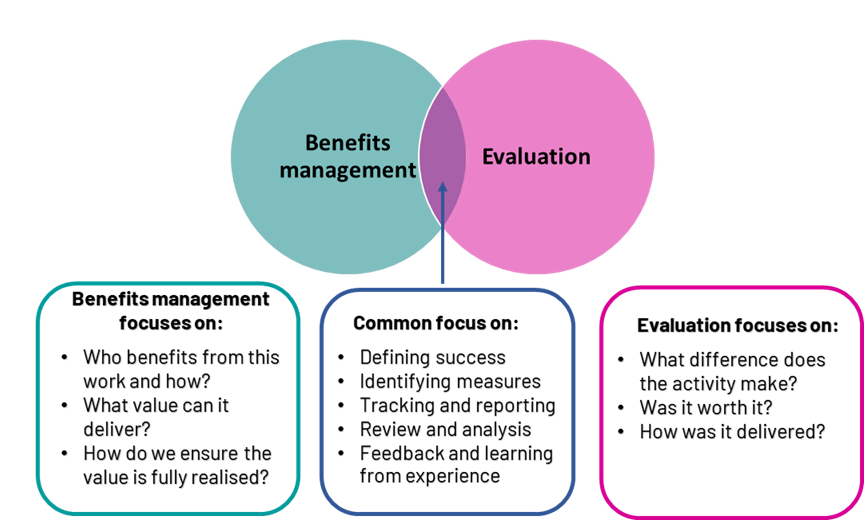
Venn diagram comparing benefits management and evaluation. The left circle, labelled “Benefits management”, focuses on who benefits from the work, the value it delivers, and how that value is realised. The right circle, labelled “Evaluation”, focuses on the difference the activity made, whether it was worthwhile, and how it was delivered. The overlapping section shows shared areas of focus: defining success, identifying measures, tracking and reporting, review and analysis, and feedback and learning from experience. The diagram emphasises that benefits management and evaluation are distinct disciplines with a common focus on measuring and assessing outcomes.
Figure 1.3 Benefits management and evaluation
Venn diagram comparing benefits management and evaluation. The left circle, labelled “Benefits management”, focuses on who benefits from the work, the value it delivers, and how that value is realised. The right circle, labelled “Evaluation”, focuses on the difference the activity made, whether it was worthwhile, and how it was delivered. The overlapping section shows shared areas of focus: defining success, identifying measures, tracking and reporting, review and analysis, and feedback and learning from experience. The diagram emphasises that benefits management and evaluation are distinct disciplines with a common focus on measuring and assessing outcomes.
Figure 1.3 Benefits management and evaluation

2 Who manages benefits?

Being clear on accountabilities and responsibilities is one of the fundamental principles of project delivery, set out in the Government Functional Standard for Project Delivery.

This is especially important for benefits management, because benefits activities often cross team and organisational boundaries, can change over time and often continue after the work has ended and ownership has transferred to operational teams.

Everyone working in project delivery should understand the importance of benefits and how they are managed as part of planning, control, solution delivery and realisation.

However, there should be clear accountability for benefits management and realisation at every stage of the life cycle.

This section provides an overview of how accountability and responsibility work in benefits management, and the typical roles associated with specific activities. Roles and responsibilities can vary depending on the nature, scale and complexity of the work, and can change as the work progresses. For this reason, you’ll find more detail on roles and responsibilities linked to particular activities in the relevant sections.

Accountability and responsibility for benefits management should be considered when setting up the work and set out clearly in the benefits management framework. For more on this, see Section 6.

The Project Delivery Capability Framework sets out the competencies and responsibilities for individual project delivery roles. The Aqua Book (requires sign in) and The Magenta Book (requires sign in) provide guidance on roles in analysis and evaluation. The Analysis Career Framework explains the different types of analysts and their roles.

2.1 Roles and responsibilities in benefits management

2.1.1 The accounting officer

Project delivery in government takes place within the UK’s system of parliamentary accountability, as set out in Section 4.4.2 of The Teal Book. This means that:

  • the minister in charge of a government department is responsible and answerable to Parliament for the use of departmental powers and for the actions and decisions of the department, including those of its arm’s-length bodies
  • the departmental accounting officer is personally responsible and accountable to Parliament for the organisation and management of the department, including its use of public money and stewardship of its assets, as set out in Managing Public Money
  • additional accounting officers, additional accounting officers, appointed in departments or arm’s-length bodies, are also accountable to Parliament within the terms of their appointment, under the overall accountability of the principal accounting officer

Making sure public money is used properly, and that portfolios, programmes and projects deliver what they set out to achieve, is a key duty for government departments and their accounting officers. This duty applies no matter who delivers the work, whether it is done by the department itself, by an arm’s-length body, or by a delivery partner. Although day-to-day responsibility can be delegated, the accounting officer always remains ultimately accountable.

2.1.2 The sponsoring body

The sponsoring body is the higher-level authority for a portfolio, programme or project. It provides oversight, sets direction, and is accountable to a defined authority, usually the departmental accounting officer, and through them to ministers and Parliament.

Sometimes, work is delivered directly by a government department. In other cases, the department (as sponsoring body) commissions another organisation to deliver outputs or even take responsibility for achieving outcomes. This delivery organisation could be an arm’s-length body, another public sector body (such as a local authority), or a private company contracted to deliver on behalf of government.

In these cases, the sponsoring body is the organisation that:

  • secures the funding
  • owns the business case (usually through the senior responsible owner)
  • sets out the requirements for the delivery organisation

The sponsoring body is also responsible for making sure benefits are realised, with accountability passing up through the relevant accounting officer.

Setting clear accountabilities

To ensure a robust focus on benefits management, accountabilities and responsibilities for this must be clearly defined in the benefits management framework and agreed as part of commissioning or contracting for the work.
The senior responsible owner may be employed by the sponsoring body or by an arm’s-length body or other public sector body, but never by a contracted delivery partner.

The sponsoring body should always retain responsibility for overseeing and scrutinising benefits management. It is up to the sponsoring body to set clear standards for benefits management. This could be done in a framework agreement, contract or delivery specification.

Practical questions, such as how benefits realisation will be managed, documented and reported, should be discussed openly between the sponsoring body, senior responsible owner and client organisation. These should be documented in the benefits management framework.

2.1.3 Portfolio directors and senior responsible owners

The portfolio director, in a portfolio, or senior responsible owner, in a programme or project, is accountable for delivering the agreed outcomes and realising the expected benefits in line with the objectives for the work. This role usually includes owning the benefits management framework and overseeing benefits realisation throughout the life cycle. They should also ensure that someone in the sponsoring body remains accountable for benefits realisation in operations after closure of the work.

If the portfolio director or senior responsible officer sits within a client organisation (see Section 2.3), their responsibilities may need to be adapted to fit the context. Any changes should be clearly documented in the benefits management framework.

2.1.4 Portfolio, programme and project managers

The portfolio, programme or project manager, as appropriate, is accountable for developing and managing the benefits management framework. This includes setting up the processes, tools and techniques needed, and overseeing the activities required to identify, plan and realise benefits.

In smaller pieces of work, they may carry out benefits management activities directly, rather than delegating them to others.

2.1.5 Benefits managers

Depending on the scale and complexity of the work, there could be a dedicated benefits manager and/or one or more designated team members responsible for benefits management activities. These roles act on behalf of the portfolio, programme or project manager.

For large work packages, a work package manager can undertake benefits management activities for their own work area.

2.1.6 Benefits owners

Once a benefit is identified, it is assigned a benefit owner. This is a named individual with the position, authority or technical expertise to take on this responsibility. The benefit owner works with the benefits manager to:

  • confirm and value the benefit
  • agree the benefit assumptions included in the business case
  • take responsibility for realising and reporting on the benefit at the agreed point
  • agree benefit closure, where appropriate

Benefit owners are often product owners or senior operational managers in the part of the organisation where the benefit will be realised. If a permanent benefit owner cannot be identified, for example because organisational arrangements are not yet in place, an interim owner can be agreed and ownership transferred when possible.

To keep benefits management effective, avoid allocating too many benefits to one owner.

2.1.7 Beneficiaries

Stakeholders who receive and are impacted by the benefits realised are known as beneficiaries. They play a key role in identifying both the potential and actual impact of individual benefits, as well as any unexpected impacts that arise. Typically, beneficiaries contribute to benefits management with or through the relevant benefits owner.

2.1.8 Analysts

Business analysts conduct research into stakeholder needs, the consequences of change, and the potential benefits of different options. They assess factors such as time, cost and risk and play a key role in identifying and valuing benefits for the business case. Their work provides evidence to support decisions about which options to shortlist and which solution to select.

Where necessary, specialist analysts like economists, statisticians, and social or operational researchers, should also be involved. In large-scale and complex work, economists or other specialists often lead work to identify and value benefits, and play a key role in developing the case for investment.

Evaluation specialists are often responsible for designing and conducting evaluation activities, so involving them in benefits identification and planning from the start is important to ensure alignment between benefits management and evaluation.

2.1.9 Business case managers

The business case manager is responsible for developing the business case. This includes making sure that benefits are identified, valued and appraised accurately. Their work supports decisions on which options to shortlist and which solution to select, and provides a clear basis for managing and realising benefits.

2.1.10 Finance managers

Finance managers can play a key role in benefits management, particularly in identifying public sector financial impacts and efficiency savings for inclusion in the business case, and then helping track and realise them.

2.1.11 Business change managers

Business change managers can support benefits managers and owners by helping to define benefits, assess progress towards realisation and look for ways to optimise their impact and value to beneficiaries.

2.2 Governance in benefits management

Governance sets direction and creates the structure for accountability and decision-making, making sure work aligns with strategic goals and stays on track to deliver them. Benefits management is central to governance because it provides the link between policy, objectives, outcomes and benefits, and shows how these are delivered and realised.

Effective benefits management enables realistic, evidence-based investment decisions and supports delivery. It is a core part of planning and control and sits within the governance and management framework for the portfolio, programme or project.

The scale and complexity of the work determine the governance and management arrangements needed, as explained in Chapter 4 of The Teal Book.

Because benefits management provides a clear line of sight from objectives to outcomes and public value, governance should focus on:

  • putting in place arrangements for benefits identification, management and evaluation, with input from stakeholders and specialist analysts as needed
  • ensuring benefits are identified, valued realistically and represented accurately in investment planning and business cases, so that investment decisions are well-founded
  • making sure planning covers all benefits management requirements, including the costs and resources needed to manage and realise benefits
  • establishing monitoring and reporting arrangements that give an accurate picture of progress on benefits realisation against the baseline business case, and contribute to evaluation

In a portfolio, governance focuses on making sure benefits plans are realistic and consistent across the portfolio, that robust management practices are in place at programme and project level, and that progress on benefits realisation is tracked against the portfolio plan.

In programmes and projects, governance should ensure that an effective benefits management framework is in place, and that benefits are properly identified, valued and presented realistically in the business case. This approach supports investment decisions that align with government objectives and are based on social value. It also keeps benefits management in view throughout delivery, realisation and evaluation.

See Chapter 4 of the Teal Book for more information on governance and management.

2.3 Assurance in benefits management

Assurance gives senior leaders and stakeholders confidence that work is under control and can deliver policy, strategy and objectives safely and successfully. Benefits management is central to this because it links policy, objectives, outcomes and benefits, and shows how they will be delivered and realised.

If benefits are not identified or managed well, this puts government objectives and policy at risk. Because of this, benefits — and how they are managed — are a key risk area. Assurance helps make sure benefits are properly identified, considered in decision-making, and can be realised.

2.3.1 Assurance in government

Assurance in government follows the sponsoring body’s risk assurance framework, as set out in The Orange Book. The Teal Book (Section 4.6.5.3) sets out four defined levels:

  • first line: management controls and self-assurance within the project, programme or portfolio team. This gives assurance to the senior responsible owner or portfolio director directly accountable for the work
  • second line: oversight and challenge from portfolio or organisational teams. This gives assurance to the accounting officer
  • third line: independent assurance by a body outside the organisation, such as the National Infrastructure and Service Transformation Authority (NISTA)
  • fourth line: external assurance by an organisation such as the National Audit Office, acting for Parliament. This provides an independent opinion on how well the organisation or system is governed and how risks are managed and controlled

Each level of assurance adds a different perspective. Together, they help make sure risks are managed and benefits can be achieved in line with objectives.

2.3.2 Assuring benefits management

2.3.2.1 Assurance in a portfolio

Assurance in a portfolio should give confidence to the portfolio director and sponsoring body that benefits are being managed properly across the portfolio. This means:

  • a robust benefits management framework is in place and working across the portfolio
  • portfolio benefits planning and prioritisation is realistic and evidence-based
  • portfolio benefits can be, or are being, realised as planned

During the work, first line assurance of benefits management should run alongside the work, with scrutiny within the team or by the programme or project board, as appropriate.

Second line assurance plays a key part in assuring benefits in a portfolio. This focuses on benefits management in the programmes and projects in the portfolio, to ensure the right practices are in place and working well. Second line review can include:

  • reviewing benefits management in individual programmes and projects, for example as part of a stage gate review
  • carrying out cross-cutting thematic reviews to assess benefits practices across several programmes or projects

Portfolio level benefits management can also be assured through third line review. This is usually carried out by an external body, such as the National Infrastructure and Service Transformation Authority (NISTA) or another audit or regulatory body. Third line assurance may include:

  • a NISTA portfolio assurance review
  • a stage gate review, such as a gate 5 (operations review and benefits realisation), for portfolios delivering a specific set of benefits and outcomes
  • an assessment or audit of benefits and outcomes delivered through grants or funds

Fourth line assurance, for example carried out by the National Audit Office, can look at benefits as part of value for money, lessons learned or good practice reviews. Such reviews are usually across one or more large portfolios, for example in health, transport or defence, or across the government major projects portfolio.

2.3.2.2 Assurance in a programme or project

Assurance of benefits management at programme or project level should give confidence to the senior responsible owner and stakeholders that benefits are being managed properly. This means:

  • a robust benefits management framework, tailored to the needs of the programme or project, is in place and working
  • benefits identification, appraisal and planning is realistic
  • benefits can be, or are being, realised as planned

During the work, first line assurance of benefits management should run alongside the work, with scrutiny within the team or by the programme or project board, as appropriate.

Second line assurance of benefits management usually forms part of a wider review, for example a stage gate review. Sometimes a focused review is needed, for example where specific issues have been identified.

Once delivery is complete, assurance focuses on benefits realisation. This is typically done through a gate 5 review.

2.3.2.3 Gate 5 reviews

Gate 5 reviews look at operations and benefits realisation. They play an important role in assuring benefits realisation after delivery and provide vital evidence for evaluation.

Gate 5 reviews are mandatory for all work in the government major projects portfolio but are good practice for all programmes or projects. They can also be used to assess benefits realisation in portfolios. They confirm that:

  • benefits set out in the business case are being achieved
  • the solution is operating as intended
  • the planned outcomes are being achieved

Gate 5 reviews can be:

  • one-off, to check that outputs and benefits have been delivered
  • repeated, with reviews on transition to operations, 6 to 12 months after transition, and/or before the end of a service contract

2.3.3 Assuring delegated delivery

When delivery is delegated to a client organisation or contracted delivery partner, the sponsoring body should consider carefully how to assure benefits management.

If the client organisation is only responsible for outputs, the sponsoring body should be responsible for assuring benefits management. This is to make sure there is a continuing focus on outcomes and benefits, not just on outputs delivered by the client organisation.

If delivery is delegated to a contracted delivery partner, the sponsoring body should always hold responsibility for assuring benefits management and realisation.

For more information on benefits assurance, see Section 11: Reviewing benefits and the Infrastructure and Projects Authority: assurance review toolkit.

3 Benefits management in portfolios, programmes and projects

The Teal Book highlights the close relationships between portfolios, programmes and projects in government. This makes it important to use consistent benefits management practices across an organisation. These practices should be tailored to fit the level, nature and complexity of the work.

At the same time, there are important differences in how portfolios, programmes and projects are managed. These differences affect how benefits management should be approached.

Portfolios typically operate on a cyclical basis. They bring together multiple programmes, projects, and/or other related work, which can join or leave the portfolio at different times. This means a portfolio often supports a number of objectives and usually evolves over time.

Programmes and projects are time-limited. They have an agreed start and end point, and their life cycle is split into phases to meet a specific policy objective, problem or opportunity. Once plans are developed and a business case is approved, delivery follows those approvals. Programmes can also evolve over time, but within a more defined structure than portfolios.

This section explains what to consider when managing benefits at each level, and how to tailor benefits management practices to different life cycles.

For more information on management structures and life cycles, see The Teal Book:

3.1 Benefits management in portfolios

Portfolio management helps senior managers and their organisations make informed decisions on:

  • where and when to invest in new work to meet the portfolio’s objectives
  • whether existing work is still viable or appropriate
  • how to optimise delivery, use resources efficiently and realise benefits effectively
  • how to address any shortfalls, for example by investing in further work

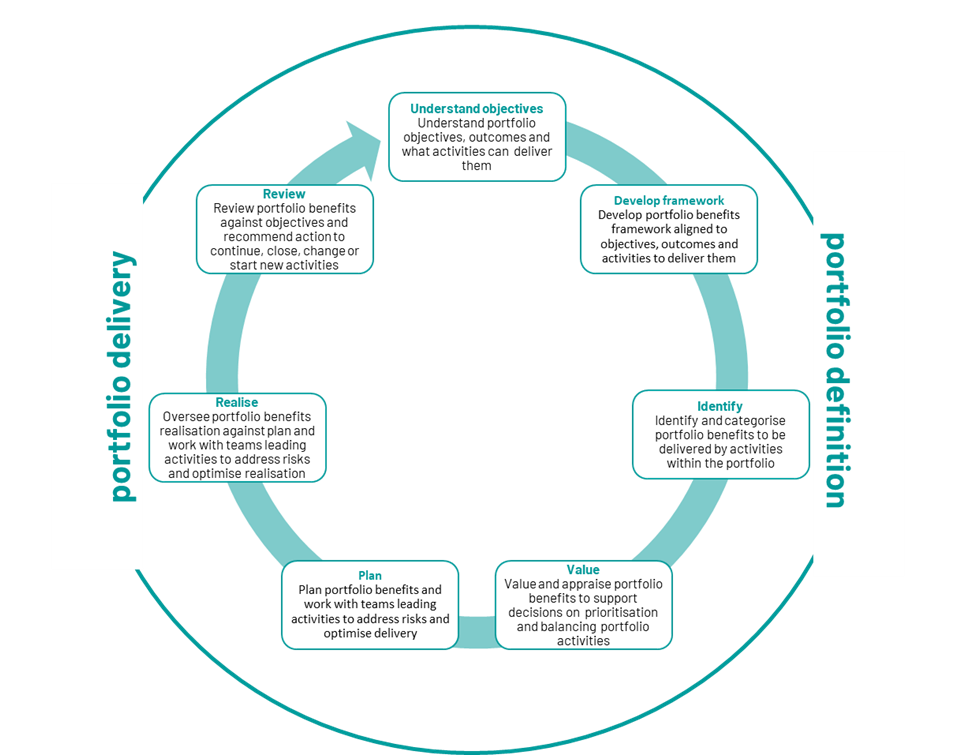
Portfolio management works on a cyclical basis. The process moves through evolving cycles of portfolio definition and portfolio delivery. Benefits management is a core part of both phases, with defined practices that are repeated regularly as the portfolio evolves. These are shown in Figure 3.1.

A figure showing the cycle of benefits management activities aligned to definition and delivery within the portfolio management. ​ ​ The activities are to understand objectives, develop the benefits management framework, value, plan, realise and review benefits, which then feeds into the next cycle.
Figure 3.1 Overview of benefits management in a portfolio
A figure showing the cycle of benefits management activities aligned to definition and delivery within the portfolio management. ​ ​ The activities are to understand objectives, develop the benefits management framework, value, plan, realise and review benefits, which then feeds into the next cycle.
Figure 3.1 Overview of benefits management in a portfolio

Benefits management practices in portfolios are similar to those used in programmes and projects. However, in portfolios the focus is more strategic, aligning benefits with wider organisational objectives.

3.1.1 Key considerations for benefits management in portfolios

Benefits management in portfolios places particular importance on several key areas.

A clear line of sight

Portfolio management focuses on portfolio-wide objectives and outcomes. These can be set at portfolio level or can support wider government and organisation objectives.

Work to achieve these objectives and outcomes is then delivered through programmes, projects, and related work within the portfolio.

To manage benefits effectively at portfolio level, it is essential to establish and maintain a clear line of sight between portfolio objectives, portfolio benefits, and the contributions of individual programmes and projects. This clarity is particularly important as the portfolio evolves, helping to maintain a coherent picture, avoid double-counting, and identify any gaps or shortfalls.

Consistent standards and practices

Effective portfolio benefits management requires a defined set of standards and practices for identifying, valuing, planning, realising and reviewing benefits across the portfolio.

As in programmes and projects, these are set out in a benefits management framework. At portfolio level, it is important to establish this framework early on and to sustain it as the portfolio changes over time. This not only supports benefits management at portfolio level but also provides a consistent approach for benefits management within the programmes and projects in the portfolio

Expertise in modelling and analysing data

Understanding which benefits come from different parts of the portfolio is critical for defining the portfolio and supporting decisions on priorities and investment. This expertise is also important during delivery, as it informs where to invest resources and support to maximise benefits realisation and the overall value delivered by the portfolio.

The effectiveness of this work depends on the accuracy and reliability of benefits identification, profiling, modelling, and the analysis of benefits realisation data. As a result, benefits data standards, modelling and analysis, using risk-based estimation techniques, are a particular focus for portfolios when managing benefits.

3.1.2 Benefits in portfolio investment appraisal

Benefits play a central role in defining portfolios and in deciding how to prioritise investment and resources. Portfolio investment appraisal is a cyclical process, usually linked to government spending reviews and departmental business planning cycles.

Unlike programmes and projects, portfolio investment proposals do not usually follow the five-case model set out in The Green Book. Instead, they are usually presented as a portfolio investment bid or plan, with requirements set by the commissioning authority. These proposals typically combine:

  • an overall strategic narrative
  • a high-level summary of proposed investment, linked to quantified social costs and benefits
  • analysis to show the expected value of the proposed investment to society

After investment decisions are made, the responsibility for planning, realising, and closing specific benefits is passed to the relevant senior responsible owner and their programme or project team.

During portfolio delivery, benefits management focuses on monitoring overall benefit realisation at portfolio level. This relies on data provided by programme and project teams. Portfolio-level intervention is usually only needed if there are significant shortfalls or concerns that affect the whole portfolio.

The review of benefits marks the end of one cycle of benefits management and feeds into the next. Outcomes from the review help reassess objectives and outcomes for the following cycle. The benefits management framework should also be updated to support the new portfolio cycle, with the previous version closed and stored. The framework is finally closed when the portfolio itself closes.

More on the application of individual benefits management practices in portfolios is included in the practice sections in Part B and Part C.

3.2 Benefits management in programmes and projects

Programme and project management provides a structured approach to define and deliver outcomes and benefits linked to one or more objectives. These objectives are agreed for the work but should support wider objectives at portfolio, organisation and government level.

Programmes and projects always have a defined start and end point. Their life cycle is broken into phases, structured to suit the needs of the work.

Benefits management in programmes, projects, or other related work follows a defined sequence of activities. These activities are aligned to the chosen life cycle for managing the work, as shown in Figure 3.2 below.

The sequence is similar to the approach used in portfolios, but in programmes and projects the activities are usually carried out in order. Some activities may be repeated, especially in programmes where individual projects are managed in an iterative way.

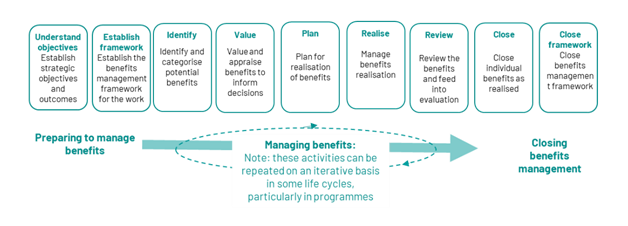
A horizontal flowchart illustrating the stages of benefits management. The chart consists of nine connected rectangles, each representing a step: Understand objectives Establish framework Identify (identify and categorise potential benefits) Value (value and appraise benefits to inform decisions) Plan (plan for realisation of benefits) Realise (manage benefits realisation) Review (review the benefits and feed into evaluation) Close (close individual benefits as realised) Close framework Above the rectangles, two sections are labelled: "Preparing to manage benefits" (covering the first two steps) and "Closing benefits management" (covering the last step). Below the main steps, a large arrow labelled "Managing benefits" runs horizontally, with a note inside: "Note: these activities can be repeated on an iterative basis in some life cycles, particularly in programmes." Dotted arrows indicate that the steps from Identify to Review can be repeated iteratively.
Figure 3.2 Overview of benefits management in programmes and projects
A horizontal flowchart illustrating the stages of benefits management. The chart consists of nine connected rectangles, each representing a step: Understand objectives Establish framework Identify (identify and categorise potential benefits) Value (value and appraise benefits to inform decisions) Plan (plan for realisation of benefits) Realise (manage benefits realisation) Review (review the benefits and feed into evaluation) Close (close individual benefits as realised) Close framework Above the rectangles, two sections are labelled: "Preparing to manage benefits" (covering the first two steps) and "Closing benefits management" (covering the last step). Below the main steps, a large arrow labelled "Managing benefits" runs horizontally, with a note inside: "Note: these activities can be repeated on an iterative basis in some life cycles, particularly in programmes." Dotted arrows indicate that the steps from Identify to Review can be repeated iteratively.
Figure 3.2 Overview of benefits management in programmes and projects

Benefits management in projects and programmes is always progressive. Even if some activities are repeated or refined during delivery, the overall process is designed to realise cumulative benefits that support the objectives and outcomes agreed at the start.

This progressive approach means benefits management often continues beyond the formal closure of the project or programme. After delivery, benefits management activities often carry on during operations, to make sure benefits are actually realised. The benefits management framework is only closed when all intended benefits have been achieved, or when an agreed end point is reached.

3.2.1 Key considerations for benefits management in programmes and projects

Benefits management in programmes and projects involves several key areas of focus.

Business case development

The Green Book places strong emphasis on benefits as part of the five-case model for business cases in government. Benefits support the strategic case for change and are central when assessing options and selecting a preferred solution. All expected benefits should be documented clearly in the business case that is submitted for investment approval.

Driving and controlling delivery

Once the business case is approved, the assumptions about benefits for the chosen solution are baselined. These assumptions become key factors in planning and managing the work. They are used to track progress during delivery and to check whether the solution is working as intended once it is in place.

Reviewing outcomes

Benefits management also involves reviewing whether benefits are being realised. This provides evidence for evaluating whether policy objectives and outcomes have been achieved, and for learning lessons for the future.

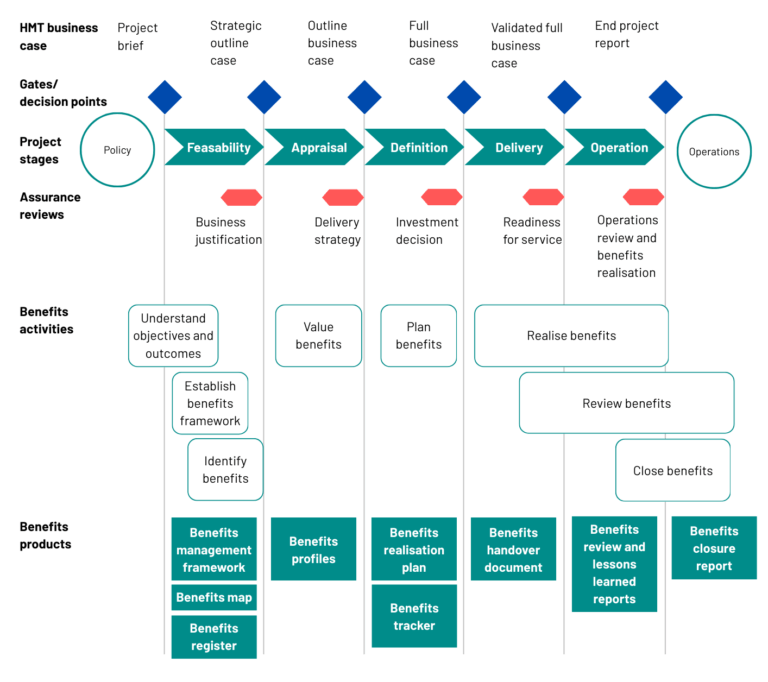
Figure 3.3 shows benefits management activities in relation to different parts of the standard project reference life cycle, and how they link to the project business case.

A flowchart showing how benefits management activities and outputs align with HMT business case stages, project phases, assurance reviews, and decision points. It illustrates that early stages (Policy and Feasibility) focus on understanding objectives and identifying benefits, supported by the benefits management framework and map, and linked to the Business Justification review. Appraisal and Definition involve valuing and planning benefits, producing profiles and a realisation plan, aligned with Delivery Strategy and Investment Decision reviews. Delivery centres on realising benefits and handing them over, supported by a handover document and readiness review. Operation focuses on reviewing and closing benefits, producing lessons learned and closure reports, aligned with Operations Review and Benefits Realisation.
Figure 3.3 Benefits management activities mapped to the reference life cycle in the Project Delivery Functional Standard
A flowchart showing how benefits management activities and outputs align with HMT business case stages, project phases, assurance reviews, and decision points. It illustrates that early stages (Policy and Feasibility) focus on understanding objectives and identifying benefits, supported by the benefits management framework and map, and linked to the Business Justification review. Appraisal and Definition involve valuing and planning benefits, producing profiles and a realisation plan, aligned with Delivery Strategy and Investment Decision reviews. Delivery centres on realising benefits and handing them over, supported by a handover document and readiness review. Operation focuses on reviewing and closing benefits, producing lessons learned and closure reports, aligned with Operations Review and Benefits Realisation.
Figure 3.3 Benefits management activities mapped to the reference life cycle in the Project Delivery Functional Standard

More on the application of individual benefits management practices in programmes and projects is considered in the practice sections in Part B and Part C.

3.2.2 Benefits in programme / project investment appraisal

Benefits management in programmes and projects follow the life cycle chosen to manage the work. The life cycle also shapes the choice of business case (for example, whether to use a programme business case, a project business case, or a combination of both).

Regardless of the life cycle or business case approach, the core requirements remain the same. Benefits should be identified, classified and valued as part of investment appraisal. How these requirements apply may differ slightly depending on the approach.

For programmes, a single programme business case is developed and approved. This business case is then revisited and updated at the end of each tranche of the programme, before seeking approval to start the next tranche. At each stage:

  • benefits are an essential part of the case for change in the strategic case, feeding into the critical success factors used to longlist options
  • benefits are then valued and appraised in detail when assessing shortlisted options and selecting the preferred solution

After each tranche, benefits assumptions are updated alongside progress on benefits realisation.

For projects, the business case is developed and approved in stages: starting with a strategic outline case, then an outline business case, and finally a full business case. At each stage:

  • benefits are included as part of the strategic case for change and are used to define critical success factors for longlisting options
  • benefits are then valued and appraised in detail during shortlisting and selection of the preferred solution in the outline business case
  • benefits are then are reconfirmed or updated as necessary in the full business case

Other aspects of benefits management are included elsewhere in the business case. Information is updated and added as more is known and the business case progresses.

Table 3.1 shows what information should be included in different parts of the business case.

Table 3.1 Setting out benefits in the business case. Elements marked with * are not included in the strategic outline case or initial programme case but are added in later versions of the business case
Case What to include on benefits
Strategic case
Asks: what are the reasons for change?
  • Describe the drivers, objectives and outcomes for the work, and the theory of change behind them
  • Show how objectives and outcomes link to benefits
  • Explain who benefits and who else is impacted, positively or negatively
Economic case
Asks: what is the net value of the change to society?
  • Set out the different types of benefit, timescales and how they are to be valued
  • Forecast and value quantifiable benefits so their social value can be calculated and different options compared*
  • Assess qualitative benefits using multi-criteria decision analysis to feed into option comparison*
  • Identify risks, assumptions and unknowns that could affect benefits and model possible impacts on value*
Commercial case
Asks: can a suitable commercial deal be struck?
  • Explain how the commercial approach should deliver outputs, benefits and social value
  • Link project outputs to benefits realisation as part of the commercial approach*
  • Set out how benefits and social value are to be assessed in procurement and contract management*
  • Outline options for variation in scope and their impact on benefits realisation*
Financial case
Asks: is the change affordable in terms of public finances?
  • Include costs of benefits realisation in cost estimates
  • Include direct cash-releasing benefits and any negative impacts in cost analysis*
  • Include direct cashable benefits in any payback and cashflow analysis*
Management case
Asks: can the proposal be managed and delivered successfully?
  • Outline the approach to benefits management and governance and link to the benefits management framework
  • Set out arrangements for benefits ownership, realisation and reporting, including after handover to operations*
  • Explain plans for reviewing benefits realisation and how this contributes to evaluation*

4 Common challenges in benefits management

The principles of benefits management are straightforward, but there can be practical challenges. Good intentions at the start can be lost as work gets busy. Sometimes, benefits management isn’t well understood, or people see it as a low priority or too difficult.

It’s important to be clear about what benefits management is for, and who should be involved. Addressing challenges as they come up helps prevent benefits management from being neglected or deprioritised.

4.1 The benefits picture is very complex

Some of the biggest challenges in benefits management come from the scale and complexity of the work, which can make it difficult to get a clear picture of what is being achieved.

In a smaller projects, objectives and outcomes are usually clear, the beneficiaries known, and the benefits of the change easier to identify, such as a new facility or improved service.

In large-scale, complex programmes, delivered over many years, things are less clear cut. Policy objectives may change, there can be many potential beneficiaries, and benefits and impacts can cut across each other.

Recent reports from the National Audit Office explore these challenges. They point to the importance of:

  • a clear vision
  • strong governance
  • effective decision-making
  • robust evaluation, working alongside benefits management, to demonstrate value in large and complex projects.

It’s important to recognise and manage a complex benefits picture from the outset:

  • seek help from analysts with expertise in benefits and evaluation
  • create a benefits management framework and evaluation plan that work together, and keep a clear focus on them both as the work progresses
  • make sure you have the resources needed to manage benefits properly

Alongside these broad issues, watch out for some other challenges and common pitfalls that can arise in large and small projects alike.

4.2 Being too optimistic about benefits

Project and programme teams are often optimistic about the benefits their work will deliver, particularly in making a case for investment. However, optimism can lead to over-promising, which creates problems later if those benefits can’t be delivered.

Business cases need to present a realistic assessment of both costs and benefits to support good investment decisions. Overstating benefits causes big problems for delivery and can lead to disappointment and criticism when expectations are not met.

There are effective ways to counter optimism bias. Simply being aware of the tendency to be optimistic and having assumptions independently checked can help. Adjusting benefit estimates to account for bias using sensitivity analysis, basing forecasts on evidence, and expressing costs, benefits and timescales as ranges rather than single numbers can all help manage expectations and support more accurate forecasting.

4.3 Benefits are hard to measure

Some benefits are difficult to measure with certainty, and some may be hard to measure at all. It is important to capture significant benefits as fully as possible, even if they can’t be monetised or quantified precisely. In many cases, qualitative benefits can be just as important as quantitative ones.

Start with the benefits management framework for your organisational portfolio or programme. Others may have already developed ways to measure similar benefits. A consistent approach makes it easier to compare and prioritise benefits, even if the measures are not perfect. Section 8 provides more help on prioritising benefits.

The Green Book provides detailed guidance on assessing different types of economic benefit, including those related to the environment, sustainability, health and wellbeing. Some organisations are skilled at measuring these benefits, often with the help of expert analysts.

Seek help from economists and evaluation specialists in your organisation, as they can connect with colleagues across government who may have encountered similar challenges.

Where possible, use existing data from management information systems. If data is unavailable and new metrics are needed, keep these in step with the importance of the benefit. This helps avoid unnecessary effort and cost in data collection and evaluation later.

When quantitative measures are not practical or would be disproportionate, consider using proxy measures or qualitative assessments. These approaches can help build a more complete picture of the benefits and provide valuable evidence for wider evaluation, even if they can’t be included in economic investment appraisal.

4.4 Benefits management isn’t understood or taken seriously

Benefits management is gradually becoming more established across government, but its importance is not always fully recognised. People can assume that, once a business case is approved, benefits management is finished or will simply happen as part of delivery.

This becomes a real problem if senior leaders or benefits owners do not value benefits management or fail to ensure it gets enough attention. Benefits management needs time and resources. There’s no quick fix, but there are things that can help.

Introducing the right tools, training, and support helps everyone understand their role in embedding benefits management, including senior leaders and benefits owners who may be new to it. Resources such as the quick guide to benefits management can be a useful starting point for further discussion.

A clear benefits management framework, with benefits aligned to objectives and clear accountabilities (as set out in Section 2), reinforces the importance of benefits management and realisation to the organisation.

Consider developing an engagement plan for individual benefits, focusing on the required outcome and points of resistance. Early adopters and benefits champions among the senior team can help make the case to others across the organisation.

Don’t assume senior managers will automatically support benefits management, or that benefits owners will take on their responsibilities just because it’s expected. Showing how benefits management supports evaluation and delivery of objectives, outcomes, and social value is much more likely to persuade people to take it seriously. Engagement involves appealing to both the heart and the head, even with experienced leaders.

4.5 Changes needed to realise benefits aren’t identified or managed

Realising benefits successfully depends on people adopting and embedding new organisational capabilities. This often means new ways of working and changes in behaviour. It’s important to identify the necessary business and behavioural changes early, and to develop effective strategies to achieve them.

Benefits planning helps people think through what needs to happen for benefits to be realised. Involving business change managers early, when developing the business case and planning, helps make sure practical requirements are identified, planned for, and included in funding estimates.

4.6 Benefits realisation after delivery isn’t properly planned

Benefits can be realised throughout the life cycle and can continue to be realised for years after closure. This makes it particularly important to plan properly for benefits realisation, so that it’s clear when and where benefits are likely to be realised.

Proper planning means ensuring that, at completion, the benefits management framework, register and realisation plan are baselined and then handed over to an agreed senior business owner in the sponsoring body responsible for overseeing benefits realisation in operations. This could be the portfolio director, or a policy or operations director, for example.

Benefits realisation and tracking should be included in delivery partner and/or operator contracts and should be monitored as part of performance.

Handover to operations should include:

  • the benefits management framework, benefits register and benefit profiles
  • the ongoing plan for realising and reviewing benefits in operations with agreed timescales, roles and responsibilities
  • agreed measurement, rereporting and review mechanisms
  • budget for handover procedures and/or identified operational funding to support continued benefits realisation and review to the agreed end point

Involving the portfolio or programme office, evaluation and operations teams in benefits management from the start helps ensure buy-in, clarity and the wider organisational understanding needed for successful benefits realisation in operations.

4.7 Benefits are realised but at too high a cost

Sometimes, a portfolio, programme or project achieves its intended benefits, but the cost of doing so is too high. This can be because of optimism bias about costs or timescales, unrealistic assumptions in the business case, weak benefits ownership, or an unwillingness to stop work because of previous investment (‘sunk cost’), even though it is no longer delivering value.

To prevent this, it’s important to ensure that decision-making is benefits-led, supported by:

  • rigorous forecasting
  • strong risk management
  • clear governance and accountability

If work is not delivering the expected benefit or value and continues to incur costs, the senior responsible owner or operational leader accountable should look at whether the position can be improved, If not, they should consider stopping the work.

4.8 Where to find help

Where these, or other challenges arise, always seek help, for example through:

  • your organisation’s central portfolio office or centre of expertise for project delivery, who may have a benefits lead or subject matter expert
  • members of the analysis profession, for example economists, operational analyst teams or evaluation specialists in the organisation
  • the Evaluation Task Force based in the Cabinet Office
  • the National Infrastructure and Service Transformation Authority or other parts of HM Treasury
  • colleagues in other organisations or one of the cross-government communities of practice and special interest groups on benefits management
Back to top