We use some essential cookies to make this website work.
We'd like to set additional cookies to understand how you use the Government Project Delivery website, remember your settings and improve government services.
The purpose of portfolio management is to provide a structured approach through which an effective balance of organisational change and business as usual can be maintained while remaining within a specified funding envelope and constraints.
Portfolio management is a co-ordinated collection of strategic practices and decisions that together enable the most effective balance of organisational change and business as usual.
The portfolio management practices described in this chapter provide senior management with the evidence and control to make informed decisions on:
where and when to invest in new work
whether existing work continues to be viable or appropriate
how to optimise delivery, resource usage and benefits realisation
Portfolio management is not the passive collection of data and production of reports, but the active management of everything within it. It provides a means of collaborating across team boundaries, bringing functions, operations and other business teams together in the shared objective of delivering the changes an organisation needs.
Unlike programmes and projects which have a beginning and an end, the management practices of a portfolio are cyclical, with the practices typically falling into 2 groups of ongoing activity. These cycles are normally called portfolio definition and portfolio delivery. This can be seen inFigure 12.1, with the practice of continuously validating the portfolio’s objectives and strategy linking the 2 cycles. The activities in these cycles are not sequential; the practices in each can happen at the same time or in a different order depending on the circumstances at any given time. This enables the portfolio manager and their team to adapt continuously to a changing context and environment.
What is important is that everyone involved in managing the portfolio, including relevant stakeholders, is clear on how these practices operate by defining them in the portfolio’s governance and management framework(see Chapter 11: The governance and management of portfolios).
The management practices in this model apply regardless of the approaches, techniques or tools used. When combined with the planning and control (see Part E: Planning and control) and solution delivery practices (see Part F: Solution delivery), the management practices provide a comprehensive integrated approach for directing and managing any government portfolio.
Figure 12.1 Portfolio management as an ongoing and iterative activity, showing decision points and assurance reviews
12.2.2 Setting the vision and strategy
The vision and strategy for a portfolio define the overarching aspirations, objectives and outcomes that inform decisions about how the portfolio is delivered.
requires each portfolio to have a defined strategy, describing the objectives and desired delivery outputs and outcomes. The strategy should include:
the organisational objectives and priorities from the business plan which relate to the portfolio
the portfolio’s long-term strategic objectives
summary information on the benefits and costs
outcomes and capabilities to be delivered and how these link to the portfolio’s strategic objectives and priorities from the business plan
success factors and resource and risk information, including setting the risk appetite for the portfolio
At the organisational level, the vision and strategy for the portfolio should be consistent with, and could be the same as, the vision and strategy for the organisation as a whole. It is important that the vision and strategy are aspirational but achievable, and motivate stakeholders to engage in the collective pursuit of the portfolio’s objectives.
The portfolio strategy should set the context for defining and planning the portfolio, informing the criteria for investment decisions and the authorisation of work components. This should include the identification of a set of organisation or portfolio specific benefits categories. These help trace how individual programmes and projects contribute to the the strategic objectives, and how strategic objectives flow down into the work being delivered (see Chapter 19: Benefits management and Chapter 23: Traceability management).
12.2.3 Definition and planning
The purpose of defining and planning the portfolio is to ensure that the delivery of the portfolio is controlled. Definition and planning should be done in accordance with the governance and management framework with the aim of ensuring:
investment is aligned to the government’s policy and organisational vision and strategy
benefits to be realised by the portfolio as a whole are optimised
the portfolio is balanced, including to cover both short-term and long-term strategic objectives
risks across the portfolio are within the organisation’s risk appetite
the organisation’s capability and capacity are optimised
those impacted by the portfolio’s outcomes can absorb the changes
the use of funding and resources is optimised and the associated risks considered
To do this, the planning and definition of a portfolio is usually broken down into the following steps:
understanding and categorising the portfolio’s current and potential work components
12.2.3.1 Understand and categorise the portfolio’s current and potential work components
The first step in defining the portfolio is identifying and understanding the changes needed to deliver the objectives included in the portfolio strategy. This should include the consideration of the programmes, projects and other work already in progress as well as any potential and prioritised work in the pipeline.
This work usually involves the collection of information and data by the portfolio office for each current and potential work component with the aim of providing a clear, consistent and factual view on:
what is in the current portfolio
the potential and prioritised components awaiting authorisation
performance to date
current benefits realisation
forecast costs and benefits
risks to delivery
Once this information is available, it is possible to categorise the work components. This can follow the benefit categories and classifications in theGreen Book (requires sign in) (see Chapter 19, Benefits management), organisational groupings such as strategic objectives, the type of work (for example, infrastructure, digital, transformation), or why it is needed (for instance, legal compliance, policy commitment or desirable service improvement). Frequently, it is useful to have multiple perspectives. Investment criteria should be developed, and consideration should be given to tailoring the criteria to each group. This helps decision-makers understand the portfolio and make better decisions on the optimum use of funding and resources.
12.2.3.2 Prioritise the portfolio’s work components
Having understood and categorised the work components, they can be valued or scored and prioritised based on a set of agreed metrics aligned to the investment criteria agreed for the portfolio. As portfolio prioritisation often needs to consider a range of factors, this typically involves the use of multi-criteria analysis. This might combine, for example:
social value metrics, assessing social costs and social benefits, using summary measures of social value such as benefit cost ratio or return on public sector cost, as set out in the Green Book (requires sign in)
achievability metrics, assessing aspects such as risk, delivery confidence, consequential impact and complexity
attractiveness metrics, assessing aspects such as contribution to strategic objectives and policy commitments, or in terms of total benefits (monetisable and non-monetisable)
Each current and potential work component can be evaluated against these criteria in a scorecard (see Table 12.1) to produce a set of scores which can be ordered to produce a prioritised list of components which can meet the objectives within the defined constraints. Not all work components are likely to be selected.
Table 12.1 Example weighted prioritisation scorecard to assess an individual work component
Type
Criteria
Weight
Contribution
Score
Total
Low
Medium
High
Attractiveness
Criteria 1
25%
0
5
10
10
2.5
Criteria 2
10%
0
5
10
10
1
Criteria 3
10%
0
5
10
0
0
Achievability
Criteria 4
25%
0
5
10
10
2.5
Criteria 5
20%
0
5
10
5
1
Criteria 6
10%
0
5
10
0
0
Prioritisation score:
7.0
12.2.3.3 Balance the portfolio
While producing a list of prioritised work components is useful, this is not where the definition and planning of the portfolio should stop as, on closer inspection, the list created using scoring might produce results that are not desirable. This is the purpose of balancing, asking whether the prioritised list of selected work components actually represents an optimised portfolio when considering aspects such as:
coverage of strategic objectives
the scheduling of components to manage available budget or resources over a given period or to enable changes to be spread over time
risk appetite and aggregate risk levels
benefits realisation and return on investment
ability of the market to support delivery
ability of the organisation or society to absorb the changes
enabling and regulatory needs
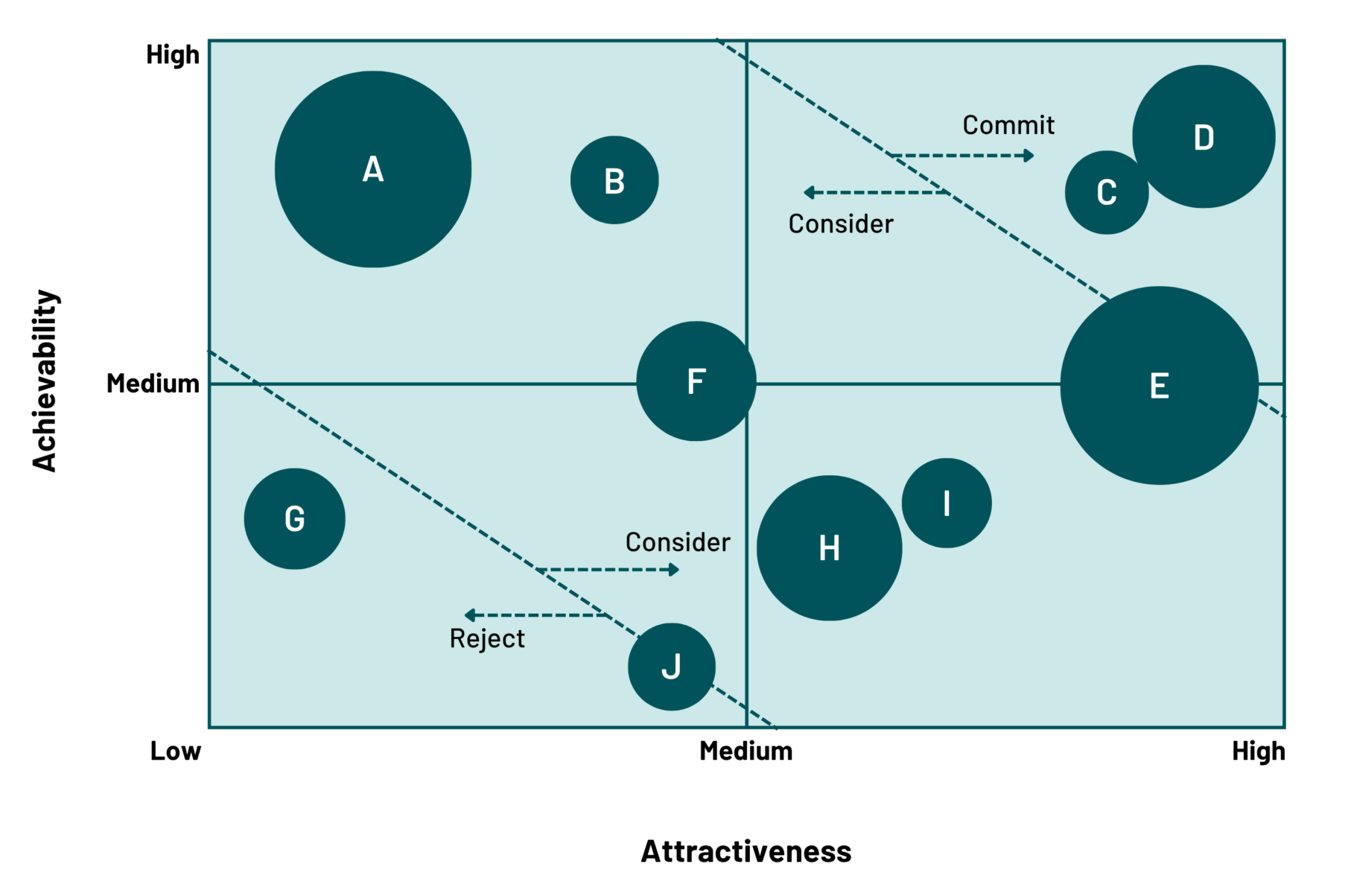
To balance effectively, it is important that such work is not done in isolation but that other functions and areas of the business are involved so that impacts, risks, issues and benefits can be explored and fully understood and communicated to the decision makers. One technique is the production of a portfolio map as shown atFigure 12.2. In this example, financial, achievability and attractiveness scores from the prioritisation of the portfolio are mapped on a chart. Such a map can be used to support validation discussions with stakeholders. For example, in Figure 12.2:
the work component listed as G could be work that ensures an organisation is compliant with new regulations and so, even if it is not attractive or achievable, needs to be done. This might involve accepting the risk or prompting action on how the work could be made more attractive or achievable
the work components labelled as C, D and E are all very attractive to deliver. However, these could all impact the same area of the organisation, reducing the ability for that area to absorb the change. Another possibility is that these are dependent on enabler components that map as less attractive or achievable. In such situations, consideration should be given to the sequencing of these components and therefore when they are authorised to start
Figure 12.2 An example portfolio map with work components plotted against achievability and attractiveness scores and where the size of the bubble indicates the scale of benefit
12.2.3.4 Plan the portfolio
Planning brings all of the work done during the definition of the portfolio into a single plan. The portfolio plan is an elaboration of the portfolio strategy, providing more detail on how the strategy is to be achieved. The portfolio plan should include:
the objectives of the portfolio
the justification for undertaking the plan in qualitative and quantitative terms
the constituent work components
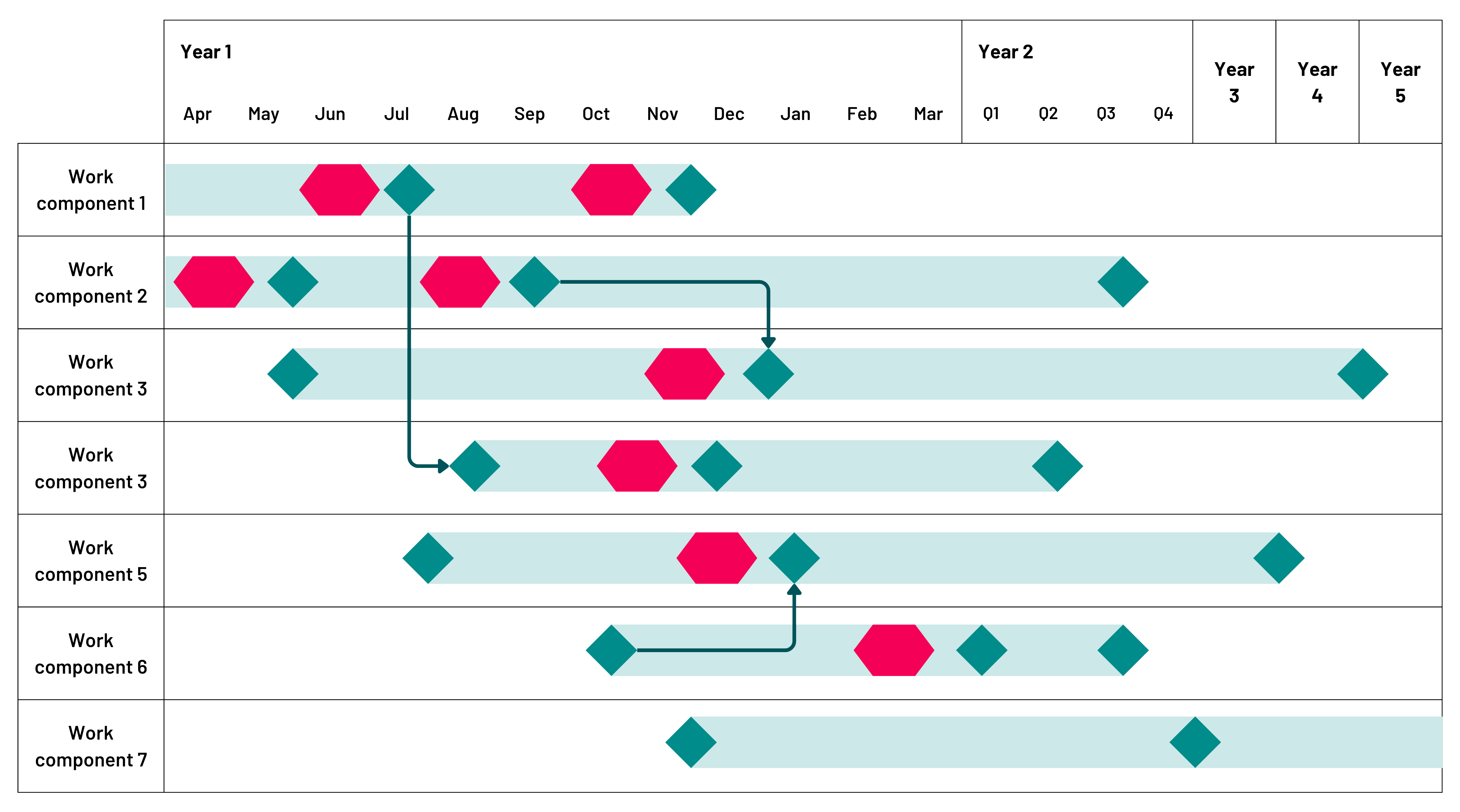
a delivery schedule which is usually done on a rolling, annual basis with more detail available for the current year (see Figure 12.3)
interdependencies between work components or with activities outside the portfolio
sources of funding
cost and resource information and allocations
benefits to be realised and when
portfolio level and aggregate risk and issue information
The plan should be developed in accordance with the guidance set out in Chapter 16: Planning.
The portfolio plan should be approved and baselined to then be used to track performance against. Changes to the plan should be controlled and approved (see Chapter 22: Change control).
There can be a tendency to try and create a single, detailed Gantt chart mapping out all the activities planned in each work component. Similarly, it can be tempting to try and have sight of all the dependencies within each work component and manage them. Both should be avoided. The management of such a large amount of information by rolling up detailed programme and project plans into a portfolio plan has little value at the portfolio level and duplicates and undermines the work of the programme, project and team managers in scheduling their work. Instead, an appropriate level of schedule needed for the control and management of the portfolio overall should be defined with the portfolio director and relevant boards focused on major decision points and assurance reviews.
Figure 12.3 A simplified example of a five-year rolling portfolio schedule showing decision points, assurance activities and dependencies
12.2.4 Validating objectives and strategy
The purpose of validating the portfolio’s objectives and strategy is to ensure periodically that they are still current and affordable and the right programmes, projects and other related work are being undertaken.
The portfolio should be validated whenever a new work component is initiated or changed as these decisions can have a major influence on the rest of the existing portfolio’s work components. However, the portfolio should be formally validated from time to time (such as quarterly or half-yearly, depending on the volatility of the portfolio) to check it is still serving its purpose and has not drifted off course or if a significant external influence has been omitted. Such formal validation activities should be scheduled in the portfolio plan. The portfolio director, manager and relevant boards should also trigger validation activities outside the schedule whenever changes in the organisation’s strategy, plan or environment are identified. If the portfolio’s vision and strategy need to be changed, the portfolio’s definition and plan should be analysed to understand if it still represents the optimal collection of work components. This might result in current work components being terminated, paused, rescheduled or having their scope revisited and new work components being identified and authorised. Validating the portfolio might sound like a lot of work but it is fundamental to portfolio management and therefore core to those working in the portfolio team
The purpose of authorising the start of work components is to ensure that new work components are identified, defined, prioritised and authorised to start in accordance with the portfolio plan.
Authorising the start of work involves managing the portfolio’s potential work components in a structured way, selecting those that are likely to be included and tracking them until they are either authorised as part of the portfolio or rejected.
Figure 12.4 Potential, prioritised and authorised work components
Managing the pipeline is concerned with achieving 3 things:
policy and idea generation while balancing the risk of too many against too few potential work components
having a controlled entry point to the portfolio and for the authorisation of work
setting up work components to succeed by being clear about the problem to be solved (or opportunity to be exploited) and devoting sufficient attention to programme and project initiation and development
This can be achieved by having a set of criteria, both for selection as a prioritised work component and for the portfolio itself. Before a work component is considered for authorisation, the portfolio manager should ensure that an impact assessment is conducted of financial, resource and technical capability and availability, and that the programme or project does not duplicate other related work.
Authorised entry into the portfolio should be aligned to the initial decision point for starting the first phase of a programme or project. At this point, the decision is not based on a business case but instead on the approval of the programme or project brief (see Chapter 14: Programme and project life cycles).
This decision is concerned with confirming there is a real policy need or opportunity which needs addressing now and that:
the envisaged outcome is desirable
the work can be justified
risks have been identified and are acceptable or can be mitigated
the solution is (or if not known, is likely to be) acceptable
funding and resources are available to complete the work and support any outcomes
there is an outline plan for the work
This involves reviewing the vision, justification and outcomes for a programme or project together with any strategic assumptions before any funding and resources are committed (see Chapter 15: Managing a programme or project).
At this point, the portfolio director should ensure that an appropriately skilled and experienced senior responsible owner and programme or project manager have been appointed.
Government Major Projects Portfolio and appointing senior responsible owners
Programme or projects in or expected to join the Government Major Projects Portfolio, should appoint the senior responsible owner, by letter, jointly from the accounting officer of the sponsoring organisation and the Government Head of Project Delivery (or as delegated to the Government Head of Profession for Project Delivery). The letter should be published on GOV.UK. See The role of the senior responsible owner for more information.
Departmental Major Projects Portfolio and appointing senior responsible owners
Programme or projects in or expected to join the Departmental Major Projects Portfolio should appoint the senior responsible owner by letter from the accounting officer of the sponsoring organisation. See The role of the senior responsible owner for more information.
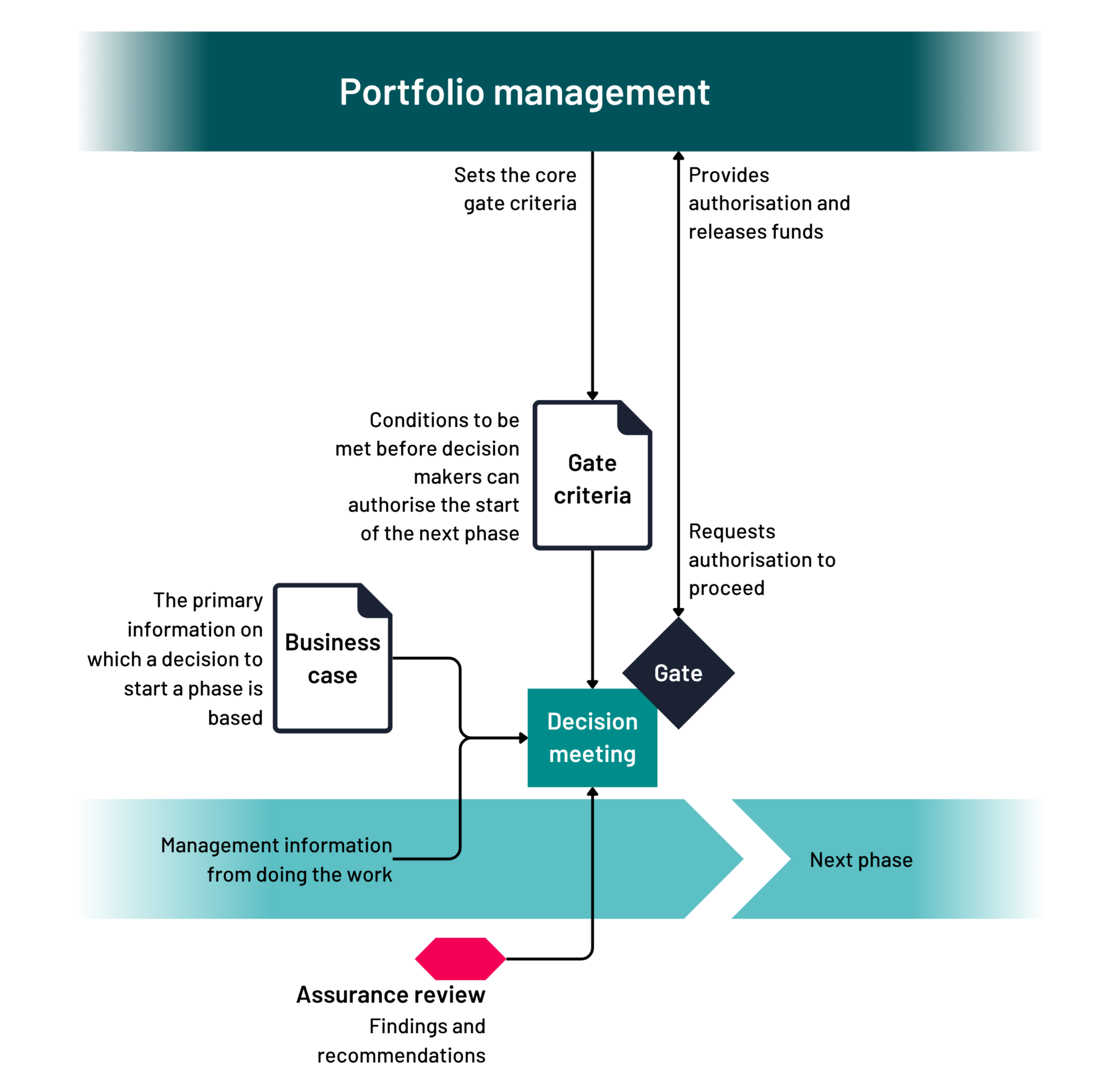
When authorising the start of work, the portfolio director and any relevant boards should clearly define the tolerances and constraints that the senior responsible owner should operate within. Work should be authorised on a phased basis to contain risk by limiting the amount of expenditure and effort until enough information is available to make a decision on whether the work should continue. As such, the portfolio manager should ensure that each work component has an integrated assurance and approval plan and that this aligns with the decisions expected from the portfolio director and relevant decision-making body (for example, an investment committee).
Figure 12.5 Potential interactions between the portfolio and a programme or project at a gate decision point
12.2.6 Monitoring and analysing delivery
The purpose of monitoring and analysing delivery is to ensure that the performance of the portfolio is analysed, understood and corrective or preventative action taken, if needed.
The aspects of the portfolio that should be monitored and analysed include:
outcomes achieved and benefits realised
adherence to defined constraints (such as cashflow, cost, schedule and risk)
Being able to analyse portfolio delivery requires an understanding of the performance of the work components in the portfolio and those being assessed for inclusion. The portfolio office should get performance data by having direct access to programme or project information systems, or by collecting reports.
Stakeholders should be engaged and their attitudes and influence monitored, with new stakeholders identified and existing stakeholders re-evaluated. New risks and issues should be identified, existing ones managed and the aggregate risk for the portfolio analysed.
Action should be taken to ensure the portfolio meets its objectives in line with its plan and within the defined constraints. This might include additional support or scrutiny, or result in existing work components being identified for amendment, rescheduling or termination or the need for new work components being authorised.
The purpose of performance reporting is to ensure that the performance of the portfolio against the plan is provided to inform decision makers and others who rely on the information to fulfil their roles.
Portfolio performance reports should be drafted and issued in accordance with the guidance in Chapter 18: Reporting. They should include information on aspects such as:
funding and costs
outcomes and benefits
milestones
risks and issues
Reports should show progress as reflected against the portfolio’s baselined plan with analysis and commentary to explain variances and the actions being taken to correct or prevent them. Reports should also include forecasts for future performance.