The purpose of stakeholder engagement is to ensure that the needs and concerns of stakeholders are addressed appropriately to meet the objectives of a portfolio, programme or project.
Previous
Chapter 25: Procurement and contract managementThe Teal Book: Part E

Orders are open until 31 December 2026.
The purpose of stakeholder engagement is to ensure that the needs and concerns of stakeholders are addressed appropriately to meet the objectives of a portfolio, programme or project.
Stakeholders may be sponsoring or investing in the work, involved in delivering it, affected by it, or have a broader interest in it, for example as a campaigning organisation.
In government, some stakeholder engagement is required by law, for example as part of public consultation and impact assessment.
Effective stakeholder engagement throughout the life cycle:
Understanding stakeholder interests and expectations helps to:
Where stakeholders have concerns about the work, or oppose it, it is important to recognise and understand these concerns, including their potential impacts, and consider how they can best be addressed.
Engagement with a diverse range of stakeholders to inform policy and delivery options development is a way to identify impacts on different groups. This helps ensure the work is designed with equality, diversity and inclusion in mind (see Chapter 5: Equality, diversity and inclusion), as part of the government’s obligations under the Public sector equality duty.
Stakeholder engagement requires a systemic approach to stakeholder identification, analysis, planning and engagement activities through the life cycle.
The Project delivery glossary defines a stakeholder as:
Individual, group or organisation that can affect or be affected by, or perceive itself to be affected by a decision, initiative or activity.
It is closely aligned to communications which focuses on the design, delivery and evaluation of messages and campaigns at defined audiences (see Chapter 27: Communications).
In government, project delivery can impact on or engage the interest of multiple stakeholders, sometimes with very different expectations and perspectives. These might include:
Stakeholder analysis is carried out to identify groups and individuals who have a stake in the work, the nature of their interest, expectations and influence, so that these can be represented in planning and considered throughout the life cycle. A list of stakeholders forms the basis of the stakeholder register.
A stakeholder engagement plan is then developed as part of planning (see Chapter 16: Planning), defining how to engage stakeholders in a co-ordinated and appropriate way. The plan should be implemented, monitored and updated to reflect newly emerging stakeholders and changes in the position of existing stakeholders as the work proceeds.
Engagement can be designed to:
Some stakeholders are also engaged directly in the work, for example in:
Stakeholder attitudes should be assessed, updated and validated throughout the work. The views of stakeholders should also be considered as part of learning from experience, post-programme and project evaluation, and benefits realisation.
Stakeholder engagement can take many forms and so can involve a range of people across the team. Accountability and responsibility for stakeholder engagement should be clearly defined within the governance and management framework and reviewed on a regular basis, to avoid duplication or gaps.
The portfolio director, in a portfolio, or senior responsible owner, in a programme or project, is accountable for stakeholder engagement, including owning the stakeholder engagement framework and plan, and engaging with the most critical and senior stakeholders.
The portfolio, programme or project manager, as appropriate, is accountable for developing and managing the stakeholder engagement framework, register and plan, including ongoing monitoring, review and evaluation, as well as any specific stakeholder engagement activities allocated to them.
Everyone in the team should understand how stakeholders are to be engaged and what information is (and is not) to be shared, with whom and when. This matters even if team members are not directly involved in stakeholder engagement activities, to reduce potential for confusion and miscommunication.
In general, any person with a legitimate interest may identify a stakeholder. In practice stakeholders are normally identified in the early phases of the work by the sponsoring body or the team itself, including suppliers. For public works stakeholders may often identify themselves.
Depending on the scale of the work, there could be a dedicated stakeholder manager or team with responsibility for developing and maintaining the stakeholder register and engagement plan and managing engagement activities, either themselves or through an engagement owner. An engagement owner is responsible for building the relationship with their assigned stakeholder. The stakeholder manager and engagement owners should work closely with the business analysis, business change and communications teams. In some cases, the stakeholder manager may also act as the engagement owner for specific stakeholders.
More detail on the stakeholder manager role and competencies can be found in the Project delivery capability framework.
The approach to stakeholder engagement, monitoring and evaluation should be tailored to suit the nature of the work and the phase of the life cycle. Large portfolios, programmes and projects, particularly those involving contentious proposals or extensive organisational or social change, require a more developed approach and more ongoing management than simpler ones.
Engagement activities should also be tailored to the particular position, interests and perspectives of different stakeholder groups, and should reflect their needs and preferences, for example in terms of how best, where and when to engage. Stakeholders have a choice whether or not to engage so the approach needs careful consideration. For example, a stakeholder unfamiliar with government can find it easier to explain their perspective in their own environment. Employees might prefer to use an existing meeting rather than add another one. When in doubt, ask for their preferences or provide options.
Stakeholders vary considerably, not only in terms of their interest and attitude towards the work but also in terms of their power and potential influence on it. Sources of power can include:
Influence can stem from power but also from other sources, for example:
Government project delivery takes place in a complex socio-political context, where stakeholders do not operate in isolation but are part of a complex system of social networks. Understanding this and factoring this into planning and engagement activities is therefore critical for effective stakeholder engagement. Power and influence can be visualised on a power-influence matrix (see Figure 26.2).
In engaging stakeholders, openness and consistency are key to building confidence and trust. It is important to ensure that an accessible and consistent overall narrative, with a supporting body of information, is maintained for sharing with stakeholders, tailored appropriately to their interests and contribution. This is especially important in mass communications (see Chapter 27: Communications) where external scrutiny, by groups such as the media and campaign and special interest groups is likely. Care should be taken, particularly in larger and more complex work, to avoid confused or conflicting information being given to different (or even the same) stakeholders. Where information cannot be shared, or shared yet, the reason why should be explained. See also Chapter 24: Information and data management.
Stakeholder engagement is most effective when it helps to build enduring relationships based on trust, rather than as a one-off transactional activity. This can mean starting to engage with some stakeholders early in the life cycle, before their input is needed, and maintaining the relationship afterwards.
Two-way communication and feedback are key to successful stakeholder engagement. If a stakeholder takes time to contribute their views and hears nothing further, they could conclude that their input was not valued or has been ignored. Providing feedback, not just on what decisions were taken but also why, is important in ensuring that stakeholders feel heard. Similarly, if a difficult message has to be given, it is likely to land better if stakeholders hear it directly rather than through other channels. Even where an unwelcome decision has been made, direct communication helps show a stakeholder is still valued and can help build trusted relationships for the longer term, despite disagreement. (See also Chapter 27: Communications).
Not all stakeholders are likely to be positive about the work. For some people, the changes proposed can be seen as disruptive or threatening in terms of how it might affect their work or their lives. Strong stakeholder resistance can delay or stop work, increase costs or reduce benefits, or even lead the sponsoring body to decide to cancel it altogether. Identifying where resistance can come from, recognising the signs, and taking steps to manage it are all essential to effective stakeholder engagement.
Stakeholders can be:
Active opposition is usually easy to identify: while it might not be possible to change an opponent’s views, handling can be planned for as part of stakeholder engagement and communications. Some sources of resistance are less obvious: some critics might not be obvious but gradually undermine confidence; some people who appear neutral prove to be negative. Signs of resistance to look out for are:
Such signs of resistance might have alternative explanations: people might not engage because of a heavy workload or personal issues; critical comment often reflects genuine concern and the wish to get the work right. Where in doubt, ask or seek other feedback. Where there are growing signs of resistance, however, this usually means that more, or different, engagement or communication is needed, whether directly with the stakeholder concerned, or with others who might be influenced negatively as a result.
Expect stakeholder interest and engagement to evolve over the life cycle. This often reflects the phase of the life cycle: for example, proposals going through Parliament often drive significant attention from ministers and external interest groups, while service user interest typically peaks during implementation and transition, as changes are introduced.
Stakeholder perspectives can also shift as a result of internal or external changes. For example, a reduction in funding can increase demand for changes that deliver savings or efficiencies; domestic or international policy changes can raise sensitivity and drive opposition to changes.
It is easy to assume that engagement is going well, in the absence of evidence to the contrary. Developing evidence-based indicators to track stakeholder perceptions is therefore important, particularly where work is complex or contentious. External review can also help provide a broader perspective and insight into key issues.
Loss of stakeholder confidence and trust can be very damaging, particularly if momentum builds, and responding quickly is important, particularly if significant concerns or opposition start to arise. Changes in stakeholder engagement assumptions and requirements should be identified as early as possible, together with their impact, for example on schedule and resources, and escalated and managed under change control as part of the integrated plan.
Stakeholder engagement requires a systemic approach to stakeholder identification, analysis, planning and engagement activities through the life cycle. Defining a strategic framework to govern these activities, and deciding on suitable tools and processes to support them, provides the foundation for effective stakeholder engagement.
The first step is to take a strategic view of likely requirements for stakeholder engagement. Is this a short-term project with consistent stakeholders, or an evolving programme where they could change significantly over time? In a portfolio, are there common stakeholders or are they all different? Is the work likely to be contentious or complex, or involve multiple groups with differing views?
This initial view should provide a basis for defining an overall approach for stakeholder engagement, to be set out in the stakeholder engagement framework which forms part of the governance and management framework for the work. The stakeholder engagement framework defines the processes, methods and tools to be used, including how:
Key in the engagement framework is the stakeholder register which includes a list of stakeholders together with information such as:
This register is the primary working tool for keeping information on stakeholders up-to-date.
The other task at this point is to identify what tools are to be used, for example in identifying and profiling stakeholders, analysing and storing data. These should also be set out in the engagement framework.
For small initiatives, information and analysis can be handled on spreadsheets and standard software analysis tools. For larger and more complex endeavours, for example involving public consultation or interaction with multiple stakeholders over time, keeping track and managing complex data sets can be very resource-intensive, and specialist data analysis or customer relationship management (CRM) systems could help.
There are a number of tools which can be used to help analyse and visualise stakeholder information, and some examples are shown in Figure 26.1, Figure 26.2, Figure 26.3 and Figure 26.4. These are often linked to the information in a stakeholder register so that changes in the register are immediately apparent in the diagrams.


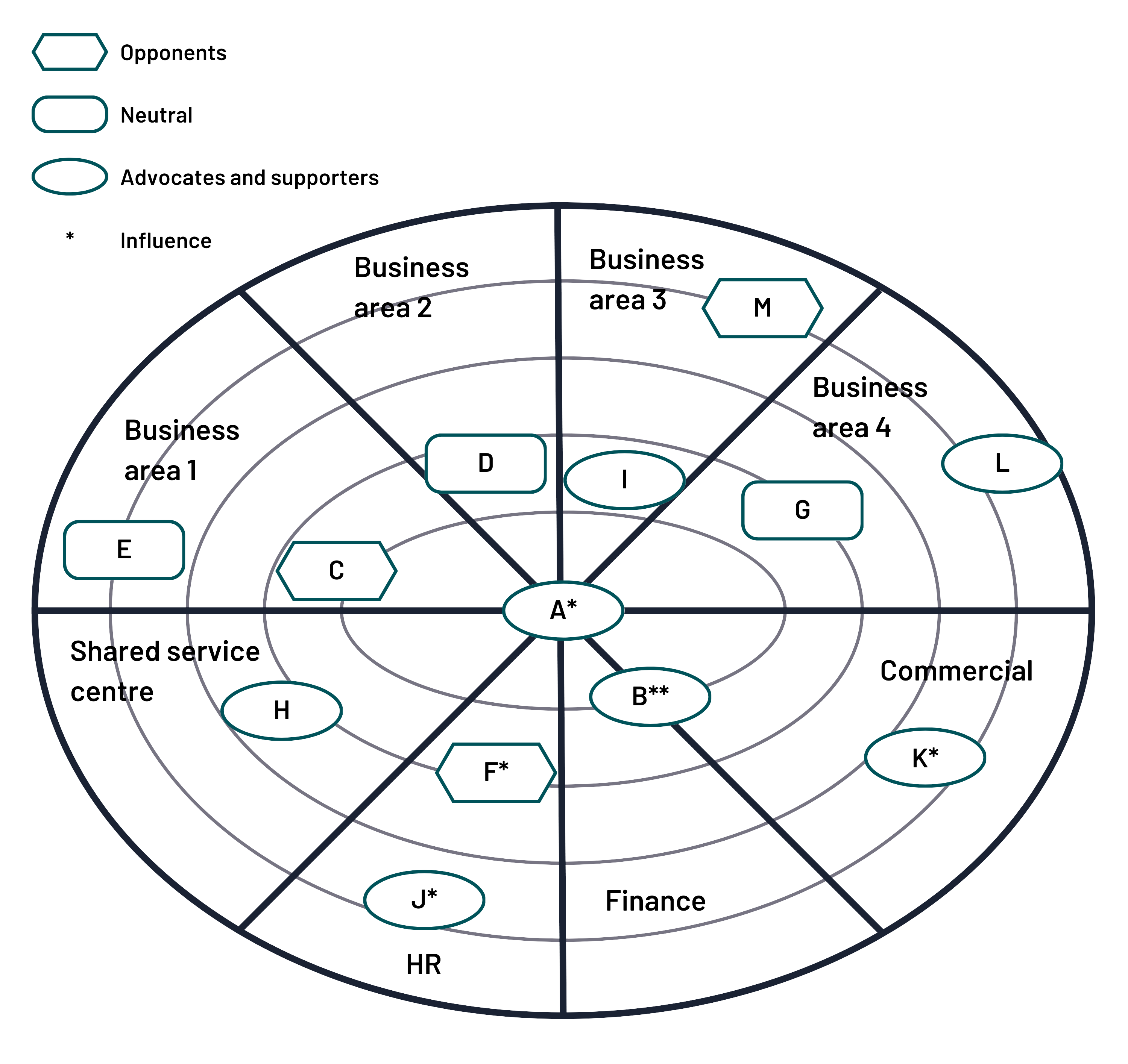
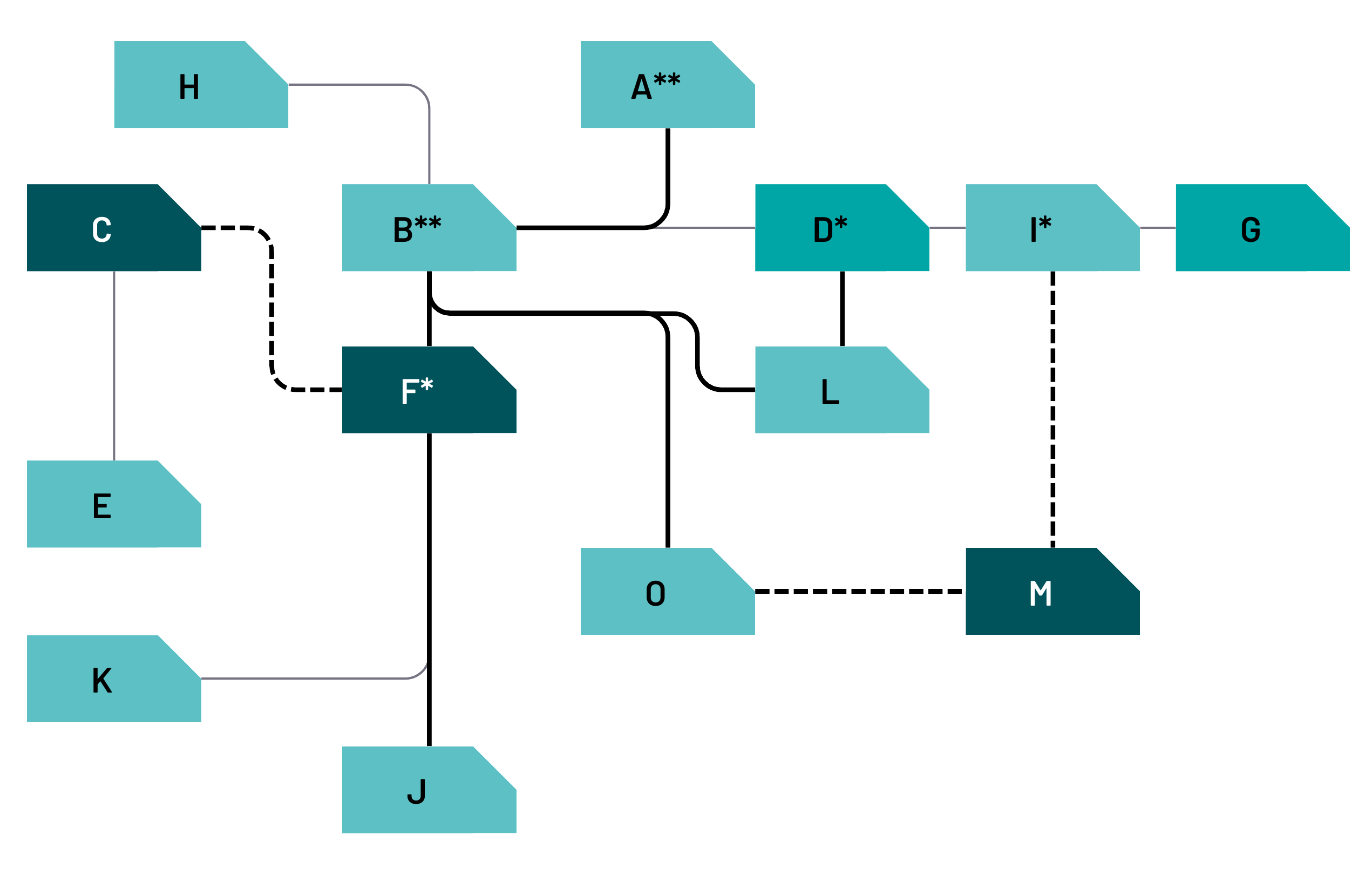
Stakeholder engagement involves a series of related activities, as shown in Figure 26.5 and considered below. These may be sequential or iterative, depending on the nature of the portfolio, programme or project.

The approach to engaging stakeholders should be defined including any processes, methods, tools and techniques to be used. This forms part of the overall governance and management framework for the work (see Chapter 4: Governance and management). The important aspects of this activity are discussed in more detail in 26.6.2.2 on defining the stakeholder engagement framework. The framework should be maintained to address relevant feedback from its use.
This brings together the needs and concerns of all stakeholders to build an overall picture of the challenges and opportunities, and how these might affect the work’s objectives. For example, are there common themes emerging, shared by different groups, or is there a genuine lack of consensus? How should the stakeholders be grouped? Who is best placed to be assigned as the engagement owner?
A preliminary analysis should be done on any identified stakeholders (see 26.6.3.4 on identifying an individual stakeholder or group) to segment them into groups, such as decision-makers, suppliers and users, and against specific areas of interest. These can then be broken down further, for example by role, organisation or geographical location, to support analysis. The list of stakeholders should be verified and held in a stakeholder register which, like a risk or issue register, should be kept up-to-date. The preliminary analysis can then be used to assign an appropriate engagement owner for each stakeholder who is then responsible for further analysis, planning, engagement and monitoring.
The engagement plans for each stakeholder (see 26.6.3.6 for planning to engage the stakeholder) or group should be brought together in a stakeholder engagement plan. A stakeholder engagement plan outlines how all the stakeholders are to be engaged in a coordinated way, with priorities set on those who have the most impact. It draws on the stakeholder register, identifying the stakeholders, their level of interest and influence, and the best methods and frequency of engaging and communication for each stakeholder group. Stakeholder maps can also be included to show the situation at a point in time (see 26.6.2.4 for choosing the appropriate tools). Activities, where significant, should be included in the overall schedule, resource and cost plans for the work. Once approved, the stakeholder engagement plan should be managed under change control, as part of the wider integrated plan (see Chapter 16: Planning).
Throughout the life of a portfolio, programme or project, stakeholder attitudes and perceptions need to be reported on regularly so that the portfolio director and senior responsible owner and their respective boards have an up-to-date understanding of problems or opportunities being faced and can plan any required responses accordingly.
The management framework should be monitored to make sure it remains effective and appropriate as the work proceeds, particularly if things change significantly.
Government project delivery, by its nature, involves many different stakeholders, whether supporting the work, developing and delivering it, being impacted by it, or as organisations and people with a broader public interest. Not all stakeholders are obvious or indeed interested in being involved, even if they are likely to be affected by it in due course. The attitudes of groups and individuals can change over time. A systematic approach to identifying and maintaining an up-to-date register of stakeholders is therefore important, to avoid missing a key individual or group.
Identification usually begins at the start of the work with the stakeholder manager and other team members creating a long list of stakeholders, and then assigning an engagement owner to each individual or group, as appropriate (see 26.6.3.3 on overseeing stakeholder engagement). Additional stakeholders can be identified and added at any point in the life cycle.
Once a stakeholder has been identified, the assigned engagement owner should undertake further analysis to understand the characteristics of the stakeholder more fully, such as their likely interests, attitudes and potential impact or influence on the work. This information is collated to create a profile for each stakeholder that is recorded in the stakeholder register (see 26.6.2.3 on preparing a stakeholder register) and can be plotted onto stakeholder maps. The maps and profiles can be brought together as part of overseeing stakeholder engagement, in the stakeholder register providing a summary view of relevant information for each stakeholder and/or stakeholder group.
Further analysis can also be conducted using this information, for example to show the relative interest and influence of different stakeholders; key interested groups across different phases of the work; and the network of relationships and influence between different stakeholders (see 26.6.2.4 on choosing the appropriate tools). This data can be held in the stakeholder register used by the stakeholder manager to decide on priorities for stakeholder engagement as the work evolves.
The analysis of the stakeholder is then used to develop, in consultation with the stakeholder manager, a plan to engage their assigned stakeholder. As for other plans, the plan can be developed iteratively, with an overall high-level plan, and detailed planning for individual phases. The plan should identify, for each stakeholder or group, the nature and purpose of the engagement, the timing and proposed channels, and who is involved.
The individual stakeholder engagement plan is submitted for approval to the stakeholder manager so it can be checked against plans for other stakeholders and collated into an overall stakeholder engagement plan (26.6.3.3 on overseeing stakeholder engagement).
Once approved, the stakeholder engagement plan is implemented, with activities logged and progress on engagement monitored, through the life cycle.
Often, interaction with some stakeholders starts before a plan is in place, for example with ministers, sponsors and the immediate team. Once the plan is approved, however, it should be used to manage and track engagement across all stakeholder groups, in line with the stakeholder engagement framework.
Progress on stakeholder engagement should be monitored and reported regularly to the stakeholder manager. This should include not only what has been done, but also the response to it, with supporting data and evidence. Where possible, stakeholder views should be assessed, either through direct feedback or other means, for example stakeholder surveys or other available data.
Not all stakeholders need to be engaged throughout the duration of the work; and so direct engagement can, in consultation with the stakeholder manager, be stopped or they could be added to a different group for lower level of monitoring. Once a stakeholder no longer needs to be engaged, engagement activities can cease, and the engagement owner can be stood down. The stakeholder register should be updated to reflect the ‘closed’ status of that engagement.
Following transition to business as usual, stakeholders should be informed and thanked for their contribution to the work, where appropriate, identifying any continuing activities they can support, for example in contributing to work on learning from experience or benefits realisation. Where a programme or project closes, ongoing stakeholder engagement activities can either cease or move to portfolio level.
The effectiveness of stakeholder engagement should be evaluated as part of closing the work. Stakeholder engagement information should be archived in accordance with the sponsoring organisation’s information and data retention policies (see Chapter 24: Information and data management). The stakeholder engagement framework should then be closed.
Added a formal definition of ‘stakeholder’ from the Project delivery glossary, added a reference to Chapter 5: Equality, diversity and inclusion, added alt text descriptions for the four stakeholder analysis figures, renamed the closing activity from ‘Close stakeholder engagement’ to ‘Close stakeholder engagement framework’, and added two further reading references: the Project delivery capability framework and the Public Sector Equality Duty guidance for public authorities.
Addition of missing content on overseeing stakeholder engagement.
Page permissions updated for public launch.
First published for closed beta consultation.