Beta

This is a new service and pages are being tested and improved.

16.1 Purpose of planning

The purpose of planning is to ensure that the outputs, outcomes and benefits of a portfolio, programme or project can be delivered within defined constraints, such as time, cost and risk, to achieve the agreed objectives.

16.2 Key points

  • Planning identifies what needs to be done, when, by who and at what cost, and provides the baseline against which progress is tracked and performance measured.
  • Time spent on planning in the early phases ensures that work meets business objectives and delivers social value.
  • An integrated plan brings together the scope and defined constraints into a single view, providing the evidence needed for decisions on investment
  • Portfolio plans are developed on a cyclical basis and aligned to organisational planning cycles.
  • Programme and project planning is progressive, starting as soon as the work is initiated and adding detail as understanding grows and is used to manage the work through development to delivery of outputs, outcomes and benefits.
  • Planning is collaborative, led by the portfolio, programme or project manager with specialist input and consultation.

16.3 Why plan?

Planning helps to understand what activities and deliverables are needed to achieve the objectives of a portfolio, programme or project, and how best to do so. Planning:

  • ensures that the outputs, outcomes and benefits of a portfolio, programme or project can be delivered within defined constraints such as time, cost and risk, to achieve the agreed objectives
  • enables the necessary funding, resourcing and other requirements for the work to be arranged
  • provides a defined baseline for maintaining control and tracking performance

Time spent on planning in the early phases of work, sometimes known as ‘front end loading’, helps portfolios, programmes and projects meet their objectives and deliver social value.

A flow chart illustrating a cyclical control process with five steps: 1. Plan, 2. Do work, 3. Track progress, 4. Assess and analyse status, 5. Take action. The process is informed by policy and objectives and generates outputs, outcomes, and benefits, as well as reports.
Figure 16.1 Planning as the basis for controlling and reporting on work

16.4 What is planning?

A plan sets out how objectives, outcomes and outputs are to be delivered within defined constraints, in accordance with the strategy agreed for the portfolio, programme or project. A plan provides the basis for decision-making on investment and approvals, for example a programme or project business case or a portfolio investment bid.

Planning identifies the considerations for delivery so that these can be managed in an integrated way through the life cycle, as a portfolio, programme or project plan. This approach is often known as integrated or consolidated planning.

A portfolio plan (also known as a delivery plan) supports the organisation’s strategic objectives and is developed on a cyclical basis as part of organisational business planning, for example as part of a spending review or the annual business planning cycle. Once approved, the portfolio plan is baselined, with subsequent changes managed through change control (see Chapter 22: Change control) until the next planning review.

A programme or project plan (also known as a delivery plan) is developed on a progressive basis from initiation onwards and covers both the development and delivery of the work through the life cycle. The programme or project plan should provide a robust basis for decisions on investment to be taken at the appropriate point in the life cycle. This does not mean work needs to be planned in detail from end to end, as this is often not feasible, for example in large multi-phase programmes, or inappropriate, for example in agile delivery.  The plan for a current phase should be in enough detail to enable decisions to be made and progress to be tracked. Plans for later phases can be in outline, with governance and approvals tailored accordingly.

Once the full business case is approved, the programme or project plan is baselined, with subsequent changes managed through change control until the work is completed. Detailed plans for individual projects or work packages can be developed iteratively, within the constraints and tolerances agreed for the business case and overall plan.

A plan should include the proposed scope of the work to be delivered to achieve the objectives, particularly:

  • outputs and outcomes, what is to be delivered, by who and when by?
  • benefits, what benefits are to be realised, by who and when by?

A plan should also include the anticipated constraints, particularly:

  • time, how long should the work take to develop and to deliver?
  • resources, what people, facilities and equipment are needed to undertake the work?
  • cost, what funding is needed, when and where from?
  • risk, assumptions and dependencies, what are they, how might they affect the plan and how can they be managed?
  • issues, what are they, how do they affect the plan and how can they be managed?
  • quality, how much features and characteristics of an output bear on its ability to show that it meets expectations or stated needs, requirements or specification?

A plan should not only cover the work needed to deliver, build or develop the outputs, but should build on the delivery strategy and cover aspects such as:

16.5 Who manages planning in project delivery?

Planning is a specialist competence within project delivery and requires careful management and tight control. Accountability and responsibility for planning activities should be clearly defined from the outset within the governance and management framework and reviewed as planning develops.

At portfolio level, the portfolio director is the ultimate owner of the portfolio plan, alongside the portfolio’s vision and strategy. The portfolio manager is accountable to the portfolio director for planning and managing the portfolio as a whole, ensuring that its work components are sufficient to meet the portfolio’s objectives.

In a programme or project, the senior responsible owner is the ultimate owner of the delivery plan, alongside the business case. The programme or project manager is accountable to the senior responsible owner for planning the work needed to deliver the business case, and for monitoring and controlling the plan on an ongoing basis. Work package or team managers are accountable to the project manager or a higher level work package or team manager for planning the work needed to deliver the work plan for the work package and for managing the plan on an ongoing basis.

Depending on the scale of the work, there could be a dedicated planner or planning team, reporting to the programme or project manager or to a dedicated planning manager, with responsibility for developing and maintaining the integrated plan. Work package managers and others, for example finance and human resource managers, commercial specialists and economists should also contribute to planning.

More detail on planning roles and competences can be found in the Project delivery capability framework.

16.6 How to plan

16.6.1 What to consider

16.6.1.1 Tailoring the approach

The approach to planning and the detail needed to monitor and control (see Chapter 17: Controlling) effectively should be tailored to suit the nature of the work being planned. Large portfolios, programmes and projects, particularly with dispersed planning teams, need to have more developed procedures, tools and support than simpler ones.

Often work is managed by suppliers. It is unlikely that those managing at a higher level would have direct access to a supplier’s planning systems and so it is important to specify what data is needed, how it is to be delivered, how often it is updated and how current it should be, so that the relevant information can be considered when planning, monitoring and controlling the delivery plan.

Planning often includes multiple documents developed over time, sometimes in different formats and at different levels of detail. Their format and relationship should reflect the nature of the work and enable them to be managed as an integrated product or set of products.

16.6.1.2 Planning portfolios: cyclical planning

Portfolio planning is usually cyclical and aligned to a spending review or the annual planning cycle.

Portfolio planning rarely starts from scratch, unless it is an entirely new portfolio. Typically, a portfolio plan is built up from existing programme and project plans, making provision for risk and contingency on a cross-portfolio basis. Plans are assessed in terms of what they are required to deliver against organisational strategic objectives and also against agreed or expected constraints, for example time, cost and resources and risk. When shortfalls are identified against objectives, or constraints exceeded, changes are proposed, either to reduce or increase planned activity, usually involving some form of formal prioritisation exercise.

Portfolio plans cover a range of activities. They are developed only to the level of detail needed to support decisions on priorities and monitor portfolio performance. This includes decisions to intervene, for example, if a programme or project goes out of agreed tolerances, such as on cost, schedule, risk, resource use or benefits.

Once approved, the portfolio plan is baselined. The Project delivery glossary defines a baseline as:

A reference basis for comparison against which performance is monitored and controlled.

Subsequent changes are managed through change control until the next planning review.

Plans should be kept updated as detailed planning progresses at programme and project level. They should also be reviewed when there is new information or assumptions change. Portfolio plans should be reviewed regularly, usually at least annually and sometimes quarterly. This may be aligned to the fiscal cycle and the organisation’s financial management cycles.

For more information on portfolio planning see Part C: Managing portfolios.

16.6.1.3 Planning programmes and projects: progressive planning

Planning programmes and projects is more linear because of the need to deliver policy-driven outputs and outcomes within spending cycles. Programme and project plans should be developed progressively through the early phases of the work. Decisions need to be made on how best to organise the work into phases and the delivery approach to be adopted in each phase (for example, predictive, iterative, incremental, adaptive, or combined), so that planning is structured accordingly. See Chapter 10: Tailoring to the nature and context of the work, and Chapter 14: Programme and project life cycles.

In the early phases, a delivery plan might be based on uncertain information. It should reflect this uncertainty, for example by using probability-based estimates for time, cost, resourcing and benefits. These are best expressed as ranges with appropriate provision for risk. As delivery options are explored, activities, costs and resource needs are identified, and decisions made, planning can become more detailed.

Even when plans firm up, planning is rarely exact and needs to provide for known and emerging threats and opportunities. This might mean setting agreed tolerances within the delivery plan or building in float to protect critical milestones. Where a high degree of uncertainty or volatility is expected, phasing and incremental delivery can help manage this while keeping the work moving forward (see Chapter 14: Programme and project life cycles).

Plans should be based on robust, evidence-based estimates, fully aligned to the schedule, and factoring in risk, contingency and optimism bias. This should be in line with the Green Book (requires sign in), Cost estimating guidance (requires sign in) and Best practice in benchmarking. Once approved, a delivery plan should be baselined, with subsequent changes managed through change control (see also 16.6.3.8 on approving, baselining and maintaining the plan).

Further information is also set out in Chapter 19: Benefits management and Chapter 29: Finance.

16.6.1.4 Taking account of risk

Understanding risk is an integral part of planning, as the aim is not only to produce an achievable plan but one which adequately considers risk appetite and optimises risk. A range of risk-based planning and estimation tools and techniques can be used (see Chapter 20: Risk management) and further information available in the Green Book (requires sign in), Orange Book (requires sign in) and in the Cost estimating guidance (requires sign in).

A strategy for managing risks on an individual and aggregate level should be developed. This strategy should be considered within the delivery strategy and plan (see Chapter 20: Risk management). These choices need to adequately factor in and adjust for the risks associated with significant decisions, for example around procurement, verification, integration, transition into use, organisational and societal change and validation (see the relevant chapters in Part E: Planning and control and Part F: Solution delivery of The Teal Book).

16.6.1.5 Ensuring traceability

Planning should provide a clear line of sight from the objectives of a portfolio, programme or project through to outcomes and outputs, and the solution chosen to deliver them. Planning documentation should be traceable to the parts of the solution, and from there to outputs and outcomes. Once approved, the plan should be managed under change control so that it is clear what each work package is delivering, who is accountable, where any work is delivered externally, for example as part of a contract package, and what (if any) contract package the work is included in. For more information see Chapter 23: Traceability management.

16.6.2 Preparing for planning

16.6.2.1 Define the planning framework

Before starting to plan, it is important to define the planning approach to be used. This should match the nature, scale and complexity of the portfolio, programme or project, and the expected delivery approach, for example predictive or iterative delivery.

Planning in government should also take account of central government and organisational requirements, particularly in relation to spending reviews, annual business planning and investment. The Green Book (requires sign in) and its supporting guidance set out requirements for investment appraisal and business case development which apply to all programmes and projects involving significant central government expenditure. Planning should also follow guidance on analysis and evaluation set out in Government Functional Standard for Analysis, and in The Aqua Book (requires sign in)andThe Magenta Book (requires sign in).

In defining the planning approach, it is also important to consider how planning is organised: what planning activities are needed and when, who carries them out, and how the integrated plan and other planning products are to be structured, managed and stored.

A range of planning tools are available to support planning, ranging from widely available project delivery planning software to specialised integrated planning, scheduling and cost management solutions. Planning can be resource-intensive, and planning tools can therefore be useful, particularly in large scale and complex work, for example in major infrastructure and defence projects.

16.6.2.2 Choose the level of the plan

Planning is often conducted at different levels, starting with the high-level plan, and then developing more detailed work plans for different work packages, with activities repeated at different levels. Typically, the levels are:

  • level 1, an end-to-end ‘executive summary’ view on a single page
  • level 2, a more detailed ’management summary’, broken down into major work components, and used for higher level management reporting
  • level 3, a view of activities at work component level, used to co-ordinate and manage activities within and across work packages, typically bringing together detailed views of delivery through work plans(level 4), and in large or complex projects supported by level 5 plans to manage technical delivery

Portfolio plans also follow this approach but are rarely developed below level 3, relying on the more detailed programmes and projects plans: see Part C: Managing portfolios.

16.6.2.3 Consider requirements for consultation, assurance and approval

Planning is a collaborative activity and involves input from a range of people within the team and beyond it, including stakeholders, suppliers and others who may need to be consulted or informed. Internal and/or external assurance of plans, and scrutiny as part of investment or business case approvals, are also normally required.

Identifying formal consultation and other statutory planning requirements early is critical, as they need to be factored into planning and can impact significantly on time, costs, resources and risk profile, particularly if consultation or planning approvals are potentially contentious. Requirements vary but typical examples are:

  • projects involving building, engineering or changes in land use might need formal planning permission under national or local statutory planning requirements
  • major infrastructure projects might require statutory legislation, preceded by regulatory impact assessment and public consultation, to secure parliamentary approval to proceed
  • programmes and projects involving significant organisational or business change can require formal consultation with employees and representative bodies

Regulatory and other formal impact assessment, and associated consultation requirements, should have been considered as part of initial policy development, together with obligations arising from the public sector equality duty (see Chapter 2: Policy and evaluation). However, further impact assessment and formal consultation might be needed as plans develop or as a condition of approval. Planners should therefore check what has been carried out previously, what else is needed and ensure that all requirements have been met or are included in plans. Further information on impact assessment is set out in the Green Book (requires sign in).

Assurance and approval requirements should be set out in an integrated assurance and approvals plan (IAAP), to enable the planning, co-ordination and provision of assurance activities and approval points throughout the life cycle (see 13.4.5 on programme and project assurance).

Government and Departmental Major Projects Portfolios and Integrated assurance and approvals plan

Programmes and projects in the Government or Departmental Major Projects Portfolios are required to have an agreed Integrated assurance and approvals plan by HM Treasury and the National Infrastructure and Service Transformation Authority as part of HM Treasury’s Treasury approval process for programmes and projects (requires sign in).

16.6.3 Key planning activities

16.6.3.1 Overview

Planning involves a series of related activities, as shown in Figure 16.2 and considered below. These may be sequential or iterative, depending on the nature of the portfolio, programme or project.

A flowchart depicting a planning process. It shows the steps involved in developing and maintaining a planning framework, including defining scope, deciding and sequencing activities, developing the plan, integrating and reviewing the plan, approving, baselining, and maintaining the plan. The roles of the "Planner" and "Planning Manager" are shown with their respective responsibilities in each step. The process also highlights the importance of feedback, learning from experience, reporting, objectives, risks, and traceability.
Figure 16.2 Overview of key planning activities and their primary relationships

16.6.3.2 Develop and maintain the planning framework

The approach to planning should be defined including any processes, methods, tools and techniques to be used. This forms part of the overall governance and management framework for the work (see Chapter 4: Governance and management). The important aspects of this activity are discussed in more detail in 16.6.2.1 on preparing to plan. The framework should be maintained to address relevant feedback from its use.

16.6.3.3 Oversee planning

The planning manager oversees the development of the plan which should normally comprise the activities below. They should maintain an overall view of planning, its wider context and prevailing risks and issues, and ensure that it reflects current reality and both current and emerging risks. They should also ensure that the various elements of the plan are mutually consistent and that the plan reflects both the higher and lower-level plans. For example, a project plan should reflect the work plans for each work package and also those for the portfolio or programme to which it contributes.

It is important to recognise, however, that the planning framework needs to be monitored to make sure it remains effective and appropriate as the work proceeds.

16.6.3.4 Define the scope and break it down into components

Planning should start from the objectives of the portfolio, programme or project. These can be expressed as a combination of benefits, outcomes and outputs, which together provide the basis for defining the scope. Understanding why a change or solution is needed, what the expected outcome is, who is expected to benefit and who else could be impacted is a core part of initial policy development. This should be the starting point for ensuring that the solution developed meets the objectives and that an achievable and realistic plan to deliver it is developed.

Understanding the context for the work, and what impact this could have on funding, timing and risk appetite, is critical in clarifying the constraints around the work in terms of resources, cost, schedule and risk. It also informs other elements of planning, for instance in identifying user needs and requirements (Chapter 31:User needs and requirements), developing stakeholder engagement and communications plans (Chapter 26: Stakeholder engagemeent and Chapter 27: Communications), and procurement (Chapter 25: Procurement and contract management).

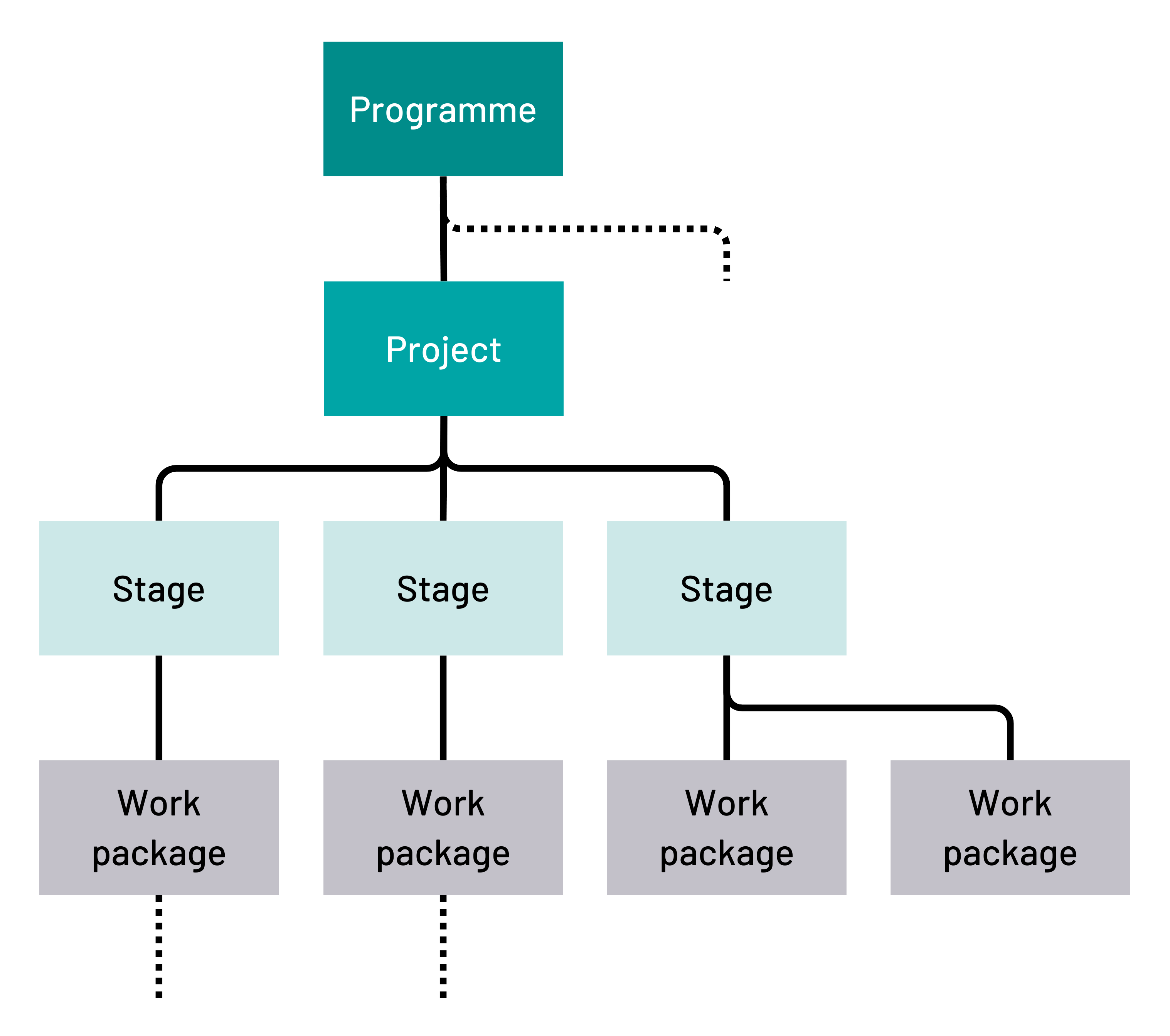
Once the scope is understood, a work breakdown structure should be defined in broad terms initially, showing how each work component contributes to overall scope. It is then developed progressively, as activities are planned in more detail

Accountability is defined for each component of the work breakdown structure so that work can be allocated. Expected duration, cost and resource requirements are added for each component, providing the starting point for schedule, cost and resource planning. From this, other breakdown structures can also be developed to provide different perspectives for planning, such as cost, resource, solution hierarchies (sometimes called a system hierarchy or product breakdown structure), epics and user stories. Whatever breakdown structures are used they should be traceable to the elements of the solution and so to the overall scope to be delivered (see Chapter 23: Traceability management).

A robust work breakdown structure, aligned to resource, time and cost estimates and delivery schedules, is essential for controlling cost and understanding performance. The structure should be retained and stored appropriately, both for review purposes and for potential future use in planning and managing similar work, thus saving significant cost and effort.

A hierarchical diagram illustrating the breakdown of a programme into projects and further into stages and work packages. The programme is the top level, followed by a project, which is divided into multiple stages. Each stage consists of several work packages.
Figure 16.3 A typical work breakdown structure

16.6.3.5 Decide and sequence work activities

Once the work breakdown structure has been broadly defined, the specific activities required to deliver each work component are planned in more detail and added, enabling initial estimates of duration, cost and resource requirements to be refined. Dependencies between work components and activities, and with external factors (for example in different projects within a programme), risks and assumptions are also identified.

Work activities are then organised into a logical and manageable sequence of work packages, often shown in a network or precedence diagram, providing the basis for building the schedule and other elements of the integrated plan.

The organisation of work activities should be determined by the needs of the work and the associated constraints, and can be managed in different ways.  For example:

  • work activities can be organised sequentially, showing a sequence of activities based on an identified critical path, showing the shortest time to complete the work
  • work activities can be organised by resources, an approach known as critical chain, showing how the available resources can be used to best effect
  • work can also be organised on an iterative basis, using time-boxing or fixed periods of activity (sprints), which can be sequential or in parallel, to develop the work within the overall constraints agreed

Ultimately, however, all work activities, however organised, are brought together into a consolidated view to provide the basis for developing the plan.

16.6.3.6 Develop the plan

Overview

Once the work activities have been identified, the different elements of the plan can be developed, usually starting with the schedule, and then adding estimates of resources and costs to deliver the work and other considerations, aligned to the schedule.

Develop the schedule

The schedule is developed from the proposed organisation and sequencing of activities and their estimated duration. It shows how long the overall scope of work and the activities within it are expected to take, and so whether delivery is feasible within identified schedule constraints. It also identifies when assurance and approvals are likely to be needed. Once approved, the schedule is baselined to become a critical control for managing the work, tracking progress and assessing performance.

A schedule should be shown in terms of public sector planning timescales, showing activities within or across financial years, usually broken down into shorter periods (quarters, months, weeks or days), depending on the work and granularity of planning.

In the early phases of developing the schedule, the schedule is high level and usually developed on a deterministic (‘bottom up’) basis, without considering risk and uncertainty. Benchmarking can also be used to provide a ‘top down’ view. At this point, however, timescales should be given as ranges rather than point estimates. As the schedule develops, probabilistic analysis should also be conducted, for example Monte Carlo or curve analysis, in order to test and refine the schedule.

By the time a plan is ready to be approved, the overall schedule should be robust and evidence-based.  The plan should include critical milestones and, where appropriate, the critical path, critical chain, time-boxing or sprints proposed for delivery. It should also make appropriate provision for risk and contingency, and align fully to cost and resource plans.

More detailed activity schedules may be developed within each work package to manage and control delivery, but these should always be traceable back to, and within the tolerances agreed for, the approved and baselined schedule.

Identify the resources needed

The people capability and other resources required to carry out the work should be identified. Capability requirements should be estimated for each work activity, both in terms of competency (professional skills, both type and level) and capacity (how many people are needed). Other resource requirements to consider can include equipment, facilities or other considerations.

Resource planning should develop progressively, moving from initial estimates to granular planning linked to each work activity within the schedule. This is often conducted as part of wider organisational design planning for the work, which determines the organisational structures for delivering the work, including how resources can best be sourced, for example internally or using consultancy or an external delivery partner.

As for other elements of planning, resource plans need to be granular enough to enable work to be costed for the business case and to support the current phase or work, future phases can be planned in outline only. However, it is still important to consider likely needs over the life cycle and how best to resource them efficiently, even where delivery is planned to be iterative.

Planning should also consider how resources can be balanced and optimised across work activities (sometimes known as resource levelling), to avoid peaks and gaps in activities which mean people or other resources are over-stretched or under-used at different points through the life cycle. This could mean changing the sequencing of activities in the schedule, which is why schedule and resource planning need to be closely aligned. Planning should also identify when activities are completed and resources are no longer needed, so that they can be reallocated or moved on in an appropriate and considerate way.

Resource requirements can be estimated in hours or days, but should be set out on a full time equivalent (FTE) basis, in work days aligned to the schedule, with costs per FTE identified so that they can be costed accordingly. When ready for approval, the integrated plan should include a robust, evidence-based resource plan, fully aligned to the schedule (sometimes referred to as a resource-loaded schedule), and making provision for risk and contingency. See also Chapter 28: Resource management.

Determine benefits and costs

Determining benefits and costs is the final element of planning, informing investment approvals, evidencing social value and affordability, and organisational financial planning.

The total benefits arising from the work should be identified by work component, showing when they arise across the life cycle (including those arising during delivery).

The total costs for the work should be determined, broken down by work component, and allocated across the schedule to show when funding is needed.

Both benefits and costs should be presented by financial year, broken down as appropriate, and identified in terms of public sector expenditure funding categories and types of social cost and benefit. This is particularly important for any cash releasing benefits.

Categories for public sector expenditure funding are set by HMT’s Budgeting framework, described in Consolidated budgeting guidance to support management of finance (see Chapter 29: Finance). Categories for social costs and benefits are set by the Green Book (requires sign in).

As for other planning, estimation of benefits and costs is progressive as planning becomes more detailed, and the time of approval should be based on robust, evidence-based estimates, fully aligned to the schedule, and factoring in risk, contingency and optimism bias in line with requirements set out in the Green Book (requires sign in)Cost estimating guidance (requires sign in) and Best practice in benchmarking (see also Chapter 19: Benefits management and Chapter 29: Finance).

Develop other plan elements

While time, resource and cost are the most critical elements of planning, most work involves other elements of planning, for example, on procurement, communications and stakeholder management, covered elsewhere in Part E: Planning and control. These should follow the same principles as for other elements of planning, be fully aligned to the schedule and integrated with other planning elements as part of the overall plan ready for approval and baselining.

16.6.3.7 Integrate and review the plan

All elements of the plan, particularly the work breakdown structure, schedule, resource, cost and benefits plans, should be brought together and reviewed to ensure:

  • all elements of the plan are fully aligned and integrated, evidence-based and robust
  • achieving the objectives is viable within the constraints and risk appetite agreed

The review of the plan may be alongside or separate to the review of the investment case before submission for approval, and can involve wider internal or external assurance, particularly for larger and more complex work.

16.6.3.8 Approve, baseline and maintain the plan

Once the plan has been found acceptable to the reviewers, it should be submitted for approval  to the appropriate higher-level decision makers. This is normally done in parallel with, or after, approval of the business case, as the plan cannot be baselined until business case approval has been given.  If the plan does not appear sufficiently robust or viable to enable delivery of the business case, it should be reconsidered and either changes made to make it viable or a decision taken not to proceed.

Once approved, all elements of the plan are baselined and put into change control, with subsequent changes subject to strict change control and traceability requirements to ensure all parts of the plan remain in step. This should include supply chain plans where relevant.

Progress against the plan should be monitored and controlled (see Chapter 17: Controlling) and reported (see Chapter 18: Reporting). Plans should be reviewed and updated, taking account of progress and any changes in assumptions or estimates, especially before significant decision points, such as gates.

16.6.3.9 Close the planning framework

Once the programme or project has been completed, the planning framework should be closed and information archived in accordance with the sponsoring organisation’s information retention policy.

Updates

Update to benefit and social cost categories from the Green Book (requires sign in)‘s update.

Reference to public sector expenditure categories from the Consolidated budgeting guidance

Page permissions updated for public launch.

First published for closed beta consultation.

Back to top