Beta

This is a new service and pages are being tested and improved.

35.1 Purpose of managing change

The purpose of managing change is to prepare, equip and support organisations and individuals (for example, users, employees, citizens) in adopting the new solutions, practices and/or behaviours needed to implement government policies and/or organisational objectives.

35.2 Key points

  • Change requires a vision, a compelling reason and careful planning that takes human behaviour into account from the outset.
  • Ensure the scope and outcomes envisaged for the work are sufficiently understood and defined.
  • Consider the changes needed when planning the work and designing the solution.
  • People need supporting if they are to engage with the changes.
  • Resistance to change should be acknowledged and addressed to avoid hindering the realisation of benefits.

35.3 Why manage change?

The implementation of government policy and organisational strategy usually requires people, whether the public or public sector employees, to adapt their behaviours and practices. The changes can be minor, such as modifying procedures within a government department or they can be far-reaching, such as moving public services online, changing use of different modes of transport or adapting home heating and energy consumption to support net zero targets. No matter the scale of the change or the technology, processes or services that are put in place, unless people’s behaviours, attitudes and needs are addressed in a planned and managed way, the desired changes, and hence outcomes and benefits, are unlikely to be achieved.

By managing organisational and societal change people can be supported in using the outputs as intended, and working or living differently so the desired outcomes and benefits envisioned in the policy or objectives can be achieved in reality. Without change, there can be no benefits, but when change management is done well, it can result in benefits being realised sooner.

35.4 What is the management of change?

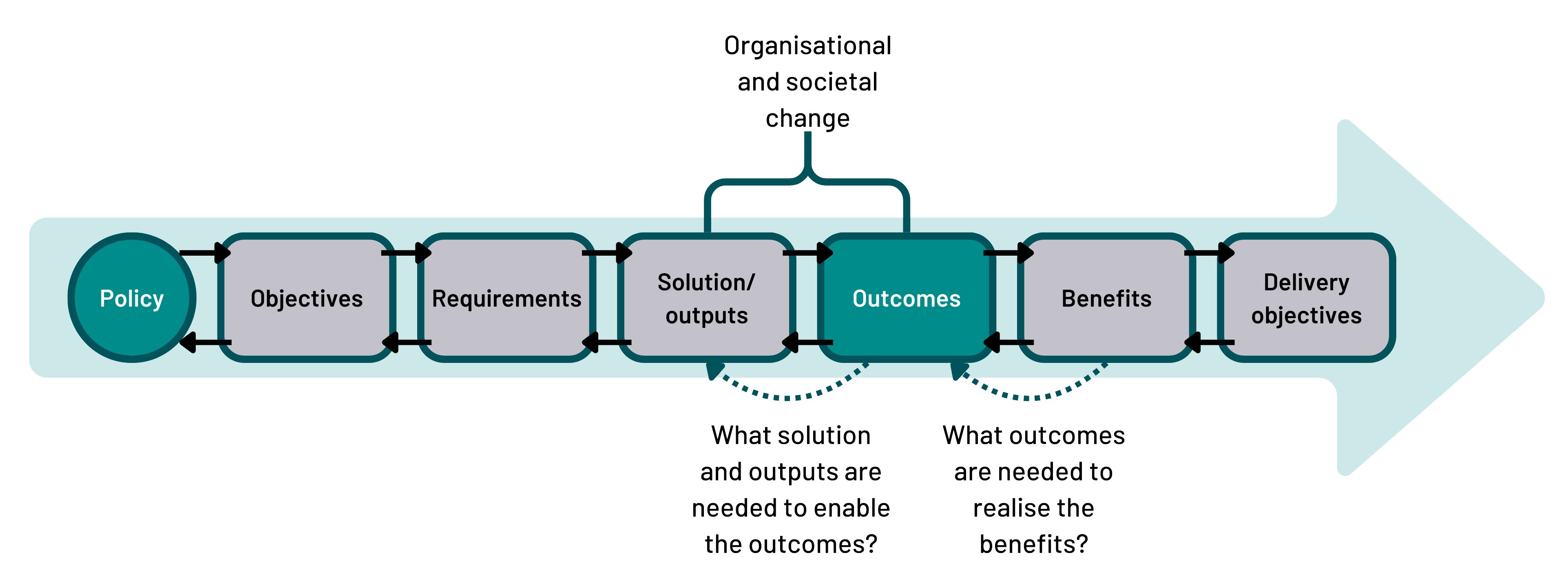
Managing change involves planning and embedding the changes needed to deliver the desired outcomes. It focusses on cultivating the behaviours needed if policy and organisational objectives are to be achieved, bridging the gap between delivering outputs of the solution and delivering outcomes. This linkage forms part of  benefits mapping (see Chapter 19: Benefits management). Outputs can be new tools and systems, such as digital services tax or social security, or enabling outputs such as education or communications programmes.


A flowchart depicting the process from policy to delivery, with emphasis on the relationship between solutions/outputs and outcomes in achieving benefits and driving organisational and societal change.
Figure 35.1 Organisational and societal change bridges the gap between delivering outputs and delivering outcomes

People often resist change because of uncertainty, competing priorities, workload concerns or doubts about the skills, knowledge and experience needed. Feeling a lack of control is also a factor.

The approach to managing change should account for this by:

  • developing a compelling vision
  • assessing impact on individuals, groups, organisation and society
  • planning the necessary changes carefully and assessing readiness for change
  • delivering and embedding changes well
  • validating that the outcomes achieved are the ones intended

This requires a systematic approach as part of the wider governance and management framework for the programme or project, working directly with:

35.5 Who manages change?

People undertaking a project delivery role require at least an awareness of planning and managing change, to ensure that it is applied in the right context, using specialists where appropriate.  Accountability and responsibility for change management should be defined within the governance and management framework and reviewed on a regular basis, to avoid duplication or gaps. Typically, accountability follows the hierarchy in the work breakdown structure.

The portfolio director, in a portfolio, or senior responsible owner, in a programme or project, is accountable for change management and is the ultimate driver of the changes.

The portfolio or programme or project manager, as appropriate, is accountable for developing and managing the change management framework, including its processes, tools and techniques.

Depending on the scale and complexity of the work, the programme or project manager could be supported by a specialist change manager with the responsibility for managing change and either acting as a team member or acting as the manager of those work packages focused on change management activities. If a dedicated change manager is not necessary, the portfolio, programme or project manager, as appropriate, should undertake the role, if they have the necessary skills and experience.

Individual or closely related changes can be assigned by the change manager to a change owner, who is a named individual responsible for planning and embedding a change or a specific aspect of a change. A change owner needs to be someone who can manage a change either due to their position, authority or knowledge and experience. As a change can evolve as more information becomes available, the ownership can be reassigned to a more appropriate person if necessary. The change owner can be supported by people assisting in managing changes and by change agents.

A change agent is someone who drives and supports the required changes from within an organisation or community. They act as a catalyst, helping people move from the existing way of doing things to the new way. Typically, they provide the change owner with the ‘local’ viewpoint, motivating and providing support to those who are subject to the change, monitoring progress, addressing concerns, dealing with resistance and helping to embed the change.

More detail on the business change and implementation competency and how this relates to each project delivery role can be found in the Project delivery capability framework.

35.6 How to manage change?

35.6.1 What to consider when managing organisational and societal change

35.6.1.1 Developing a shared vision and case for change

A clear vision of the future and a compelling case for change helps to create a positive momentum counter resistance. Both should be considered as part of policy formulation and are important in gaining support, facilitating delivery and embedding changes.

A vision should create a positive picture of the future for the people involved in or impacted by the change. It should address a specific challenge or problem that can be understood across all target groups and relate back to the drivers for change. Where the vision spans a group of changes, for example in a portfolio, it should explain the key components and how they work together to create the desired outcome overall.

The case for change is a clear explanation of why the change is needed, why it needs to happen now, and what the benefits are for those affected. It draws on the vision and the evidence in the business case to make the argument for change in a way that is meaningful for different groups.

A well-constructed case for change can motivate both the project delivery team and those people affected by the change. It needs to be consistent but can be tailored to the different needs and potential concerns of different groups. It should be positive and provide both the emotional and logical reasons for the change, focused on winning both hearts and minds, and support the policy, organisational or portfolio strategy, or business case.

35.6.1.2 Integrating the changes with the solution

The changes required, and how to make those changes, need to be defined as part of articulating the user needs and requirements (see Chapter 31: User need and requirements) and in designing the solution (see Chapter 32: Solution design). This often means developing and appraising a range of options and determining the approach which best suits the needs, circumstances and levels of risk.

For example, should the changes be phased over a period of time or delivered in a single event, or can they be delivered on a progressive or regional basis? Some options might require special facilities or capabilities to be in place, such as training facilities, or might need pilots or trials to validate the solution.

35.6.1.3 Engaging and communicating with stakeholders to embed and sustain changes

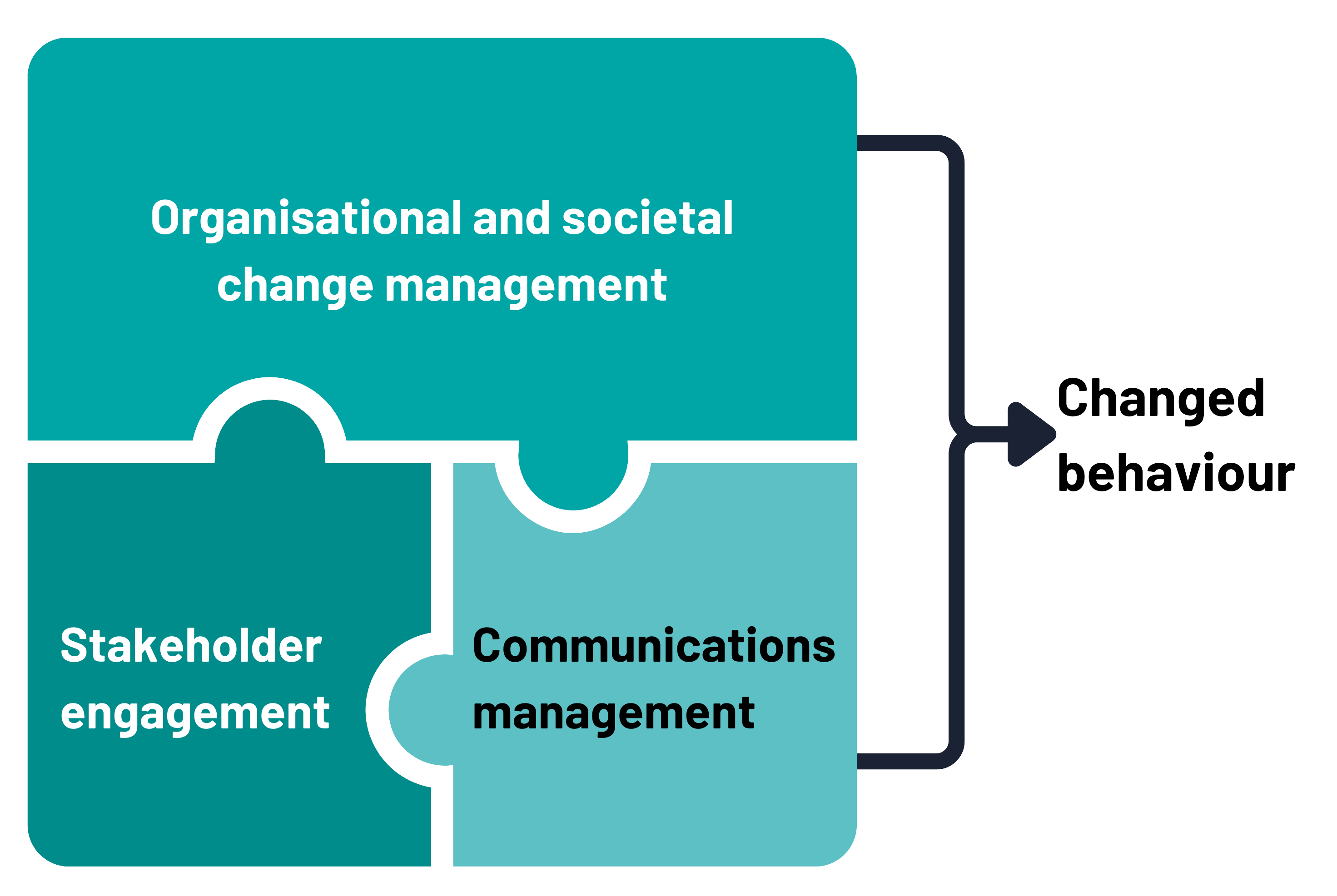
Stakeholder engagement and communications management are integral to managing change, as shown below in Figure 35.2 and addressed further in Chapter 26: Stakeholder engagement and Chapter 27: Communications.

A diagram showing two puzzle pieces labelled 'Stakeholder Engagement' and 'Communications Management' fitting together to form a larger piece labelled 'Organisational and Societal Change Management', which leads to an arrow pointing to 'Changed Behaviour'.
Figure 35.2 Stakeholder engagement and communications are a central aspect of the management of the work

Engaging with stakeholders who perceive themselves to be affected by the undertaking of the work itself, or by the outcomes that result, is central for the effective management of change. This includes the media, and pressure and special interest groups who take on causes on behalf of other people, with or without their consent. An effective change plan cannot be developed unless the attitudes, influence and likely reactions of different stakeholders, groups and those who might influence them are understood, as set out in Chapter 26: Stakeholder engagement. For example, stakeholders can be categorised as:

  • resistant to, in denial of, exploring, or champions of the change
  • influential observers, spectators, key players, or active players
  • allies/partners, neutrals, opponents or adversaries
  • those who need to be kept satisfied, managed closely, monitored or kept informed

Each category can prompt a different approach to engaging the target groups or can be a factor to consider if the change activities cannot be precisely targeted. For example, there is a tendency for people to be hostile to change where practices or behaviours have been established for a long time.

In many cases, particularly with social or widespread organisational change, it is not possible to engage everyone individually and therefore user groups, community leaders, surveys and other mechanisms are needed to understand the stakeholder landscape. This can mean skilled analysts might be needed, such as from the social research, economics, statistics, finance and operational research professions.

The stakeholder engagement techniques in Chapter 26: Stakeholder engagement can be supplemented by various specialist change management techniques.  For example:

  • visualisation techniques can be used. For example, rich pictures can be used to represent the future state of the organisation or society, illustrating the benefits and complexities of the change
  • user journeys can be developed as part of the solution design to show the future state processes and how the proposed changes are designed to reduce pain points
  • value propositions can used for different target groups
  • user stories can explain why changes are necessary based on past successes and failures

Communications are an important part of informing and influencing a target group about a change and their part in it. It provides more detail on planning, messaging, media, timing and feedback loops. For large-scale change, specialist communications professionals should be used, including to monitor effectiveness. Poor communications can undermine change management in even the best-intended work.

35.6.1.4 Developing trust with target groups

Trust with target groups affects their readiness for change. Where true trust exists, people are more likely to engage with and adapt to the changes earlier. Where trust is lacking, resistance is more likely and the change process takes longer.

The stakeholder engagement techniques in Chapter 26: Stakeholder engagement apply directly building trust with target groups. In the context of change management, particular attention should be given to being transparent about what is not yet known, providing a degree of choice in how changes are made where possible, and ensuring that the target groups can see that their views have influenced decisions. The more complex and uncertain the change, the more important this is.

35.6.1.5 Working transition and change management together

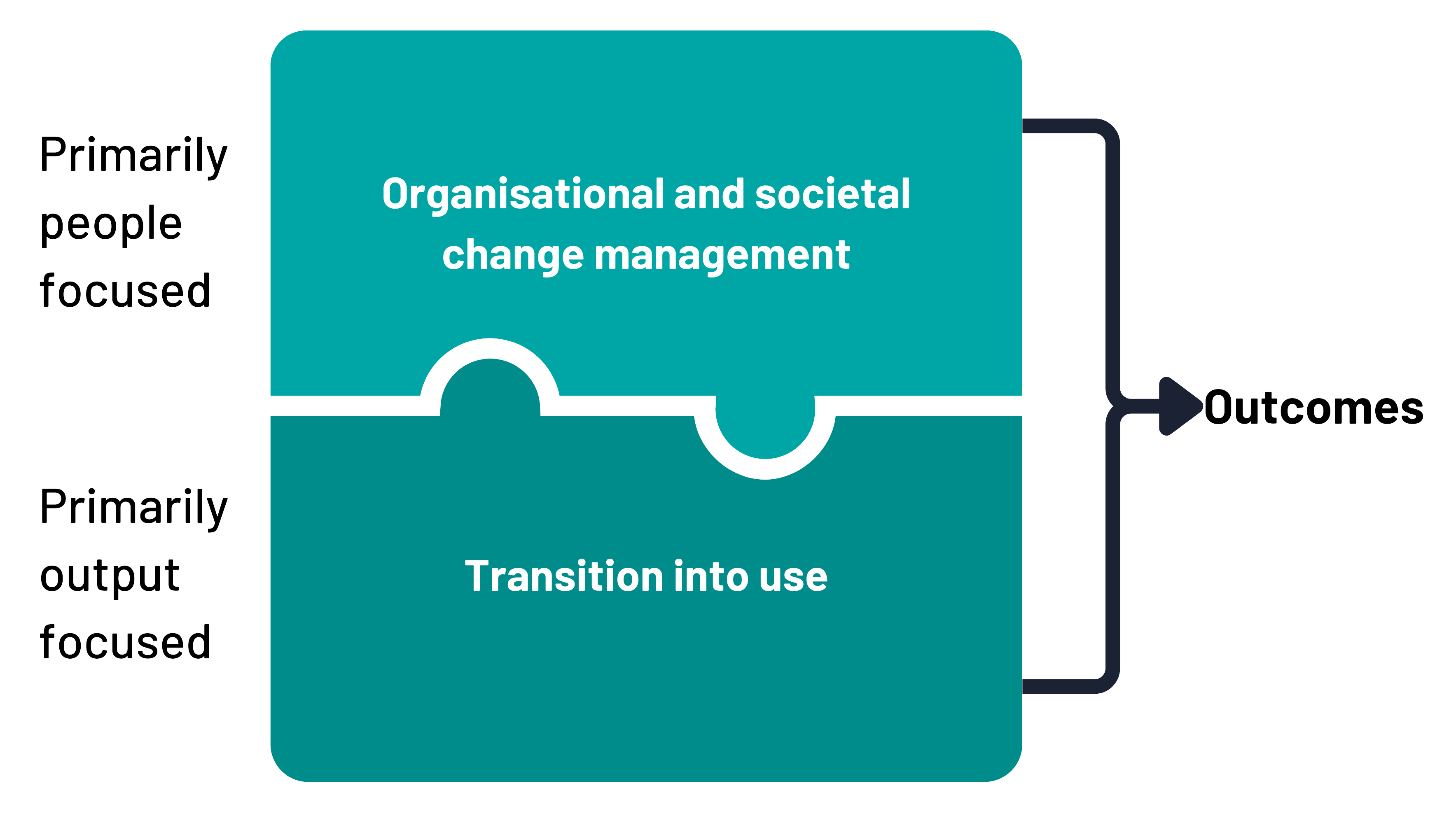
Organisational and societal change management, and transition into use, are closely linked and should be planned and managed together (see Figure 35.2 and Chapter 36: Transition into use).

The areas are interdependent. In many cases the outputs required by the change team are provided by the transition team, such as operating manuals, and those required by the transition team are managed by the change team, such as an education programme.

Different skills are needed for the different types of work, and it is for the portfolio, programme or project manager to bring together an appropriate multi-disciplinary team to plan and undertake the work, with each member

Diagram showing how organisational and societal change management (primarily people-focused) and transition into use (primarily output-focused) fit together to produce outcomes.
Figure 35.3 Organisational and societal change and transition should be managed together

35.6.1.6 Understanding the capacity and capability for change

Different people and organisations have different capacities and capabilities when it comes to change and adopt or adapt to change at different rates.

Whether an organisation or individual can absorb a change depends on context. Someone working in a high-risk operational environment, for example, is less likely to embrace potentially disruptive change than someone working in a highly agile environment where innovation is the norm.

The volume of change in a specific time period is also a factor, sometimes known as change saturation. Too much change at once can be overwhelming, no matter how well each change is planned.

In approaching change, consider:

  • whether there is enough resource to plan and implement the changes (see Chapter 28: Resource management)
  • whether the target group has the capacity. skills and knowledge to take on the change
  • what the cumulative impact of the changes will be for groups and individuals, for example, time needed for training or the effect of system down time on operations

To support the capacity for change, it may be necessary to schedule changes to avoid busy operational periods, agree a ‘change freeze’ for certain periods or build stabilisation periods into implementation. This gives the target groups space to absorb the current changes and allows the impact to be understood.

35.6.1.7 Assessing the readiness for change(s) throughout the life cycle

Change adoption normally follows a curve. Some people adopt changes enthusiastically, most follow more gradually, and some avoid the changes for as long as possible. This pattern of responses should be considered as part of planning.

The readiness of a target group to take on a change should be assessed throughout the life cycle, usually known as a change readiness assessment. The final assessment should take place just before the release of the outputs or capabilities for use, or before any major communications or education programme starts.

Ongoing assessments provide confidence that changes can be started or indicate that additional work is needed to address concerns about readiness and support, or to make changes to organisational arrangements or wider operating environment.

Careful planning is needed if the change is supported by legislation where the new approach, regulation or law comes into effect on a specific date and transition arrangements from the existing legal framework to a new one need to be planned for.

35.6.1.8 Reducing time to benefits realisation

Delivering some changes and outcomes quickly can highlight visible, early successes that can boost confidence in the work being done and its objectives. This could mean delivering a usable part of the change that has some use, often called a minimum viable product. Early deliveries can help build momentum, making it easier to overcome resistance, as well as helping validate assumptions, refine the vision and case for change, and support learning from experience.

Care should be taken to make sure focus is not lost on the main objectives and that early deliveries meet the stakeholder needs in practice. This should be considered in the delivery strategy and solution design, particularly when considering phased or incremental delivery. Even if initial changes fail, such efforts can support the development of trust (see 35.6.1.4 on developing trust with target groups) and provide valuable learning for change readiness in the future.


35.6.2 Preparing to manage change

35.6.2.1 Understand the wider governance and management framework

The wider governance and management framework for the portfolio, programme or project, and the sponsoring and delivery bodies should be reviewed early to identify where change management processes interface with other practices. This helps avoid duplication and ensures change management activity is coordinated with the wider planning, control and solution delivery practices.

The scale and complexity of the changes, and the level of impact on groups and individuals affected should determine the extent of change management activity. This is often underestimated. The greater the impact, the more planning and management is needed to prepare people for the change.

35.6.2.2 Understand the context and nature of the work needed

An early view of the context and nature of the work, including its expected objectives and outputs, complexity and scale and the interdependencies with other programmes, projects and work, helps determine the type and scale of change activity likely to be needed. This should be established from the start to help ensure that the appropriate outcomes and benefits are realised.

35.6.2.3 Decide the change approach

Once the context, nature, scale and complexity of the work is known, an appropriate change model or approach can be chosen.

Policy development should be underpinned by a theory of change. A theory of change sets out how the intervention is expected to work, the assumptions made, the evidence supporting them, and the wider contextual factors that could affect the outcome.

See Chapter 2: Policy and evaluation for more on the theory of change.

Change models and approaches fall largely into 2 general categories:

  • psychological, how people act in different circumstances, for example social cognitive theory, theory of planned behaviour and psychological contracts
  • engineered, measurable components of an organisation or society, for example Lewin’s change model (unfreeze, change, refreeze) and Kotter’s 8-step model

Some models combine psychological and engineered approaches, for example, nudge theory. A combination of models is often required and so the approach needs careful selection.

Models for change often have a range of tools and techniques to support them. These include force field analysis, process maps and flow charts, and assessments of change impact, readiness, resilience, resistance and culture.

Change impact assessments

Change impact assessments identify the gap between the current and future state and the implications for the organisation or society and its people. For example, changes in job responsibilities or accessing public services through a different channel.

It should consider the impact from both an organisational and individual perspective, including the extent of the impact on particular groups and other competing demands.

The assessment should take particular account of equality and diversity, as required by the Public Sector Equality Duty (see Chapter 5: Equality, diversity and inclusion).

Change readiness assessments

Change readiness assessments address whether an organisation or society and its individuals are ready to accept and use the delivered outputs or capabilities. This typically considers factors such perceptions of readiness and support, whether changes to the governance and management framework have been made, and the wider organisational or societal environment.

35.6.2.4 Define how change is to be tracked

Once the appropriate approach has been chosen, the information and data needed to support monitoring and reporting can be defined. This is needed as part of:

The approach taken can firm up as changes are planned and a definitive solution decided. The simpler the change, the less information and data needed and the simpler the tools and processes can be.

Where multiple pieces of work sit within the same portfolio or programme, information from one can be collated with another for reporting, particularly where there are common benefits.

The choice of data, level of detail and categorisation should be compatible to avoid aggregated reporting becoming meaningless. Sufficient information should be recorded to enable decisions and action to be taken, while keeping the management overhead proportionate.

35.6.3 Key activities in managing change

35.6.3.1 Overview

Change management requires a systemic approach to plan, implement and embed changes by understanding the work objectives, the current state of the organisation or society, defining the future state, planning and embedding the change and validating the outcomes.

These related activities are shown in Figure 35.4. These may be sequential or iterative, depending on the nature of the work.

Flowchart illustrating an organisational and societal change framework with two levels: managing all changes (overseen by change manager) and managing individual changes (by change owner supported by change agents). It includes steps from developing a framework to validating outcomes, with feedback loops and interactions with other processes (reporting, stakeholder engagement, communications, solution delivery).
Figure 35.4 An overview of the key organisational and societal change activities and their primary relationships

35.6.3.2 Develop and maintain the change management framework

The change management framework should be developed at the start of the life cycle, and, where available, should be aligned to the theory of change underpinning the initial policy proposal. The activities for preparing to manage change feed into the change management framework (see 35.6.2 on preparing to manage change).

The change management framework should include:

  • the models, approaches and techniques to be used
  • the data needed for monitoring and evaluation, and how to collect, record, and store them (see Chapter 24: Information and data management)
  • how changes are identified and categorised

35.6.3.3 Oversee management of change

Overseeing the management of change makes sure that it continues to fulfil its purpose and meets the needs of the work. This can be achieved by

  • making decisions on updating the change management framework (see 35.6.3.2 on developing and maintaining the change management framework)
  • providing periodic reports on changes and outcomes as an aggregate (see Chapter 18: Reporting),
  • identifying risks (see Chapter 20: Risk management) and issues (see Chapter 21: Issue management)

Make sure that the management of organisational change is considered early and planned into the solution design and delivery strategy.

Keep the change management framework under continuous review as the context and nature of the work can change throughout the life cycle.

35.6.3.4 Understand the objectives

Understanding the objectives of the work helps with:

  • a compelling vision of what the future state after the changes have been made
  • a case for change which justifies why the change is needed and why it is needed now

This should start from the initial vision and theory of change supporting policy development. It can then be refined progressively as the business plan (for a portfolio) or business case (for a programme or project) develops.

35.6.3.5 Understand the current state

Understanding the current state establishes a reference point for assessing changes and evaluation outputs and outcomes. Examine how the organisation or aspects of society currently works, focusing on those aspects which are going to change. Record this reference point information in line with the evaluation plan (see Chapter 2: Policy and evaluation). This is sometimes referred to as the current operating model.

35.6.3.6 Define the future state

Defining the future state sets out what the organisation or society should look like after the changes have been made. Build on initial policy proposals, taking care to identify who is impacted and possible side effects.

The future state should inform the design of the solution (see Chapter 32: Solution design) and the plan (see Chapter 16: Planning). It is sometimes referred to as the target operating model or future operating model.

This should also consider the information needed to assess changes and evaluate outputs and outcomes, in line with the evaluation plan.

35.6.3.7 Plan change(s)

Planning changes identifies what needs to happen to move from the current state to the future state.

Assess the impact

A gap analysis between the current and future state helps identify where the most significant changes will fall. This can then inform an assessment of the impacts on the organisation or society and the target groups, including the implications of the delivered outputs and capabilities. Equality, diversity and inclusion impacts should also be considered as part of this assessment (see Chapter 5: Equality, diversity and inclusion).

Identifying assumptions and risks at this stage can help avoid issues later in delivery (see Chapter 20: Risk management).

Identify activities

Activities should be identified to prepare, equip and support organisations and individuals to change practices and, where appropriate, behaviours to embed the changes. Milestones representing the achievement of outcomes can be used to track progress and maintain momentum. These activities and milestones should be included within the plan and part of the baseline.


Agree metrics

Metrics should be agreed to assess progress on implementing the changes, including outputs and outcomes, in line with the evaluation plan. Metrics that accurately reflect the outcomes make it easier to identify where changes are not landing as expected. These could be a mixture of lagging and leading indicators. If a direct cause-and-effect relationship cannot be established, a proxy measure can be used instead. Measures should be assessed for current and future performance, with appropriate adjustments made where necessary. The Government Functional Standard for Analysis and the Aqua Book (requires sign in) are useful resources for carrying out these assessments.


Forecast outcomes

Each outcome should be forecasted in terms when it is planned be realised. This could be simply be the date when the outcome is fully realised or a phased timeline showing how the outcome is realised over time.

35.6.3.8 Deliver the changes

This activity involves implementing the planned change management activities, including training, engagement, and communication. Transition into use practices can also support delivery (see Chapter 36: Transition into use).

35.6.3.9 Embed the changes

Once a change has been implemented, it needs to be sustained so that the associated outcomes and benefits continue to be realised and do not slip back. This could involve taking preventative or corrective action to strengthen the readiness components for the change.

Sustaining a change depends on the surrounding environment supporting it and encouraging and rewarding the right behaviours. This should be reviewed to see if any further measures are needed.

35.6.3.10 Validate the outcomes

Validating outcomes confirms whether the intended outcomes have been achieved and align with the plan (see Chapter 34: Verification and validation). Any issues resulting in non-delivery of outcomes should be identified and addressed, for example if outputs are unfit for the intended purpose or if changes have not been sustained effectively.

Lessons should be identified, recorded and communicated where they can improve change management activities in the future (see Chapter 38: Learning from experience).

35.6.3.11 Close the change management framework

Once the work has been completed and change management is no longer needed, the management framework should either be:

  • merged into the management framework for the solution
  • closed

Information and data should be retained in accordance with the delivery and sponsoring body’s information retention policy (see Chapter 24: Data and information management).

Updates

Page permissions updated for public launch.

First published for closed beta consultation.

Back to top