Beta

This is a new service and pages are being tested and improved.

9.1 Overview

While the Government Functional Standard for Project Delivery describes what is expected from government departments and arm’s length bodies in the direction and management of individual portfolios, programmes and projects, it does not describe how this should be done. The Teal Book builds on the functional standard and can be used as a basis to develop an organisational project delivery framework that is both compliant with the standard and which is adapted to the particular needs and circumstances of the organisation, such as the types of project it does. 

Using The Teal Book at an organisational level involves 2 key activities:

  • tailoring The Teal Book to create or refine the organisation’s own project delivery framework as appropriate
  • embedding the tailored framework into day-to-day work by ensuring that people in the organisation understand and use it appropriately

9.2 Establishing a tailored organisational approach to project delivery

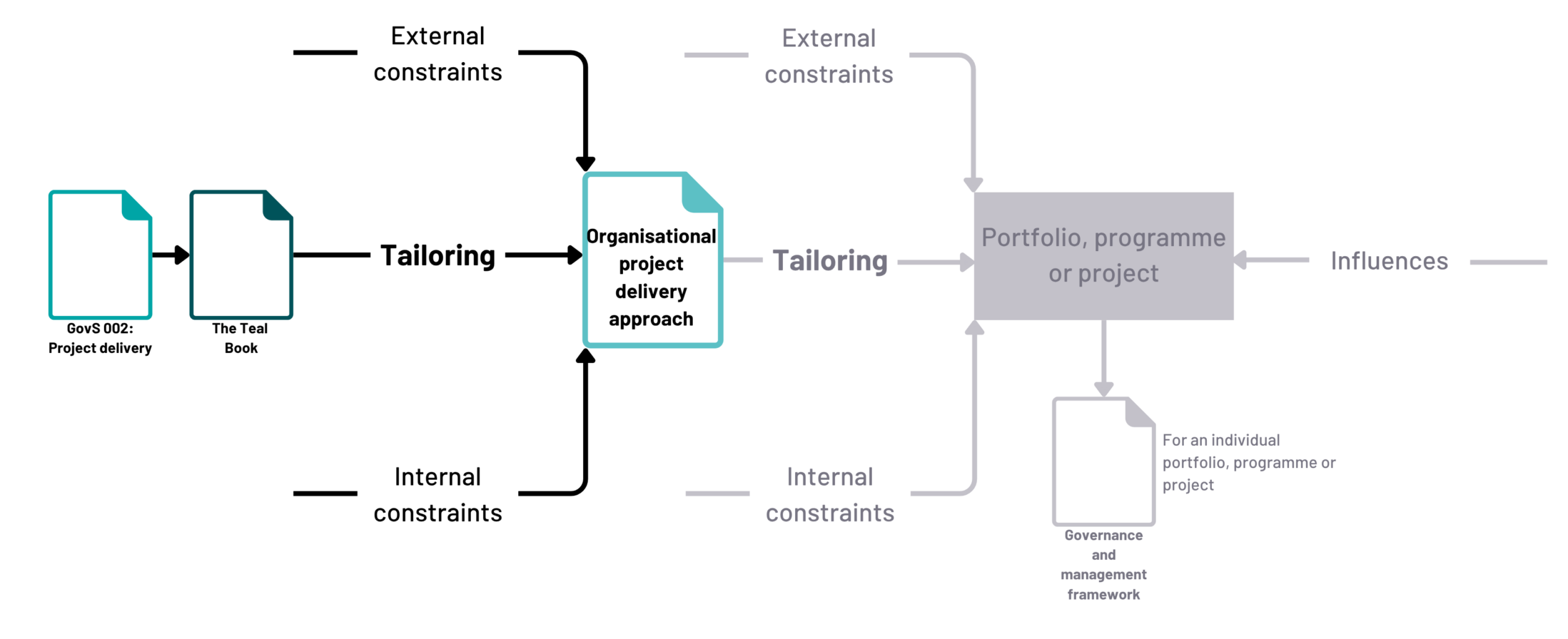
The organisational approach to project delivery should form part of the organisation’s governance and management framework. The external and internal constraints depend on the portfolios, programmes and projects the organisation typically undertakes (see Chapter 8: Tailoring). This needs a good understanding of the characteristics of the business and societal changes delivered by the organisation, such as agreed categories of work, scale of cost, timescale, risk and achievability.

A flow chart illustrating the tailoring process for project delivery frameworks. The process starts with the Project Delivery Functional Standard and The Teal Book, which are influenced by external and internal constraints. These documents are then used to create an organisational project delivery approach, which is further tailored for specific portfolio, programme, or project needs, resulting in a bespoke governance and management framework.
Figure 9.1 Tailoring The Teal Book to create an organisational project delivery approach which can then be tailored for individual portfolios, programmes or projects.

Tailoring The Teal Book to create an organisational project delivery approach should be undertaken by the owner of the processes, guidance, tools and templates used in the organisation, under the direction of a senior officer accountable for project delivery, such as a chief project delivery officer. This team could be a portfolio office or an organisation’s centre of excellence for project delivery. Where there is an organisational project delivery framework, the portfolio, programme and project managers should be able to tailor it to define their own framework for the work they are conducting where localised tailoring is required.

9.3 Embedding The Teal Book in an organisation

Once the organisation has agreed an organisational project delivery approach, it has to be embedded as the normal way of working and as a basis to drive maturity improvements. This involves the deliberate and consistent development, introduction, deployment, maintenance and use of the framework. 

Embedding the approach starts when it is being developed. Securing the support of individuals across the organisation who need to change their ways of working is essential, and an effective way to do that is to involve them in the development work, either as authors or to review it as it evolves. Changing the way people work involves understanding the current situation, designing the future state of how the organisation is to operate, identifying what changes are needed to move from the current situation to the future state, developing the necessary capabilities to meet the required changes, such as defining roles, processes, and behaviours, and engaging those affected by the change to gain their buy-in and support their transition (seeChapter 35: Management of organisational and societal change).

The organisation’s project delivery framework, once deployed, needs to be managed on a day-to-day basis so that it is consistently and effectively used. This should include introducing improvements based on the experience of using it and to reflect changes in the organisation’s influences and internal or external constraints and evolving best practice in the profession.

9.4 Considerations for organisational tailoring and adopting

9.4.1 Deciding who to involve

The people involved in the development or improvement of a project delivery governance and management framework in an organisation should have the right skills and experience, an understanding of the context and have the respect of their peers.

The framework needs to be acceptable to the users and wider stakeholders. This can involve bringing together some experienced portfolio, programme and project managers from across the organisation who can compare the way they do things now and then agree on an approach that is acceptable to all. If there are any contentious areas, bringing in recognised experts to facilitate discussions and, if necessary, recommend a solution can help.

Portfolio, programme and project management practices need to interact with processes provided by an organisation’s commercial, finance, digital, legal functions and with other teams, for example policy and operations. Bringing these teams in to help design or improve a project delivery framework not only helps to create a comprehensive approach but also helps to secure buy-in, which is essential for embedding the use of the framework into day-to-day working.

The work involved in developing an organisational project delivery framework is often best run as a project or work package, depending on the scale of change needed. However, consideration should also be given to who owns and manages the framework on a day-to-day basis once it has been created. There are many models for this, for example creating a centre of excellence or giving the responsibility to the organisation’s portfolio team. Dedicating resources to the management and ongoing development of a project delivery framework is a powerful way of ensuring momentum and improving the efficiency of delivering portfolios, programmes and projects.

9.4.2 Using the resources in Part B

There are many types of portfolio, programme and project in government which have different scales, complexity and risk profiles, and which operate in different sectors. To support tailoring and adopting, Part B of The Teal Book describes different aspects of project delivery to support and prompt tailoring of its content and practices to these circumstances. Where an organisation undertakes the same type of programme or project, these chapters should be taken into consideration when designing the organisational project delivery framework. If the type of programme or project is a ‘one off’, it would be more appropriate to support that programme or project manager in using these chapters to tailor their specific programme or project’s governance and management framework.

9.4.3 Using language consistently

The consistent use of terminology is important, as using words in the same way promotes unambiguous communication and common understanding. Problems can occur when different parts of the organisation, suppliers and government use different terms, so it is helpful to agree on the definitions of key project delivery terms.

Where possible, use Government Project Delivery’s . The glossary brings together the defined terms used across all of the government functions and more specific project delivery terms. The glossary been used in the standard, The Teal Book and Continuous improvement assessment framework for project delivery and so adoption of these terms not only helps users in an organisation understand them against their organisational framework but also helps with interactions across government organisations.

9.4.4 Using consistent and effective presentation

The way that a project delivery approach is drafted and presented can influence the extent to which it is taken up. An organisational project delivery framework which has a consistent structure, flow, look and feel should promote more confidence in its users than one which is documented in a variety of locations, formats and styles. Consistency in the presentation of material should also make it easier for people to understand and find what they are looking for. For example, the chapters in The Teal Book mirror those in the Functional Standard for Project Delivery

Consideration should also be given to the different needs of users. Not everyone needs the same level of detail and so information should be presented in a consistent way while taking into account the context, and the roles and individuals who will access it.

9.4.5 Using a standard life cycle

The Functional Standard for Project Delivery requires that each programme and project has a defined life cycle which is aligned to its reference life cycle (see Chapter 14: Programme and project life cycles and Figure 9.2). The reference life cycle could be adopted ‘as is’ in an organisation or built on to reflect the typical work undertaken by either combining or expanding out the 5 stages in the life cycle.

A flow chart illustrating the reference project life cycle, from the initial policy concept through feasibility, appraisal, definition, delivery, operation, and ongoing operations.
Figure 9.2 The stages of the reference project life cycle from the Government Functional Standard for Project Delivery

Although no single life cycle works for every programme and project having a standard life cycle in the organisation’s project delivery framework suited to the types of work it does, makes the framework more relevant and more likely to be used.

It gives programme and project managers something relevant to them, which they can either immediately adopt or tailor. It also helps organisations understand the nature and progress of programmes and projects across the portfolio, supporting effective portfolio management.

As the framework matures, the standardisation of life cycles can go further, moving from a single generic life cycle to ones that reflect the types of programmes and projects the organisation runs. For example, separate life cycles for infrastructure, software development, transformation and other work.

9.4.6 Developing tailoring guidelines

When developing the project delivery framework, it is helpful to agree rules on what can be tailored, who can tailor it, and who can provide advice, guidance and approvals.

The goal is always to keep project delivery proportionate to the scale and complexity of the work being undertaken and so basing tailoring rules on these 2 factors can be helpful, using the Risk potential assessment form as a starting point.

9.4.7 Managing and maintaining the approach

Once the project delivery framework has been defined, it needs to be managed and maintained so it remains effective and useful. The framework should include guidance, templates, processes and policies that describe how it is managed and operated.

Define a role with responsibility for managing the overall system and ensuring all its parts work together. A form of change control should be developed as changing one part of the project delivery framework often has impacts on other parts, so this needs to be recognised, managed and acted on.

9.4.8 Using the continuous improvement assessment framework

Ongoing improvements to the approach should be made if they add value. As well as direct feedback from users, consider outputs from surveys, audit and assurance activities, external scrutiny reports, and lessons from professional bodies, sector advisory groups and academia. 

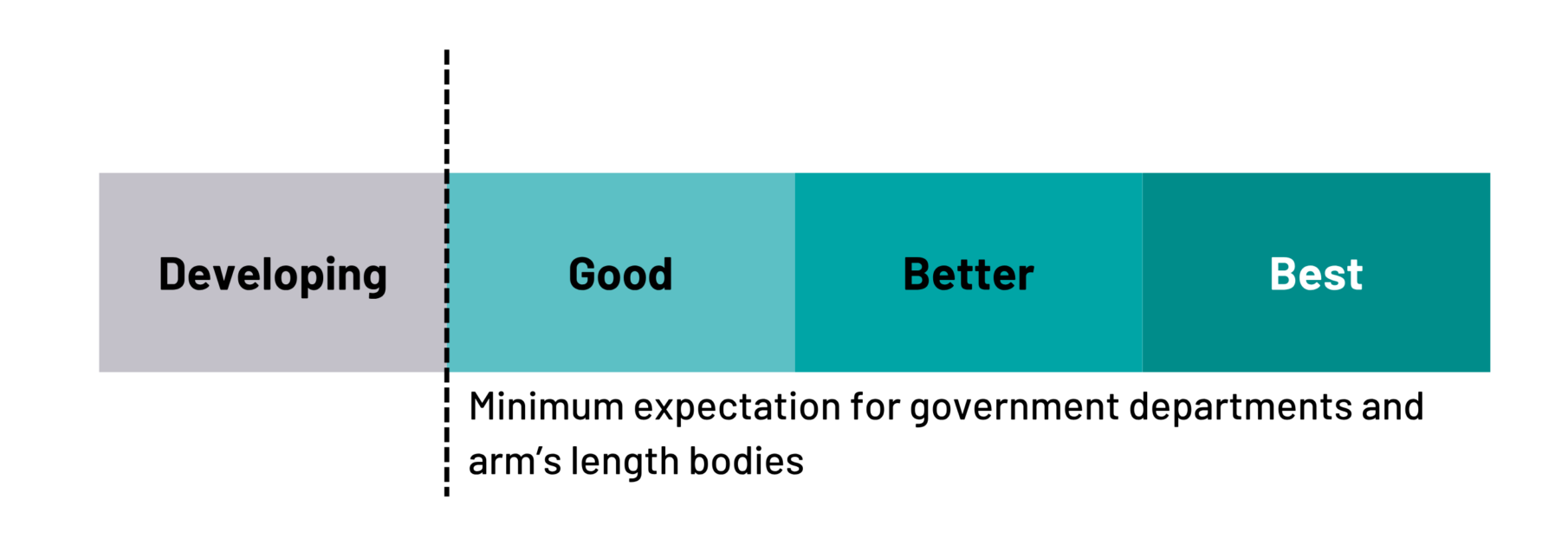
The Continuous improvement assessment framework for project delivery can be used to support ongoing improvements. This draws on the Government Functional Standard for Project Delivery and includes a set of statements indicating different levels of organisational capability against aspects of the standard, ranging from non-compliance or adopting (‘developing’), through ‘meeting the minimum’ (‘good’), to better and best, as shown in Figure 9.3.

A bar graph showing a spectrum of performance levels from "Developing" to "Good," "Better," and "Best," with "Good" being the minimum expectation for government departments and arm's length bodies.
Figure 9.3 The good, better and best rating system for continuous improvement assessment frameworks

Using the assessment framework can help with understanding the maturity of the organisational project delivery framework and support its development by:

  • helping the organisation’s leaders decide the level of capability they need to achieve to meet their policy and business needs (not every organisation needs to be ‘best’ at everything)
  • creating a reliable capability baseline against which improvements can be identified and measured
  • providing an objective assessment of strengths and weaknesses
  • justifying investment in project delivery infrastructure and methods
  • demonstrating service quality in support of assurance and auditing activities
  • reducing delivery costs and increasing benefits
  • indicating what the next logical improvement steps are to improve project delivery maturity

As the Government Functional Standard for Project Delivery, The Teal Book and the Continuous improvement assessment framework for project delivery are all fully aligned, using the assessment framework in this way can support adherence to the expectations placed on government organisations and drive mutually understood ways of working. Consistent use of the assessment framework across all government organisations also enables different departments to understand and support each other in improving project delivery practice for all of government.

9.5 Further reading

Updates

Page permissions updated for public launch.

First published for closed beta consultation.

Back to top