Beta

This is a new service and pages are being tested and improved.

10.1 Overview

In government, portfolios, programmes and projects are used to achieve a wide range of outcomes and can take many different forms. The nature of the work and its context are therefore important considerations. This chapter explores different types of project delivery in government and their associated contexts, and where particular considerations arise in consequence in applying The Teal Book.

10.2 Understanding the nature and context of the work

The nature of the work is determined, ultimately, by its objectives, in terms of the outcomes to be achieved and the outputs to be delivered to achieve that. Usually this points to the kind of work needed – for example infrastructure development, digital solutions or service transformation – but sometimes this might not be clear until different options have been considered. The nature of the work can also highlight significant additional considerations in terms of scope and phasing, scale, complexity and risk.

The context for the work also needs to be considered. Is the work to be delivered within the organisation, to service users locally or nationally, or internationally? Is it likely to be delivered directly, through delivery partners or through other means, for example in the form of a grants programme to be bid for? This too can significantly affect the scale, complexity and risk profile for the work, and even the health, safety and security of those involved in delivering it.

A portfolio can contain similar types of programmes, projects and other related work, or a diverse range. This depends on the nature of the organisation’s remit and where the portfolio sits in the project delivery hierarchy (see Chapter 3: Portfolios, programmes and projects).

Categorising the work in a portfolio helps to understand its risk profile, the stakeholders and locations involved and the resources needed to deliver it.

10.3 Categorising and reporting

Government portfolios often cannot be easily categorised from a cross-government perspective. However, programmes and projects usually fall within the following categories:

  • infrastructure and construction programmes and projects to improve and maintain the UK’s energy, environment, transport, telecommunications, sewage and water systems, and construct new public buildings such as schools, hospitals and prisons. These high investment works are essential to the nation’s economic growth, development and prosperity and are prioritised accordingly across government 
  • military capability programmes and projects are vital to the effective operation of the Armed Forces, delivering the integrated training, personnel, structures, equipment, infrastructure, technology and logistic support needed to maintain national security
  • digital and data: programmes and projects implement modern digital and data solutions, to transition from ageing technology, deliver service improvements and efficiencies, and equip government departments for the future
  • transformation and service delivery programmes and projects change ways of working, often harnessing new digital and data technologies, to improve public services and/or make government more efficient
  • international programmes and projects support UK interests overseas. This includes international development work, which follows separate governance and assurance arrangements for UK Official Development Assistance (ODA) work. Other programmes and projects are managed through departmental arrangements and join the Government Major Projects Portfolio or Departmental Major Projects Group if they meet the criteria

An individual programme or project is likely to fall primarily within one of the above categories but can also involve work relevant to other categories, particularly where the programme or project has a wide scope. To ensure consistency in government analysis and reporting, the National Infrastructure and Service Transformation’s advice on categorising new entries in the Government Major Projects Portfolio or or Departmental Major Projects Group should be sought as necessary.  

Categorisation is about grouping specific types of work, and this can help identify particular considerations for planning and delivery. However, it is not a precise science and should not, of itself, dictate how the work is delivered or the methodologies and expertise needed. These should always be determined by the requirements of the work and can often combine different approaches. For example:

  • major infrastructure and construction projects typically involve a heavy focus on engineering and tightly-managed, plan-driven delivery using predictive methods (also known as linear, sequential or ‘waterfall’ delivery) but often also involve digital and transformation where iterative design and delivery might be used
  • digital and transformation programmes typically involve user-driven iterative and incremental delivery using agile approaches, but some technical changes can require a predictive delivery approach to manage them safely
  • military projects often combine heavy engineering with advanced digital solutions, and are increasingly developed using change-driven, highly adaptive approaches, given the rapidly evolving technologies involved and the need to adapt within a changing global context

Working from delivery objectives, user needs and requirements helps ensure a wide set of options is considered, and that methods and expertise are tailored to the work (see Part F: Solution delivery).

10.4 Infrastructure and construction

10.4.1 Overview

Infrastructure and construction is the largest category of UK public investment. It includes: 

  • economic infrastructure such as energy and transport (the 2 largest areas of investment), broadband and communications, electricity and gas transmission, flood and coastal defence, water and sewerage, and research  
  • social infrastructure such as borders and policing, defence, education, health and social care, housing and regeneration, justice, tax and customs, work and pensions

Infrastructure requires a systemic, long-term view. Planning horizons are often long, and decisions can affect the lives of British people for decades. Infrastructure investment also has an important short-term role, helping support jobs and stimulate the economy. To support strategic infrastructure planning and investment:  

  • HM Treasury makes strategic decisions on infrastructure policy and spending
  • the National Infrastructure and Service Transformation Authority, part of HM Treasury, brings together long-term infrastructure strategy with best practice project delivery as the home of Government Project Delivery, and publishes the UK Infrastructure pipeline setting out planned investment across sectors
  • the National Wealth Fund provides finance to catalyse private investment to support investment and drive growth

Responsibility for infrastructure and construction policy, funding and delivery is shared between the UK government and the devolved governments, which varies depending on area.

Some areas are reserved to the UK Parliament, such as telecommunications and most of energy policy (including electricity and gas markets, nuclear and offshore oil and gas). Many other areas are devolved, including planning, roads and local transport, housing and building standards, water and sewerage, and most economic development.

Because responsibilities and consenting routes differ by nation and by sector, programmes and projects should confirm at the outset which government(s) hold policy and funding responsibility and which consenting regime applies, especially for cross‑border or offshore elements.

Infrastructure delivery can take many forms, from very large-scale single construction projects to multiple small-scale broadband and utilities projects, often rolled out as part of wider programmes. It can be a highly complex and often lengthy undertaking, requiring planning consents and sometimes legislation. It also typically involves working with multiple delivery partners from different sectors, and integration with other local and national infrastructure and services. The National Audit Office has highlighted how infrastructure programmes and projects can underperform against their ambitions, and where improvements in practices, productivity and performance are needed.  

To this end, the government has set out its plan for a 10 year strategy for the UK’s social, economic and housing infrastructure to support a flourishing modern economy, drive growth, deliver net zero and support improved public services. Implementation of the strategy will be overseen by the National Infrastructure and Service Transformation Authority.

Where construction work involves the government estate, advice is provided by the Office of Government Property, which is responsible for cross-government property strategy and overseeing work to transform the public estate. Advice is also available through organisational property functions, some of whom have specific sector expertise (defence, prisons and overseas property, for example). The requirements of the Government Functional Standard for Property should be followed at all times.

Infrastructure and construction programmes and projects require considerable sector expertise and experience in their design, planning and implementation. Some initial considerations are highlighted below, but further advice and support from the relevant bodies should always be sought early in the life cycle when the requirements are being defined and validated. 

10.4.2 Tailoring considerations for infrastructure and construction work

10.4.2.1 Taking a system-wide view of strategy and outcomes

Clear strategic objectives are needed to build support for a proposal. Consider how these contribute to the UK’s long-term infrastructure needs, as set out in UK Infrastructure: A 10 Year Strategy, and how they can realise the greatest social value. This means considering, not only the immediate outputs to be delivered, but how these interact with other local or national infrastructure, and what additional investment might be needed to deliver the strategic objectives. For example, new transport links might support regeneration only if local housing and schools are available to grow communities around them. Well-targeted investment can create new potential for economic growth and enable wider social value beyond the original investment. 

10.4.2.2 Taking a realistic view of what it is needed to deliver

Delays and cost over-runs often stem from over-optimism in planning, or early announcements setting unachievable targets. Give priority to building a realistic business case, using probabilistic cost and schedule estimating, supplemented by benchmarking or other techniques as appropriate (see Chapter 16: Planning). Sense-check economic analysis to ensure results are realistic and test assumptions and risk against different scenarios, ensuring that work meets the Government Functional Standard for Analysis. Avoid making announcements on specific timescales and costs, where possible, until planning is sufficiently advanced and assured, and always provide risk-based ranges rather than point estimates. 

10.4.2.3 Planning for the long term

Some programmes and projects, typically social infrastructure, telecommunications and smaller construction projects, are committed and delivered within government spending review cycles. Others, for example major rail and nuclear energy programmes, can run for decades, spanning multiple parliaments and spending review periods. The need to secure a parliamentary slot for legislation and planning consent can add more time, sometimes years, and increase uncertainty. 

Planning therefore needs to take a long-term view and be flexible to accommodate potential constraints and changes in the political, social and legislative agenda. Long life cycles also mean that technology and user requirements are likely to evolve, and cost and benefit assumptions can change significantly because of major shifts in the global economy, the effect of climate change and terrorism threat. Governance and management arrangements might need to evolve to reflect this, and leadership and team succession planned for.     

Planning and securing funding over long timescales can be a particular challenge. Early advice should always be sought from HM Treasury and the National Infrastructure and Service Transformation Authority on how best to plan and manage multi-year funding requirements and on the potential use of private sector investment. 

10.4.2.4 Taking a strategic approach to the supply chain

Major infrastructure and construction works typically involve multiple suppliers, who in turn appoint multiple sub-contractors, creating a complex multi-layered supply chain. Often this complexity is less visible because a single delivery partner (sometimes called the prime or tier 1 supplier) is appointed, or an arm’s-length body is created to oversee the work; but it is still there. 

Market capacity issues and skills shortages are common factors in sub-optimal performance.  Internationally, demand for infrastructure and construction skills is high and markets operate globally. Understanding the requirements of the work, in terms of skills and resources needed, and making a realistic assessment of the capacity of the market to meet them, is critical, as is considering how best to design the commercial arrangements and procurement strategy needed to secure them. Any relevant Government Buying Standardsmust be used.

Managers of programmes and projects which are dependent on scarce or highly specialised skills might need to consider how best to work with the market to build them for the future. Suppliers are also more willing to invest in skills and technology development where there is a pipeline of future work to bid for, so consider the wider government pipeline in skills planning. 

10.4.2.5 Using and promoting modern practices

Modern technology has enabled many advances in infrastructure and construction in recent years, cutting costs and carbon, increasing productivity and improving quality for users. However, these are not always considered in planning or specified in procurement.  

Those leading infrastructure and construction work in government should consider how to optimise delivery of the work through use of modern practices and technologies throughout the supply chain, and set clear expectations on this planning and procurement, as required by the Construction playbook (requires sign in) and guidance on Modern methods of construction. See the National Infrastructure and Service Transformation’s Whole life carbon handbook (requires sign in) for guidance on how to maximise whole life carbon reductions throughout the life cyle of infrastructure and construction projects

Using standardised interoperable components, platform-based approaches creating ‘common kits of parts’, prefabrication and offsite construction can:

  • improve efficiency
  • reduce the local environmental impact of the work
  • support wider economic growth and employment through a disaggregated manufacturing base

Digital information tools speed up and improve planning and delivery through the life cycle. Consider using:

  • 4D/5D design and planning software to co-ordinate construction
  • artificial intelligence tools to identify and track components
  • ‘digital twins’ to capture asset data from design through to implementation and handover into use, improving asset management and through-life maintenance

Use of the Information management initiative framework and the government’s Information management mandate (included in=Transforming infrastructure performance: roadmap to 2030) is required for government infrastructure and construction work, and should be included in contracts to improve asset information handover, management and interoperability.

10.4.2.6 Planning for integration and entry into service

The scale and complexity of infrastructure projects and programmes makes it essential to plan and prepare carefully for system and service integration and the start of operations. Poorly planned and controlled delivery into service can impact existing services and users, as well as the wider supply chain. Lessons from transport for the sponsorship of major projects highlights particular factors for major infrastructure projects to consider, such as:

  • having clear accountability for integration
  • minimising and managing internal and external dependencies
  • planning carefully how-to bring solution elements together
  • testing that they work together at each stage
  • making sure the outcome works for users. 

10.5 Military capability

10.5.1 Overview

Military capability programmes and projects are among the most complex and strategically important in government, and the second largest category within the Government Major Projects Portfolio. These are critical for the effective operation of the armed forces, delivering the integrated capabilities needed to protect the nation and help it prosper. The Ministry of Defence delivers all military capability programmes and projects, together with others concerned with digital and data, and transformation. Some other security programmes and projects are delivered by the security agencies.    

The defence portfolio is determined by the UK government’s priorities for security and defence, reviewed as part of each spending review. The most strategically important defence programmes and projects are monitored through the Defence Major Projects Portfolio.

Defence programmes and projects are typically large-scale, spanning multiple years and sometimes decades, and are characterised by fast-moving technological and logistical complexity. Many are defence acquisition programmes, typically involving heavy engineering and large-scale manufacturing, managed through longstanding commercial delivery partners. Others involve significant international considerations and are worked on jointly with international partners. Digital delivery and innovative technologies such as drones and artificial intelligence are also increasingly used, reflecting the rapidly evolving nature of military technology and capability requirements.    

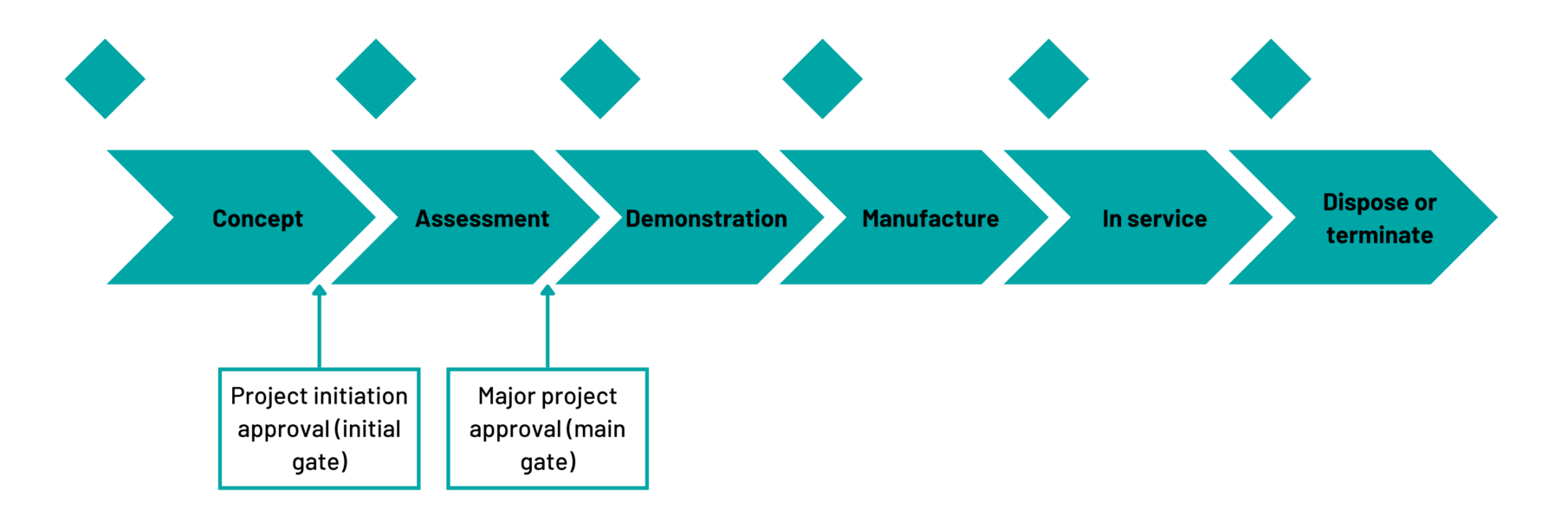
Portfolios, programmes and projects are managed through project and programme methodologies aligned to the Government Functional Standard for Project Delivery. However, the need to manage military capability on a platform basis has also led to development of an extended system life cycle model, an example of an extended life cycle (see 14.9.3.1 for the extended life cycle). Known as CADMID/T (concept, assessment, demonstration, manufacture, in service and dispose or terminate), this is shown in Figure 10.1 and considered further in Part F: Solution delivery.

A flow chart depicting the CADMID life cycle, from the initial concept phase through assessment, demonstration, and manufacture, to in-service use and eventual disposal or termination. It also shows two key approval stages: project initiation approval (initial gate) and major project approval (main gate).
Figure 10.1 The Ministry of Defence’s CADMD/T system life cycle aligned to the reference project life cycle decision points

The CADMID/T model is designed to enable all parts of the defence organisation and its delivery partners to work to common goals, share resources, processes and tools, and follow a consistent approach to safety and environmental management. Military capability programmes and projects need to meet key CADMID/T requirements as a condition of investment approval.  Further information on this is available from the Ministry of Defence Knowledge in Defence website.

10.5.2 Tailoring considerations for military capability work

10.5.2.1 Building uncertainty into planning

The nature of military capability work can make timescales and costs hard to predict. The impact of global conflict, the need for secrecy that can inhibit sharing of good practice, and the long lead times for defence programmes in a limited supplier market, all add to the challenges. Benefits are also notoriously difficult to estimate as there are no certainties about when capabilities can be used or what their impact will be. Long manufacturing runs also build in scope for iterative improvement and additional features as technology evolves, increasing forecasting challenges.

Using evidence, risk and probability-based estimation and benchmarking (see Chapter 16: Planning) can all help, as can modular development and delivery where possible; but planning also needs to make allowance for the inevitable remaining uncertainties, for example using confidence levels and ranges. 

Given the non-discretionary nature of defence, the Green Book (requires sign in) generally requires military capability business cases to appraise options on the basis of relative cost effectiveness rather than in terms of social value. However, being clear on outputs and outcomes, using a consistent outcome/benefit framework to allow comparison between options, programmes and projects, and couching these in terms of social outcomes where possible, for example, employment and economic benefits, is important, even where impacts are hard to quantify. 

10.5.2.2 Planning for integration and interoperability

Military programmes and projects need to plan on an integrated basis for new capability, including all the enabling elements, such as people, training, equipment, doctrine, infrastructure, logistics and security, known collectively as the Defence Lines of Development (DLODs). In addition to each of the individual DLODs, the Ministry of Defence needs to ensure that it can operate with and alongside other nations, partners, allies and international institutions when deemed appropriate. This is known as interoperability. The DLODs, their integration and interoperability should all be critical considerations in planning. 

10.5.2.3 Tailoring commercial strategy to the nature of the market

Military capability programmes are often delivered through multi-year contracts with national and international delivery partners, working within a complex and highly specialised supply chain. Commercial strategy is therefore a critical consideration, and effective supplier and contract management a key part of defence delivery. 

In planning, consider how to get the best balance of expertise and capability, for example in weighing procurement of bespoke solutions and off-the-shelf options. Engage early, openly, and frequently with commercial partners. Establish a clear view of the supply chain and identify areas of risk, for example multiple demands on a single niche supplier. 

Managing sole suppliers is a particular challenge for defence and identifying appropriate levers to manage performance needs particular consideration.

Security is also a key requirement. Security clearance of suppliers can be lengthy, particularly developed vetting, so this should be planned for. Where international partners are involved, check the necessary international agreements are in place to acquire overseas military equipment, and comply with them. 

10.5.2.4 Considering resourcing early

In highly specialised environments, securing and retaining the resources needed for the work can be challenging. Geographical location and security clearance requirements can make this even harder. Military posting cycles and personal career choices for civil servants can mean that teams change each 2 to 3 years, leading to lack of continuity and loss of expertise. 

This can be a particular challenge during initiation, where work has a mandate to proceed but not the resources to take it forward. The skills, expertise and leadership needed for the first phase of the work, and how to find and fund them, should be considered from the outset. A resourcing manager should be appointed as early as possible to take this forward.   

From initiation onwards, the resourcing strategy should be given high priority as part of planning for the next phase of the work, including the resources for recruitment and induction. The resourcing manager should also consider how to manage continuity and knowledge transfer between different phases and as people move into and out of the team.

10.6 Digital and data

10.6.1 Overview

Almost every government programmes and project now involves digital and data, also known as information and communication technologies, work particularly where these involve service transformation or business change. 

The Government Functional Standard for Digital defines digital technologies as electronic tools, systems, devices and resources that generate, store or process data. This includes:

  • hardware, such as devices, storage and networks
  • software, such as applications, operating systems, device drivers and code

Many government programmes and projects involve renewing the government’s ageing digital infrastructure and moving to modern digital platforms. These changes often enable wider work to refocus organisations around products, services and outcomes for users.

The default approach for most digital and data work is agile, using iterative or incremental methods. Delivery can also be predictive (waterfall) or combine different methods (hybrid) and should be tailored down to work component level (see 10.6.2). 

For example:

  • individual projects might use an adapted agile life cycle (see 14.9.3.1) or follow the reference life cycle (see 14.9.3.2)
  • more complex endeavours typically follow a programme life cycle (see Chapter 14: Programme and project life cycles). 

Government strategy for digital and data is overseen by the Chief Digital Officer in the Government Digital Service. The Government Functional Standard for Digital and the Service Standard set expectations for the planning, development, delivery and management of digital, data and technology activity in government departments and their arm’s length bodies, and should be followed at all times.

10.6.2 Tailoring considerations for digital and data work

10.6.2.1 Matching ambition to the realities of the environment

User expectations of modern digital services are high, and business ambitions for transforming technology equally so. However, technology is rarely a greenfield site, and transitioning services from legacy systems to modern digital platforms can be complex and risky. Research shows that the time, cost and effort involved to achieve such changes safely while maintaining business continuity are often underestimated.

This is particularly important where legacy systems are in constant operational use or connected to other critical operational systems which rely on them, as is often the case in government. Changing a complex digital component can introduce risk elsewhere in the system; and any failure within a major government operational system, however brief, affects operations and service users, causing reputational damage and loss of working time and revenue. Understanding current digital, data and technology architectures, and how to make changes effectively and safely, is critical in setting realistic objectives for change, 

Resourcing can often be a constraint. Specialist digital, data and technology skills are often in short supply and costly to source externally. The high level of security clearance needed for work on government operational systems increases the challenge and can add significant time to recruiting or procuring suppliers. The ability to source appropriate skills for the work should be an important factor in planning and appraising solution options.

Funding requirements also need particular consideration. While development costs can, and generally should, be capitalised, the use of service-based contracts typically requires resource funding rather than capital, and this can be harder to secure against other operational priorities. Incremental or iterative delivery means running legacy solutions and new platforms and services in parallel for long periods, increasing operating costs until the legacy systems are closed. A good understanding of current and expected future costs, and how both fall across the life cycle, is critical to identify realistic options and inform decisions.

10.6.2.2 Tailoring the delivery approach to a work component level

In digital, data and technology programmes it is important to tailor the approach to the work down to component level, whether within a service, programme or specific product or platform. The Government Functional Standard for Digital requires the person leading the work to define and establish an appropriate delivery approach, noting that:

  • for most digital, data and technology activity, the default approach should be agile, using a product-centric, user-driven approach, iterative development and incremental release of minimum viable products to deliver value to users as early as possible
  • where appropriate, a predictive (also called linear, sequential, or ‘waterfall’) delivery approach can be used instead: for example, in large capital digital infrastructure projects where value cannot be released incrementally, or in systems which are safety-critical or have significant dependencies, where a ‘test and learn’ approach would introduce substantial and unmitigable risk

Different delivery approaches can be used for different components of a wider system (whether managed as a service, programme or platform), but should be defined so components can be integrated at appropriate points, within the risk appetite agreed for the work and relevant architectures. Regardless of delivery approach, rigorous design, control, and planning for implementation and integration, are critical for all digital, data and technology work.    

10.6.2.3 Tailoring the commercial approach

Contracting for digital, data and technology needs to be tailored to the needs of the work and to include enough flexibility to allow for change and uncertainty. The Digital, Data and Technology Playbook sets out government guidance on sourcing and contracting for digital, data and technology programmes and projects. As well as providing further guidance on tailoring, the Playbook includes common requirements for all digital, data and technology procurement, including:

  • the need to assess procurement proposals against the Cyber Assessment Framework to understand potential impacts and determine contractual requirements
  • open and interoperable data and code requirements to support innovation and enable exchange and sharing of information and data between contracting authorities and suppliers, as well as across government
  • information on resolution planning, to help government prepare for risks to critical public services and other work, in the event of national disasters, cyber security incidents or other factors, for example critical supplier insolvency

Any relevant Government Buying Standards  must be used. 

10.6.2.4 Considering data requirements

Information and data management is common to all project delivery. However, the aggregated scale and sensitive nature of data held on government systems raises particular considerations for digital, data and technology work, beyond those set out in Chapter 24: Information and data management, and make it essential to put in place a data management strategy and appropriate plans for data management throughout the work.  

Planning should consider, in particular, the implications of the work for data on existing systems, including assessing data quality and completeness and how this is to be migrated or archived. It should also cover the considerations raised by new data to be generated: what is to be collected, including metadata, how it is to be managed and protected, and who can access it. These considerations are particularly important for personal and secure data, and where aggregated datasets are handled, for example during migration. For more information see Chapter 24: Information and data management and the Government Functional Standard for Digital.

10.6.2.5 Planning for resilience

Government digital and data systems support services are relied on by people across the UK 24 hours a day, 365 days a year. The Service Standard sets out the importance of planning to operate a reliable service, minimising service downtime and testing for quality and reliability. Such considerations should be planned into the design of the solution and the way the work is scheduled, costed and managed, including contingency planning and issue management.  

Security is a critical consideration in ensuring resilience and needs to be considered as part of design, development and testing, and scheduled and costed as part of planning, including through the life and disposal of the solution.  All government organisations must incorporate effective security practices and meet the Secure by design policy when delivering and building digital services and technical infrastructure. Further guidance is provided in the Service Standard and in the Secure by design guidance. See also Chapter 7, Health, safety and security  and Chapter 24, Information and data management

10.7 Transformation and service delivery

10.7.1 Overview

Transformation and service delivery change make up a significant element of government project delivery work, spanning nearly all departments and agencies.  

All programmes and projects involve change, but in categories other than transformation, such change tends to be specific in nature, introducing new solutions within a specific area of an organisation, operation, product or service. Transformation differs in terms of scope, complexity, and impact, and requires a broader and strategic perspective, taking a holistic approach to change.  Typically, government transformation involves some or all of the following characteristics, depending on the scale and complexity of the work:   

  • Improved outcomes for citizens: the public interact with government differently in receiving existing or new services, and public servants work differently in providing those services
  • operational environment transformation: there are changes in operating models, behaviours and/or organisational changes, including changes in the organisational design
  • technology and business process change: there are significant new digital, data or technology components and/or innovative processes which have widespread impact 
  • location change: there are changes in the workforce estate, either due to moving location, reducing or increasing property or changing the use of space and technology 
  • multi-stage delivery: functionality or outcomes evolve iteratively, with work potentially spanning more than one administration or spending review period

While the benefits of transformation can be substantial, work can be challenging to plan and deliver, involving significant organisational and cultural change, new ways of working and experimenting with innovative technology, often all at the same time. Transformation also requires a strong focus on people and behavioural factors, and the ability to bring together multiple different elements of change over time to deliver lasting outcomes.  

10.7.2 Tailoring considerations for transformation and service delivery work

10.7.2.1 Working with risk and uncertainty

The iterative nature of transformation means that, while the outcome should be clear, the steps to get there are often not fully mapped out and can change over time. In consequence, risk and uncertainty are often continuing features of the work, rather than reducing as it progresses. These uncertainties also create practical challenges in planning and securing investment approvals and funding over the life of the work.

A multi-phased approach, which can be developed and costed as funding becomes available, helps to manage these risks and provide reassurance to funders. To enable this while providing the necessary strategic coherence, transformation is often best delivered through a programme structure rather than as a series of individual projects. This also means that a transformation programme typically develops a programme business case, with supporting project business cases as required, as set out in The Green Book (requires sign in).

The iterative nature of transformation can also mean that programmes continue to evolve, sometimes far beyond their original scope and purpose. To guard against programme drift, clear outcomes, success criteria and benefits should be identified as part of the original business case, with agreed criteria for evaluation and programme closure which are followed.  The business case should also identify future requirements for use and continuous improvement of services, and how a stable funding structure can be established to enable and sustain this following programme closure.

10.7.2.2 Using the 7 Lenses

The 7 Lenses guidance was developed in government to provide a common language and consistent framework for considering transformation through the life cycle. It sits alongside the 7 Lenses Maturity Matrix, a tool to help transformation leaders and teams assess progress, identify which areas need more attention and agree the ambition for the next phase.

Vision

The vision gives clarity on the outcomes of the transformation and setting out the key themes for how the organisation will operate.

Design

The design sets out how the different organisations and their component parts are to be configured and integrated to deliver the vision.

Plan

The plan needs to retain sufficient flexibility to be adapted as the transformation progresses while providing confidence on delivery.

Transformation leadership

Delivering a transformation often means motivating into action a large network of people who are often not under the direct management of the transformation leader

Collaboration

Collaboration is key to transformation in a multidimensional environment that increasingly cuts across organisational boundaries.

Accountability

Having clear accountability for transformation to enable productivity, decision-making and delivery of outcomes.

People

Transformation requires people in the organisation to be engaged and to change their ways of working, making effective communication critical at every stage of the transformation.

10.7.2.3 Recognising the importance of human factors

Transformation typically requires disruption to existing ways of working and this brings risk, instability and often anxiety within the organisation until the changes have been implemented and new working practices have been embedded. Planning for, acknowledging and supporting people through such challenges are critical tasks for leaders and teams working on transformation, requiring close attention to organisation design, culture change and human resource management, as well as stakeholder engagement and communications.   

Transformation also affects citizens and service users, external and internal. User-centred design is a critical requirement for transformation, and particularly so where new digital services are being developed. The impact of options on the customer or user experience should be assessed (see Chapter 35: Management of societal and organisational change and Chapter 26: Stakeholder engagement), using customer journeys and scenario planning and ensuring equality, diversity, inclusion and accessibility requirements are met (see Chapter 5: Equality, diversity and inclusion).

The human and behavioural factors involved in transformation mean the skills and leadership qualities required can differ significantly to those required for other programmes and projects. The work can also be challenging emotionally, so supporting team wellbeing is particularly important. Further guidance on leading and managing transformation can be found in The Art of Brilliance: a handbook for leaders of transformation programmes.

10.8 International

10.8.1 Overview

The UK government delivers a wide range of programmes and projects overseas, many led by the Foreign, Commonwealth and Development Office (FCDO) but others led and managed by other government departments. These activities, collectively, play a critical part in delivering the UK’s foreign policy aims.   

Much of this work is focused on international delivery, aligned to the UK’s international development strategy and overseas policy priorities and supporting its international commitments, for example to the United Nations Sustainable Development Goals. International delivery, and the associated funding, falls within 2 categories:

  • work falling within the Organisation for Economic Cooperation and Development (OECD) definition of Official Development Assistance (ODA), where funding promotes and specifically targets the economic development and welfare of developing countries
  • ‘non-ODA’ work, where funding is used to support UK foreign policy priorities and strategic objectives, but cannot be used to fund ‘ODA-eligible’ activities, or in countries which are not ‘ODA-eligible’

Other departments also deliver a range of other programmes and projects overseas, Examples include work on energy security and net zero, business and international trade, migration and refugee programmes, and joint military capability and security programmes. 

International work is delivered through various implementation routes, including joint working with other countries and international bodies, agreements with large multilateral organisations, accountable grants provided to non-government organisations, and contracts with suppliers. The nature and context for such work varies considerably, and planning and delivery need to be tailored accordingly, recognising the inherent challenges of operating within or across different countries and cultures, and the specific challenges in some overseas environments.

The FCDO Programme Operating Framework (PrOF) sets out how all programmes and projects on the FCDO’s departmental accounting baseline should be managed. Other international programmes and projects are managed within the relevant organisation’s governance and management framework, and are included in the Government Major Projects Portfolio or and Departmental Major Projects Group  where appropriate, categorised under the relevant category.

Specific governance requirements apply to all ODA programmes, whether or not managed by the FCDO. By agreement, such programmes are not included within the Government Major Projects Portfolio. Instead, the Independent Commission for Aid Impact (ICAI) has oversight of the ODA portfolio and independently scrutinises UK aid spending, conducting reviews focused on particular geographical or thematic areas of how government spend on overseas development assistance.   

10.8.2 Tailoring considerations for international work

10.8.2.1 Understanding the legal requirements

All international work must be consistent with relevant UK law and follow guidance, including regulatory requirements. International law, including human rights and humanitarian law, and reputational risks to HM Government must also be considered. 

The International Development Act 2002 provides the main legal basis for the provision of development assistance, with reporting requirements defined in the International Development (Reporting and Transparency) Act 2006, and these must be complied with. Policies and programmes must also show how their interventions will impact on gender equality, disability inclusion and other equality considerations. Other critical legislation for international work includes the Human Rights Act 1998 and the Terrorism Act 2000. A wider list of relevant legal considerations is included in the FCDO Programme Operating Framework.

All international work must also align with the United Nation’s Paris Agreement – an international treaty on climate change – and assess climate and environmental impacts and risks, taking steps to ensure that no environmental harm is done. Any International Climate Finance (ICF) programmes must also identify and record ICF spend and results. 

10.8.2.2 Tailoring the work to the context

International work should be designed to align with the UK’s strategic objectives and priorities, and present a unified view of government policy. It is also critical to ensure that work sits appropriately within the regional and country context, and takes account of local factors which could increase risk or make the work more challenging to deliver.  

The Foreign, Commonwealth and Development Office should be informed of all proposals for international work and can provide appropriate advice. In developing a business case, programmes and projects should consult all key stakeholders, including the relevant thematic, regional and country leads, as appropriate.  

Foreign, Commonwealth and Development Office heads of mission within individual countries are responsible for ensuring that all relevant UK spend in their country is reflected in the country plan, and that activities are aligned, complementary and do not contradict established UK policy or duplicate spend. All work to be delivered in country should be agreed through the country board. The country board is also the forum to resolve any prioritisation or other issues between UK departments.

10.8.2.3 Building risk management into design and delivery

Managing risk is a critical consideration in international work. Risks can arise in many forms: sudden shifts in strategy and context; poor delivery or commercial management; inadequate resourcing or operational support; security, legal, technology, information or property risk; safeguarding, financial and fiduciary risks, for example funding being used for unintended purposes; or major compliance failures. All of these can impact on the delivery and impact of the work, and on the wider credibility and reputation of the UK government. The FCDO has a defined risk appetite for different categories of risk, against which all risk should be managed. 

Provision for monitoring, escalation and mitigation, with associated costs, should be factored into business planning, and risk registers used to document and monitor risks, and the effectiveness of mitigating actions, through the life cycle of the work. Consider, in particular: 

  • contextual risks: does the proposed approach align with country policy; what are other donors funding; is there potential for duplication of effort or double counting? 
  • delivery risks: are there cultural differences that might make it harder to engage with beneficiaries and others; has due diligence been conducted on the partners selected to deliver the work; do some delivery partners present more risk than others?
  • safeguarding risks: what measures are needed to safeguard staff and other people working on programmes and beneficiaries?
  • financial and fiduciary risks: where might such risks arise in the delivery chain, particularly where work is managed remotely? Consider what can be done at each level, for instance partner reporting, independent verification or targeted assurance.

10.8.2.4 Agreeing how to manage performance

International work can present particular challenges in managing performance, especially where managed remotely. Programme and project managers are responsible for implementing an appropriate performance monitoring strategy, assessing what is needed for adequate oversight and assurance, how to obtain it, and how it will be used to inform decision-making. The resources and expertise needed, and the ethical standards and risks involved in data collection and use should also be considered. The Programme Operating Framework suggests a range of helpful tools for use in monitoring performance.

10.8.2.5 Evaluating and learning from experience

Evaluation of outcomes, identifying lessons learned, and communicating and sharing them is a key principle of international work. Quality and rigour are critical: the credibility of an evaluation is a key factor in its use and uptake, and is important for the UK’s reputation. The FCDO Evaluation Policy sets out core principles and standards on ethics and quality for international work. Evaluation results should be communicated and shared, and published where possible to provide accountability, maximise learning and meet UK transparency commitments. See also Chapter 2: Policy and evaluation and Chapter 38: Learning from experience.

10.9 Further reading

Infrastructure

Military capability

Digital and data

Transformation

International


Updates

Page permissions updated for public launch.

First published for closed beta consultation.

Back to top