Beta

This is a new service and pages are being tested and improved.

8.1 Purpose

The purpose of tailoring is to adapt the guidance and practices in The Teal Book to suit the situation in which it is intended to be used in an organisation or for a particular portfolio, programme or project. Tailoring is a means to ensuring that approaches to project delivery are proportionate and appropriate to the context. Often, tailoring is only needed on certain aspects of the portfolio, programme or project.

8.2 Key points

  • Tailored approaches should conform to the government functional standards.
  • Tailoring should be within the constraints of any higher-level governance and management frameworks and can be adopted in full if it works in the situation.
  • Tailoring is essential for effective and efficient project delivery.
  • Tailoring should take account of both internal and external constraints.

8.3 What is tailoring?

The Government Functional Standard for Project Delivery principles set out that:

  • governance and management frameworks, and controls are proportionate and appropriate to the work and the level of prevailing risk
  • defined working methodologies are tailored for use accordingly

Tailoring does not change the purpose of a practice, nor what should be done but allows those responsible for establishing and maintaining the governance and management framework to determine how the practice should be undertaken (see Chapter 11: The governance and management of portfolios and Chapter 13: The governance and management of programmes). This means that managers are not restricted in the methods they use and opens the way for innovation.

The following aspects of The Teal Book may be tailored:

Roles may be combined or split, provided that accountability is maintained, there are no conflicts of interest, there is sufficient capacity and the competencies in the Project delivery capability framework are met.

Management information and documentation may be combined or split into any number of documents or data sources and held in document or digital forms

Tailoring does not mean that any of the practices in The Teal Book can be excluded. The Teal Book is built on the expectations set in the Government Functional Standard for Project Delivery on practices that need to be fulfilled. If a practice is omitted, the management of the work will be weakened and so threaten a successful outcome.

Tailoring can be done at the organisational level (see Chapter 9: Embedding The Teal Book in an organisation) or at portfolio, programme or project level.

Tailoring is not simple and requires skill, experience and judgment to get right and there is no single solution that can be applied to every portfolio, programme or project in government throughout the life cycle.

8.4 Why tailor?

It is not feasible to develop a one-size-fits-all approach to project delivery that is suitable for every government organisation, portfolio, programme, or project. This is because there are approximately 600 government bodies, each with its unique context and requirements, and thousands of projects. This is where the significance of tailoring comes into play. By customising the practices, tools, techniques, and approaches used in The Teal Book or an organisational project delivery framework, it is possible to ensure that they are appropriate and proportionate for the specific work’s context, while avoiding wasteful overheads.

Using The Teal Book as a core reference to tailor from helps ensure that approaches are appropriate for the work while also providing a consistent basis across government for:

  • sharing experience, processes and tools between organisations
  • risk-based assurance, control and maturity comparison
  • continuous improvement and professional development
  • developing new common tools across government

Tailoring appropriately, within the required elements of the Government Functional Standard for Project Delivery, also enables novel working approaches to be used and therefore promotes innovation.

8.5 Who is responsible for tailoring?

At the organisational level, the senior officer accountable for project delivery (such as the chief project delivery officer in a government department) is responsible for determining the level of tailoring that can be applied in that organisation. This is generally in the form of an organisational project delivery framework or approach incorporating tailoring guidance. 

At the portfolio, programme and project levels, the respective portfolio, programme or project manager is responsible for developing their respective governance and management frameworks. This should be done with the support of their work component managers (such as work package managers for a project manager) and in consultation with the portfolio director or senior responsible owner.

8.6 Key considerations when tailoring

8.6.1 Overview

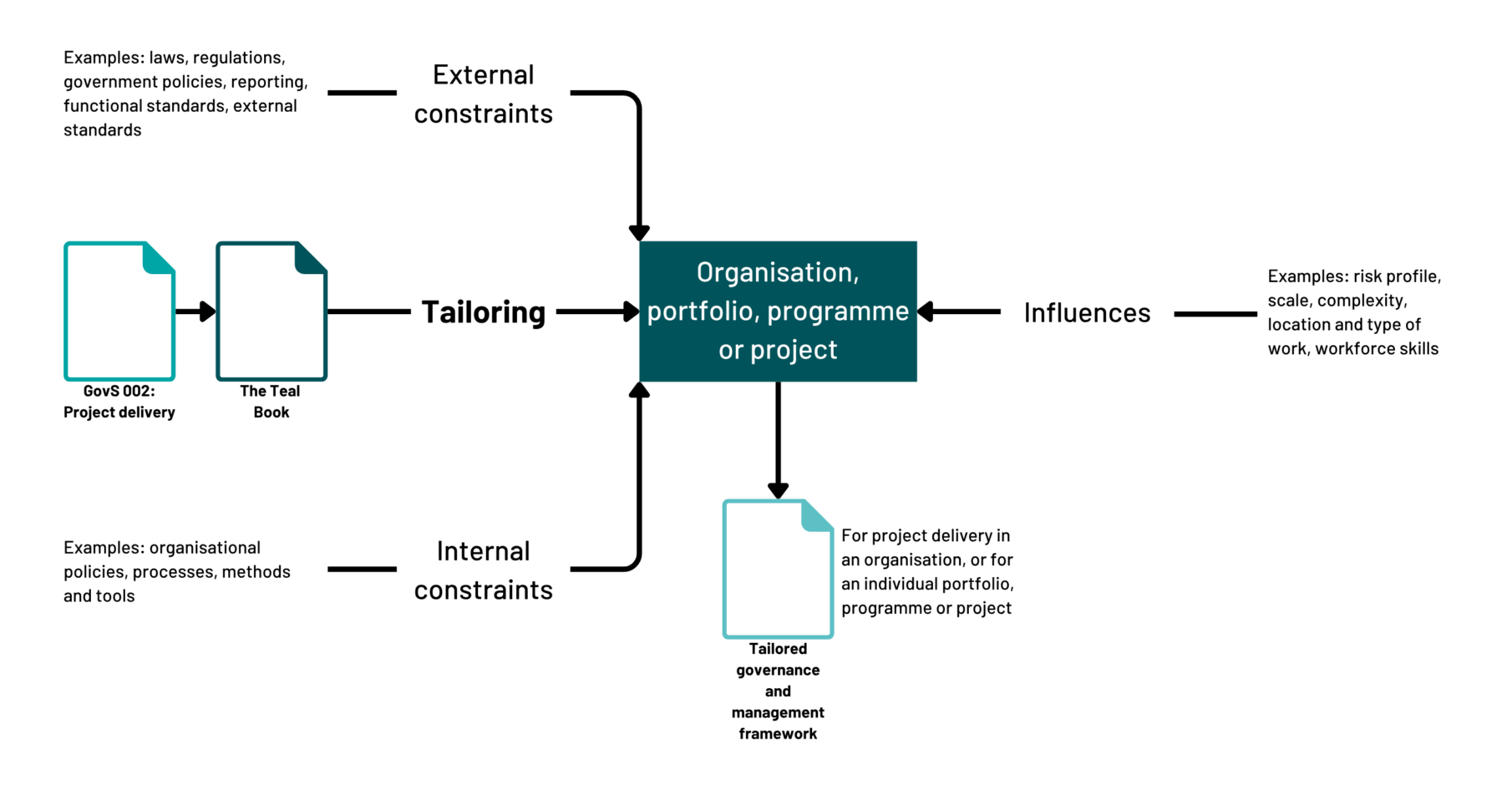
For tailoring to be effective, it needs to be deliberate, controlled and to take into account the wider context. This includes considering:

  • the position the work has in the hierarchy of portfolios, programmes and projects within the organisation (see Chapter 3: Portfolios, programmes and projects and Figure 8.2), but also:
  • external constraints imposed by others, outside the organisation
  • internal constraints, such as policies and rules that the organisation imposes on itself
  • influences due to the unique circumstances of the work being done

This is shown in Figure 8.1.

A flow chart illustrating the factors influencing the tailoring process for a project delivery approach. External constraints like laws, regulations, and standards, as well as internal constraints like organisational policies and tools, are considered. These influence the tailoring of "The Teal Book" to create a bespoke governance and management framework, applicable at the organisation, portfolio, programme, or project level.
Figure 8.1 The constraints and influences on tailoring

8.6.2 Aligning with higher-level governance and management

The governance and management framework for a portfolio, programme or project should be aligned with that of the sponsoring organisation or, where different, the delivery organisation. If the organisation has its own project delivery framework, that framework is part of the organisation’s governance and management framework.

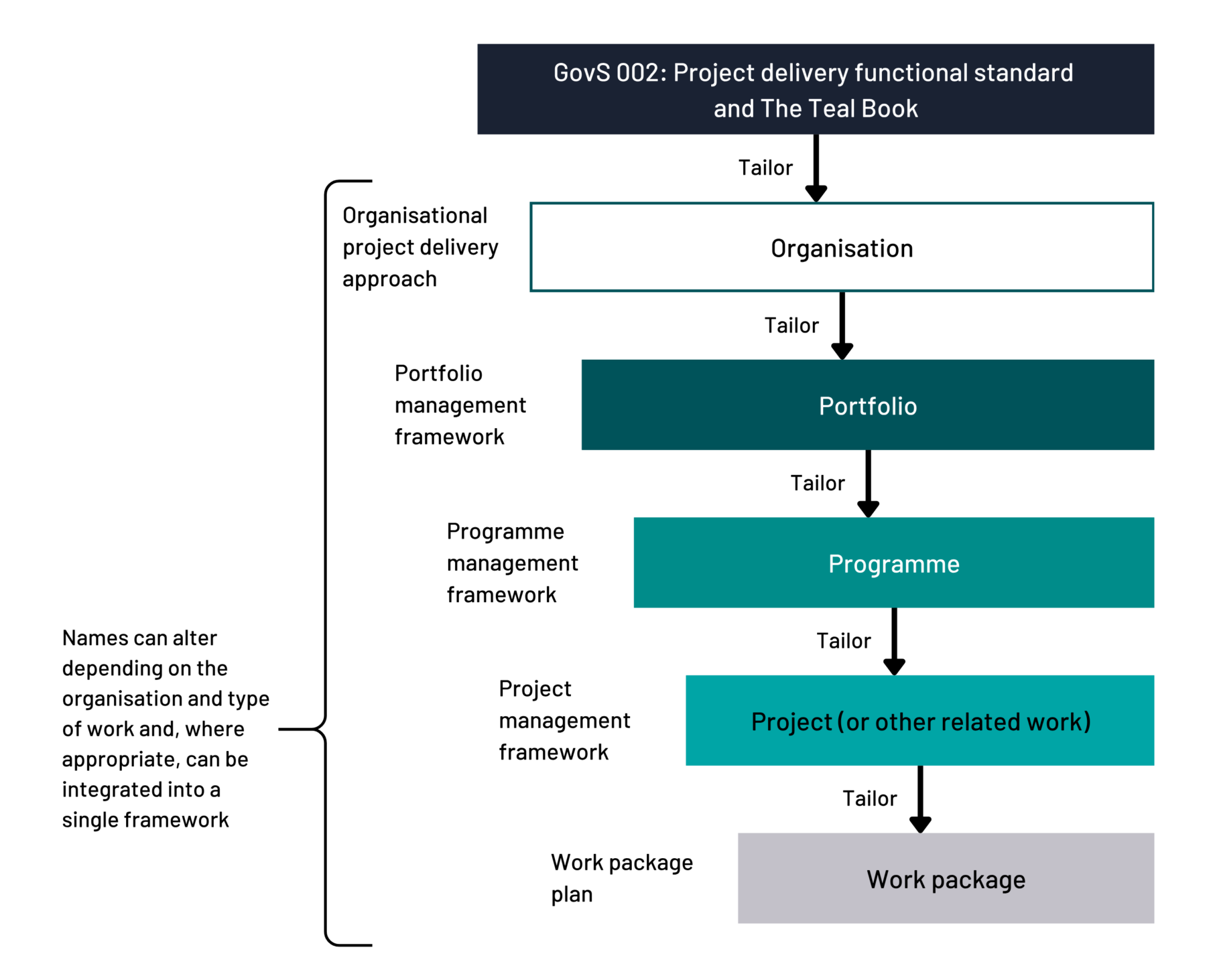
In practice project delivery practices, processes, and techniques should be based on the organisation’s internal policies, methods and practices, but can be tailored at each level of the hierarchy (see Figure 8.2):

  1. A portfolio’s governance and management framework may be tailored from the organisation’s framework
  2. A programme in the portfolio should then have a governance and management framework tailored from the one for the portfolio
  3. A project in the programme should then have a governance and management framework tailored from the one for the programme (or the portfolio if it is a standalone project)
  4. A work package should then have a governance and management framework tailored from the one for the project or other work it is a part of
A flow chart illustrating the tailoring process of project delivery frameworks. The process starts with the organisational project delivery approach, based on GovS 002 (Project Delivery Functional Standard) and The Teal Book. This is then tailored for the organisation, portfolio, programme, and project (or other related work) levels, resulting in management frameworks for each.
Figure 8.2 The cascade of tailoring from organisation to work package

This does not mean that each level of the hierarchy needs to have a separate and distinct governance and management framework document or set of documents. Tailoring should always be proportionate, if needed at all, and it is frequently the case that a single and integrated framework exists. For example, a governance and management framework for a programme can integrate the arrangements for the projects, other related work and work packages that are a part of it. 

For good governance, it is important that the chain of accountability from top to bottom should not be broken and that everyone understands what has been tailored, why, and what impact it has on how they do their work. Usually, a manager should consult at the next higher level and secure approval before tailoring their practices. Tailoring should normally only apply to those aspects which are unique to the portfolio, programme or project being managed. Tailoring for the sake of it or to satisfy a personal viewpoint is not a good use of resources. 

Formalising tailoring can at first glance appear unnecessary but is important to ensure traceability and, if done well, it can reduce considerably the management overhead for the work (see 8.6.6 on documenting the tailored framework).

8.6.3 Taking account of external constraints

Constraints which limit discretion to tailor The Teal Book can include:

  • treaties, laws and regulations, including those around procurement, employment, equality and accessibility, health, safety, security, data handling, sustainability and the environment.
  • mandatory certification points in regulated sectors, which may determine the the most appropriate life cycle phases to use 
  • government-wide governance requirements including those defined in Managing public money (requires sign in), functional standards, HM Treasury and other central government spending approval and controls, reporting, procurement policy and subject specific standards, codes of practice and cross-government shared services and platforms
  • requirements for programmes and projects that are part of the Government Major Projects Portfolio and the Departmental Major Projects Portfolio
  • department’s specific HM Treasury delegated limits and with the wider approach to functional controls set out in the Department’s Memorandum of Understanding with HM Treasury
  • professional codes of practice and other publicly available standards, such as British Standards Institute (BSI), International Organization for Standardisation (ISO), or the International Electrotechnical Commission (IEC) where the government has committed to their use

These are referenced throughout The Teal Book. 

8.6.4 Taking account of internal constraints

Within the external constraints above, and subject to the overall control and direction of ministers, government departments can organise, direct and manage the resources at their disposal, with control and accountability through the accounting officer.

Arm’s length bodies have similar freedoms, within the terms of their framework.

Organisations can therefore adopt their own policies, processes and methods for project delivery. These are often linked to digital platforms and applications, such as enterprise resource planning and accounting software and document repositories.


8.6.5 Taking account of influences

The Teal Book should be tailored according to the nature of the work and its context including risk profile, size, complexity, location and type of work. The level of detailed guidance required also depends on the complexity of the governance and management arrangements and the capability of the team. Methods and tools need to be appropriate for both the work and the people using them (see 8.6.6 on documenting the tailored framework).

Contracts with suppliers also influence how work is delivered. The obligations and terms in contracts should be aligned to the required governance and management arrangements, as far as possible. They should consider supplier preferred and specialist ways of working.

The portfolio, programme or project manager is responsible for integrating all of these factors to ensure the successful delivery of outcomes and realise benefits.

8.6.6 Documenting the tailored framework and briefing the team

Documenting a governance and management framework is important. It has to be accessible when needed and kept up to date. Documentation that is bulky or partly out of date, is unlikely to be used, causing team members to fall back on previous experience. This can make it difficult to maintain control over the work. See Chapter 22 for more information on information and data management.

An effective tailoring approach is to prepare a concise, version-controlled set of information which refers directly to the primary source being tailored, rather than copying large amounts of existing material. In most cases this means documenting only what is unique to the work, such as:

  • organisation structure
  • names and roles
  • delegated authorities for key decisions (including change requests)
  • categories of risks, issues and changes
  • risk matrices
  • planning processes

A similar approach can be done for the practices in Part F: Solution delivery. As these practices relate to methods for developing outputs or realising a particular outcome, it is unlikely there are standard approaches for every circumstance. Those involved in managing and undertaking the work should be aware of, and able to define, their working approach, especially how quality and progress is to be measured.

It can be tempting to document guidance and processes in extensive detail, but this should be avoided. Other approaches to sharing knowledge and experience are more effective such as team inductions, briefings, coaching and mentoring (see Chapter 38: Learning from experience and Chapter 39: Project delivery induction and training).

Updates

Addition of Departmental Major Projects Portfolio as an external constraint.

Page permissions updated for public launch.

First published for closed beta consultation.

Back to top