The purpose of governing and managing a portfolio is to increase the likelihood of the portfolio’s objectives being achieved at an acceptable level of risk and within a specified funding envelope.
Previous
Part C: IntroductionThe Teal Book: Part C

The purpose of governing and managing a portfolio is to increase the likelihood of the portfolio’s objectives being achieved at an acceptable level of risk and within a specified funding envelope.
Chapter 4: Governance and management provides an overview of the aspects of governance and management that apply to all parts of project delivery, regardless of whether the context is a portfolio, programme, project or other related work. This includes an overview of why governance and management are important overall.
For portfolios in particular, governance and management ensure that the portfolio is strategically aligned and remains viable and controlled. This helps the portfolio director optimise the outcomes needed to achieve strategic goals and drive the changes the organisation needs, while balancing them with the capacity of the organisation to deliver and take on those changes.
Characteristics of effective governance and management are described in Chapter 4: Governance and management and include purpose, knowledge, behaviour, process and structure. All 5 characteristics need to be considered and present in the governance and management framework for a portfolio, or there is a risk that some aspects, such as people’s behaviours and attitudes, could be missed.
The governance and management of the portfolio defines how it is to be overseen, directed and managed. Regardless of the scale of the portfolio and its team, each person should be clear on what is expected of them. This is what governance and management provides by defining the processes, methods and tools individuals should be using and how their role relates to other roles. If there is no defined way of working, or if coordination and collaboration across the team are weak, misunderstandings are very likely. This can lead to a loss of focus and threaten the achievement of the portfolio’s objectives.
Portfolio management provides the approach needed to manage a collection of programmes, projects and other related work in pursuit of defined strategic goals and vision. As strategic goals are set at the organisational level, effective portfolio governance and management should reflect and be consistent with the business model for the organisation. This should include its structure, for example, whether the organisation has a single governance and management framework or if it is federated across a sponsoring department and/or its arm’s length bodies. It is also important that the accounting officer and wider senior leadership are involved in the management of portfolios, endorsing its approach and integration across the organisation.
See Portfolio guidance, Portfolio management overview for more information on what portfolio management is, what it is not and the benefits behind a portfolio management approach.
Everyone involved in the direction and management of a portfolio has an impact on its governance and management. However:
The organisation structure for a portfolio is fundamental to good governance. It is a requirement of the Government Functional Standard for Project Delivery that roles are defined and assigned to people with the appropriate seniority, skills and experience. Descriptions of roles should include, but not be limited to, the activities, outputs or outcomes people are responsible for and the person they are accountable to. If a person doesn’t know who they are accountable to, they cannot be held to account nor would they know who to take direction from or escalate issues to. Portfolios can operate in a matrix structure with many different teams and governance arrangements involved (see 11.6.7 for organisational governance alignment) so explicit accountability avoids confusion.
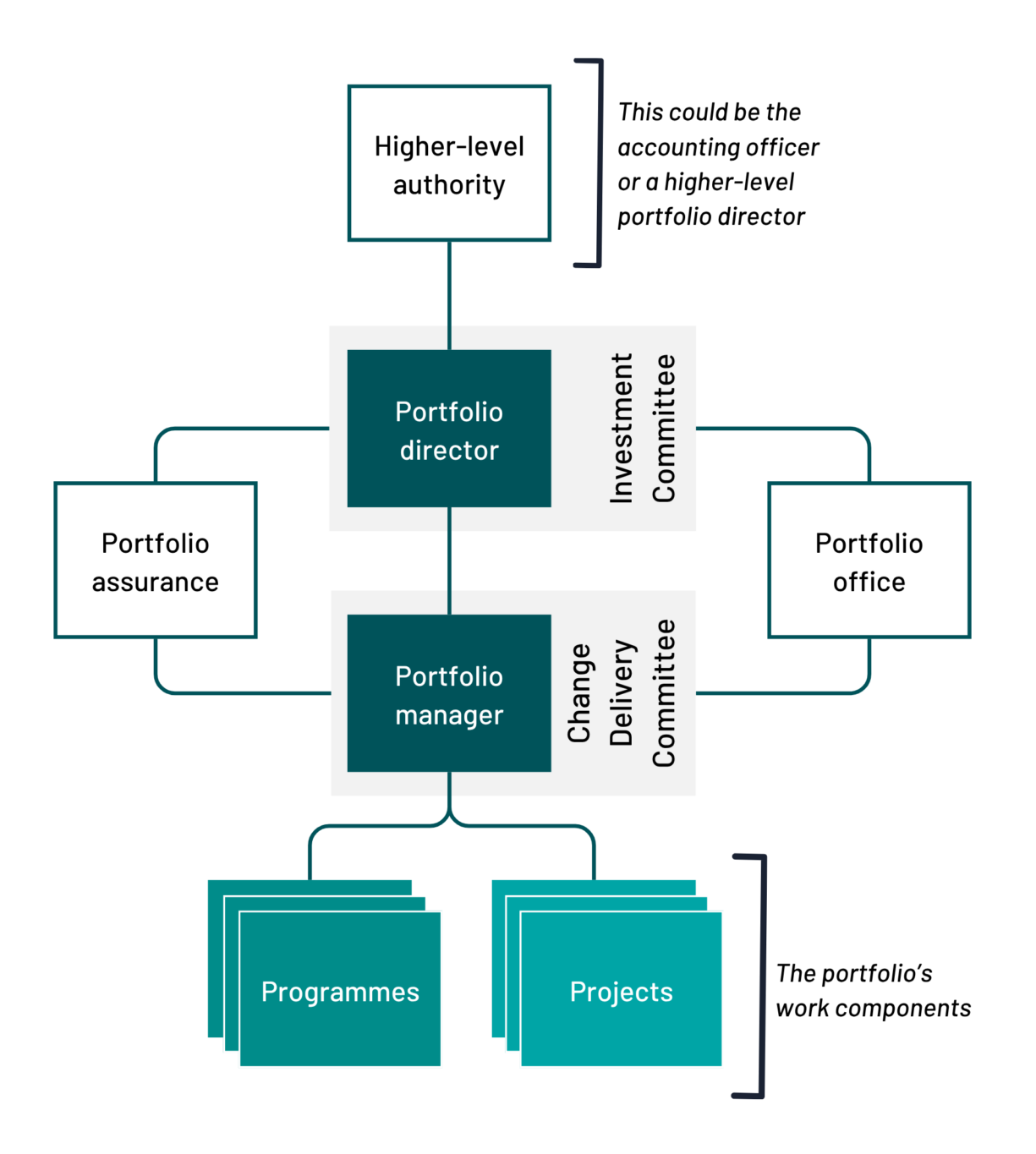
Figure 11.1 shows a possible organisation structure for a portfolio, highlighting the relationship between the different roles. The roles are described more fully in the sections below. These descriptions should be used in conjunction with the Project delivery capability framework which includes the professional standards for a range of project delivery jobs operating at different capability levels, covering both leadership and technical skills.
The portfolio director is accountable to a defined higher-level authority for the direction and governance of the portfolio. The higher-level authority could be the accounting officer, another senior sponsor, for example a member of the organisation’s management board, or a higher-level portfolio director.
The portfolio director provides leadership and direction and owns the portfolio’s vision and strategy. Responsibilities include:
The portfolio director should not also be the senior responsible owner for a project or programme within the portfolio they oversee, because of the conflict of interest that this creates.
The role of the portfolio director can be supplemented or supported by a portfolio board (see 11.5.4 on the portfolio board), which can be separate to or integrated with the organisation’s investment committee. Due to the wide-ranging and far-reaching nature of the role, they can be accountable for different aspects of their role to different management positions in the organisation. For example, the portfolio director could be accountable to the accounting officer for the vision and strategy; to an organisation’s chief project delivery officer (or the senior officer accountable for project delivery in an organisation) for having defined portfolio management practices and to the chief finance officer for ensuring funding is allocated where needed.
The portfolio manager is accountable to the portfolio director for planning and managing the portfolio as a whole, ensuring its constituent programmes, projects and other related work deliver the portfolio’s objectives.
Responsibilities include monitoring spend against budget, benefits realisation, business and societal change and risk. The portfolio manager is responsible for the day-to-day management of the portfolio, coordinating the effective operation of the portfolio management practices and ensuring the efficient flow of information to decision makers. Responsibilities include:
The role of the portfolio manager can be supported by a portfolio board, such as a change delivery committee, a portfolio office and relevant specialists. As for the portfolio director, different aspects of the portfolio manager’s role can be accountable to different management positions in the organisation.
For government portfolios, boards can be established that support the portfolio director and portfolio manager in undertaking their responsibilities. The purpose of each board should be clear and set out in terms of reference accessible to the board members and those who interact with them. There are many different models for boards at the portfolio level which usually fit into one of the 2 approaches:
The design of a board is an important consideration. As achieving the right mix of roles, experience and skills determines its effectiveness. Defining this clearly helps decide on membership and ways of working.
While a board supports the portfolio director or portfolio manager, consider the nature and extent of its decision-making powers. This includes whether decisions require a consensus, majority vote, quorum or other conditions.
A board should not be too large as it is a governing and decision-making body, not a means for stakeholder engagement. The membership should include some that are independent to the delivery of the work to provide a degree of assurance.
Subsidiary boards can be established focused on specific activities, such as change control or architectural or solution integrity.
The portfolio director is accountable for assurance on the portfolio and can be supported by an individual or group who manages this aspect of their work on their behalf (see 11.6.5 on assurance in portfolios). In some cases, an organisational level group could take on this role. For more information on portfolio assurance, see the Government project delivery assurance framework.
Other management and team roles should be defined to suit the needs of the work required, for example those undertaking specialist roles or managing specialist processes, procedures, techniques and outputs. These roles usually form a team called the portfolio office that supports the portfolio director and manager in the definition and management of the portfolio.
The exact function and services the portfolio office provides depend on the needs of the organisation, the complexity and scale of the portfolio being managed, and the capability and capacity of the portfolio management function. These functions and services can include:
A number of project delivery job roles which could form part of a portfolio office are defined in the Project delivery capability framework, for example, the job role of the portfolio analyst. However, a portfolio office could also include roles from other government professions depending on the services it provides, for example from the finance, commercial, analyst, people and operational delivery professions.
Every chapter of The Teal Book is a part of and relevant to the governance and management of portfolios and Chapter 4: Governance and management should be referred to understand the key aspects of governance and management that apply across all of project delivery. This includes aspects such as behaviours and leadership, the governance and management framework and decision making.
However, viewed top-down from a governance viewpoint, seven aspects are particularly relevant to portfolios:
The Project delivery glossary defines a governance and management framework as:
A governance and management framework sets out the authority limits, decision-making roles and rules, degrees of autonomy, assurance needs, reporting structure, accountabilities and roles, together with the appropriate management practices and associated documentation needed to meet this standard.
The Government Functional Standard for Project Delivery requires that each portfolio has a defined governance and management framework which should align to, and work with:
The governance and management framework for a portfolio should be tailored from the organisational project delivery approach (if any) which, should already be aligned with other organisational processes and practices. In many cases, where an organisation has a central or enterprise-level portfolio, the governance and management framework for the portfolio and the project delivery approach for the programmes and projects could be combined (as they are in The Teal Book).
Where organisations have multi-level portfolios (see 11.6.8 on multi-level and multiple portfolios), the governance and management frameworks for each portfolio should be appropriate for their context but designed to work together. If there is no organisational project delivery approach, The Teal Book can be used as a model to build on.
The governance and management framework should be maintained and updated as work proceeds to reflect changes and improvements identified from any lessons learned from using it (see Chapter 38: Learning from experience). The framework therefore needs to be version controlled (see Chapter 22: Change control).
See Portfolio guidance, Portfolio governanceto find out how to effectively govern a portfolio and align it to organisational governance.
A portfolio plan supports the organisation’s strategic objectives and is developed on a cyclical basis as part of organisational business planning, for example as part of a spending review or the annual business planning cycle.
It defines and justifies the choice of programmes, projects and other work, which, together, are expected to provide the outcomes and benefits at an acceptable level of risk. The plan should include the portfolio’s funding sources, objectives, scope, expected benefits, outcomes, costs, resources, schedule and risks. Once approved, the plan should be baselined, with subsequent changes managed through change control until the next planning review (see Chapter 16: Planning).
The approval of a portfolio plan does not give the authority to start a new programme or project, or to change existing ones. Each programme or project has to have its own formally approved business case before the work can begin. The business case justifies the work, defines the scope and benefits and authorises funding and resources (see Part D: Managing programmes and projects). The relationships between these different levels of approval and authorisation (see Figure 11.2), who makes them and when, should be documented in the portfolio’s governance and management framework.
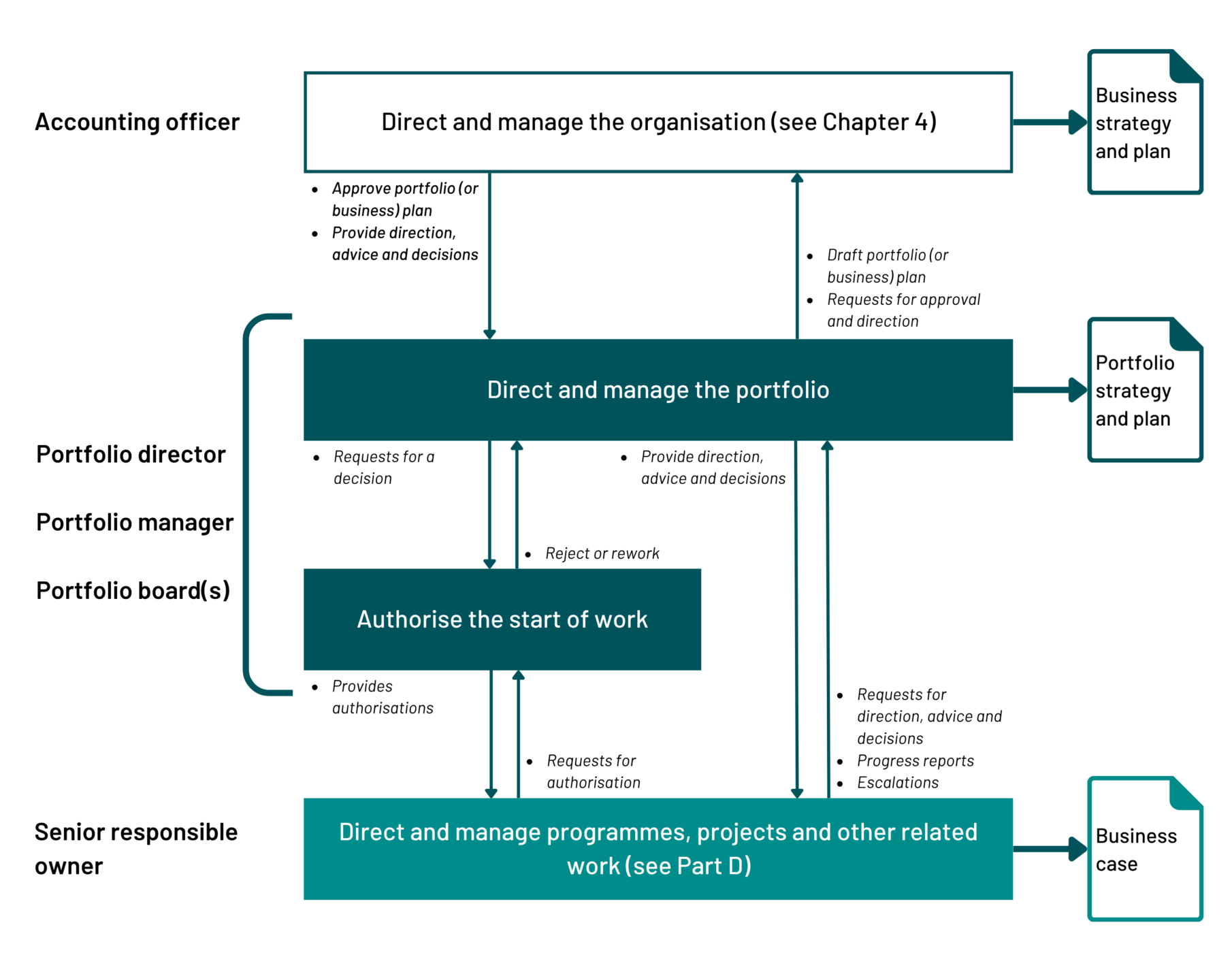
Decisions relating to the direction and management of a portfolio should be made in a way that is timely, communicated and in consultation with stakeholders and subject matter experts. The Government Functional Standard for Project Delivery requires that the assessment of options is done in accordance with the Government Functional Standard for Analysis.
It is important that decision-making rights are defined in the governance and management framework so that everyone managing a component of the portfolio understands who has the authority to make which decisions, on what and when, and who should be consulted. Leaving all the decisions to the portfolio director or board is not an effective approach. Instead, decisions should be delegated to those best placed to make them, while at the same time ensuring those decisions are visible to those in higher authority.
Frequently, decisions related to the management of a portfolio are taken through a portfolio board where decisions require a consensus, majority vote or other arrangement for decision-making (see 11.5.4 on portfolio boards).
Effective systems and processes need to be in place to support decision making so that there is an efficient flow of information to the decision makers. This does not mean setting up separate processes, but ensuring that information and data (see Chapter 24: Information and data management), reporting (see Chapter 18: Reporting) and communication (see Chapter 27: Communications) are built into the working approaches for managing the portfolio.
Decisions which require formal authorisation or approval include:
Each portfolio should have a defined and integrated plan for undertaking assurance, known as an integrated assurance and approval plan (IAAP), typically with at least 3 levels (see 4.6.5 on assurance). This should be a part of the portfolio plan (see 11.6.3 on portfolio plans).
The approach to assurance reviews in government is set out in the Government project delivery assurance framework which provides a set of assurance reviews that can be used for portfolios, programmes and projects. Portfolios should be reviewed using a portfolio assurance review as set out in Assurance workbook: Portfolios and portfolio management which looks at aspects such as strategic alignment and definition, performance and risk, management, culture and processes and capability and capacity.
Government Major Projects Portfolio and portfolio reviews
If a portfolio includes programmes or projects in the Government Major Projects Portfolio, periodic portfolio reviews should be arranged. The interval between such assurance reviews should not usually exceed 3 years.
Assurance and approvals are closely related. The Government Functional Standard for Project Delivery requires that assurance reviews take place before significant decisions, so that decision makers have an assessment of the status and outlook of the work. Assurance reviews can also be undertaken in response to an issue or to verify delivery.
If not planned properly, assurance reviews can be disruptive, reviews should be scheduled to minimise disruption. Activities in the wider organisation should also be considered when scheduling reviews, such as spending review and budget planning, strategy developments or launching a target operating model.
Effective portfolio management depends on holistic understanding of the portfolio’s objectives and how to achieve them. Senior leaders whether on the portfolio board, part of the team or acting as decision makers, play an important part in delivering the organisation’s strategic objectives and in contributing their knowledge of the business. Senior leaders should act in the interests of the organisation and the portfolio as a whole not just the part they are responsible for. There can sometimes be a conflict of interest. The creation and sharing of a vision can help unify effort and motivate those leading and working on the portfolio’s programmes, projects and other related work.
Portfolios are typically permanent forming part of an organisation’s business as usual capability. This is in contrast to programmes and projects, which are unique and temporary management organisations that end once the outcomes have been delivered and validated. As such, effective portfolio governance means that the governance of the portfolio needs to reflect and integrate with the governance arrangements for the wider organisation. There should be a shared understanding across the entire organisation of how and when portfolio related decisions are made.
A number of other governance bodies and arrangements can exist for specific parts of an organisation’s work. For government organisations this can include departmental boards, executive committees, audit and risk committees and performance committees. These bodies should be considered when defining and maintaining the governance and management framework for the portfolio, including the relationship between portfolio management boards and other relevant boards, to maintain clarity on accountability for decision-making.
The successful management of a portfolio relies on the support and contribution of the accounting officer and executive board as well as people in other government functions and professions, not just project delivery professionals. Examples include people with expertise in finance, commercial, human resources, strategy, policy development and legal activities. These functions and professions should be considered when defining the governance and management framework for the portfolio. Information should be shared regularly between them and the portfolio team as their perspectives can bring greater insight into the status of a portfolio. For example, it is important to keep teams responsible for strategy and policy development involved in the definition of the portfolio’s vision and strategy and informed of progress against strategic objectives.
Many government organisations need more complex governance arrangements for their portfolios because there are many levels of change through the organisation. For example, Figure 11.3 shows:

In situations such as this, consider having a governance and management framework for portfolio management across the whole organisation where:
A programme or project should not be part of more than one portfolio as this causes conflict and confusion over accountabilities, direction and processes. If more than one portfolio has an interest in the same work component, mechanisms, such as agreeing interdependencies or having common board or team members, should be in place so that information can be shared and responsibilities for oversight are defined.
Even with a central portfolio, not every programme, project and other related work needs the same level of scrutiny, or needs to sit within a portfolio. Including every work component to understand full alignment and contribution to strategic objectives can quickly become overwhelming for organisations that do not have the maturity or capability for this level of oversight.
There is also a risk that portfolio management turns into an activity focused on collecting data instead of providing the insights needed for effective portfolio management. A tiered portfolio structure can help address this with scrutiny and reporting requirements tailored to agreed criteria such as criticality, risk, scale and/or complexity.
Updated the key points for section 11.1, replacing the previous bullet points with new ones covering the cyclical nature of portfolio management, the scope of portfolio work and the principle that good portfolio management includes deciding what not to do. Added a definition of governance and management framework from the Project delivery glossary in section 11.6.2. Updated the further reading list to add the Government project delivery assurance framework, the Government Functional Standard for Analysis and Portfolio management in government, and to remove the Project Delivery Capability Framework.
Page permissions updated for public launch.
First published for closed beta consultation.