The purpose of resource management is to balance the supply and demand for appropriate resources to be deployed when needed. This includes people with the right skills, equipment, materials or facilities.
Previous
Chapter 27: CommunicationsThe Teal Book: Part E

Orders are open until 31 December 2026.
The purpose of resource management is to balance the supply and demand for appropriate resources to be deployed when needed. This includes people with the right skills, equipment, materials or facilities.
Portfolios, programmes and projects are delivered by multidisciplinary teams using equipment, materials, and facilities. Having the appropriate human and other resources needed to deliver the work is essential to enable work to be completed within defined constraints such as resource, schedule, cost, and risk.
Securing the resources needed at the right time is not always straightforward. People with the skills and experience needed can be in short supply within the organisation or deployed to other work. Recruitment and external sourcing timescales can be lengthy and subject to local constraints, and external market demand can make it hard to compete on cost or to source what is needed.
Managing resources efficiently and effectively is a critical responsibility for government organisations, and a core part of meeting the obligations on the proper use of public funds granted by Parliament, as set out in Managing public money (requires sign in) (see Chapter 29: Finance).
Resource management is concerned with ensuring that resources are planned for and managed efficiently, so that they are available when needed, and that efficient use is made of available capacity and capability in the organisation, using external sourcing where necessary. Resources can be classified into 3 types:
Resource management in government often focuses mostly on people, facilities and equipment, but it is important to consider and plan for the full range of resources needed through the life cycle.
People are the most important form of resource and manage the other resources. They can be employed directly by the organisation, seconded or loaned by another organisation, or contracted from the external market. People employed by government organisations can be:
There are specific rules governing the recruitment and movement of different employee categories which are important to consider when planning resource management. Advice can be provided by the human resources function in the organisation, and further information is in the Government Functional Standard for People.
Skills can also be procured through external contracts, for example:
Skills can also be provided as part of wider contracts with suppliers for the delivery of solutions and services, including through the delivery partner model being used increasingly for the delivery of major capital works.
There are strict controls on the use of contingent labour and consultancy within central government overseen by the central Government Commercial Function in the Cabinet Office. Further guidance on sourcing from the external market is provided in Chapter 25: Procurement and contract management, and in the The sourcing playbook (requires sign in) and The consultancy playbook.
The approach to resource management forms part of the governance and management framework for the work (see Chapter 4: Governance and management), and a critical part of planning to ensure that resources are available when they are needed and managed efficiently (see Chapter 16: Planning).
Resource management should be undertaken in accordance with the Government Functional Standard for People and the Government Functional Standard for Commercial, and advice should be sought from the government human resources and commercial functions as necessary.
Anyone overseeing or managing resources requires an understanding of how to define resource needs, the routes available for meeting them, and of their responsibilities in managing them. Accountability and responsibility for resource management should be clearly defined within the governance and management framework for the work and reviewed on a regular basis, to avoid duplication or gaps. Typically, accountability follows the hierarchy in the work breakdown structure, but some roles can also be designated as having cross-cutting responsibilities.
The portfolio director, in a portfolio, or senior responsible owner, in a programme or project, has overall accountability for resource management and owns the resource management framework, ensuring that it is effective in providing the capability and capacity needed to deliver the work.
The portfolio, programme or project manager, as appropriate, is accountable for developing and managing the resource management framework, including its processes, tools, techniques, and for ensuring that it remains effective through the life cycle, as well as acting as the resource manager. Depending on the scale and complexity of the work, there could be a dedicated resource manager (often from a support office) with responsibility for overseeing resource management on behalf of the portfolio, programme or project manager. Support is also usually provided by an organisational human resources and commercial business partners who can call on specialist support from the organisation’s human resources and commercial functions if needed. More information on human resources and commercial roles are set out in the Government Functional Standard for People and Government Functional Standard for Commercial respectively.
The resource manager might exercise their responsibilities partly through a resourcing board, which they or the portfolio, programme or project manager might chair, usually as a sub-board reporting to the portfolio, programme or project board.
Resources are assigned a resource owner, who is a named individual responsible for identifying, sourcing, mobilising, managing and demobilising the human and other resources needed for the work. Depending on the scale of the work this could be by resource category. The resource owner needs to have the appropriate skills and experience to manage the resource category assigned to them (for example, human resources, commercial, facilities etc.) and can be supported by others as necessary.
The resource owner also ensures that, as people join the team:
As with financial management, resource management carries significant responsibilities in terms of the use of public funds and resources. Roles involving decisions on recruitment or procurement and deployment of resources should therefore be undertaken by substantive employees, other than where this is a defined element of the contract, for example for an interim managerial role, or outsourced to a delivery partner.
More detail on the resource management competency and how this relates to each project delivery role can be found in the Project delivery capability framework.
Resource management needs to start as soon as the work is initiated, to identify the resources needed to start planning the work. Typically, in-house resources are used in the early phases.
As options are developed, the people capability and other resources required to carry out the work are identified (see Chapter 16: Planning) and linked to individual work activities in the work breakdown structure to provide a basis for estimating cost and time. Human resources requirements should be identified by skill, role type and level, using the relevant professional capability framework where appropriate.
As resourcing needs are identified, the resource manager should consult the organisation’s strategic workforce planning and facilities teams to explore whether the resources can be met from the existing workforce, as this can offer the quickest and most cost-effective route to meeting them, particularly for small-scale work.
If the required resources are not available internally, the resource owner, working with the resource manager, needs to consider options for sourcing them from other parts of government or externally, through external recruitment or procurement.
Where procurement is likely to be required, commercial advice should be sought, and a delivery model assessment should be completed in line with the Government Functional Standard for Commercial and the The sourcing playbook (requires sign in) and The consultancy playbook.
The decision on how to source resource should be based on:
There are additional considerations in sourcing people and skills, such as:
The accountabilities and responsibilities of a senior responsible owner mean that this role should be held by a substantive civil servant or public servant.
Scheduling resources is an integral part of planning (see Chapter 16: Planning). The availability of resources and time needed to mobilise them can be a significant constraint on scheduling. For example, where there is a shortage of subject matter experts, a recruitment freeze, limited availability of resources locally, nationally or internationally, or the need for specialised equipment or environments that are limited in availability.
The plan should take into account the availability of resources and set the timescales for activities accordingly. In some types of work, for example in iterative software development, the availability of the appropriately skilled people is the primary driver of the schedule, whereas in major construction work, the availability of engineering equipment can be the driving factor.
Other environmental constraints can affect resourcing and need be considered, such as night-time working requirements, shift patterns, or international time zones where work is carried out overseas. Creating a view showing resourcing requirements and plans for meeting them (sometimes known as a resource forecast) is important in developing a robust schedule for the work.
Resource loading is a commonly-used approach to allocate resources within a schedule, assigning resources to activities and then reviewing the overall allocation of resources. This enables the overall balance of resources to be considered across the work and provides the opportunity to rebalance or optimise their deployment across work activities, for example through:
Both resource levelling and smoothing can require changing the sequencing of activities in the schedule, which is why schedule and resource planning need to be closely aligned. The plan should show when activities are completed and resources are no longer needed, so that they can be reallocated or moved on in an appropriate and considerate way.
Sourcing resources can often take longer than anticipated. Allocate an appropriate amount of time for this activity and plan it alongside other activities, considering the potential risks and responding to them, for example through adding time contingency (sometimes known as buffer).
The typical risks associated with sourcing external resource are a change in the global supply chain creating a market shortage in particular skills, a recruitment campaign that fails to find someone with the necessary skills, knowledge, behaviours, and experience, or a failed procurement of contingent labour, professional services, or consultancies.
Scenario planning can help identify resourcing risks so that action to mitigate them can be taken. This might include ensuring lead times for sourcing include some contingency within the plan, having separate contingency plans, for example to fill a role temporarily if recruitment fails, or the ability to reschedule work components if critical equipment or development environments are not available.
The aim is to build a comprehensive resource plan that is integrated into the overall plan at the level of detail appropriate for the planning horizon.
Resourcing needs to be managed actively through the life cycle of the work in alignment with work activities and the integrated plan. Even in a portfolio, there are likely to be peaks and troughs of work which call for resources to be moved to different priorities at different times. In a programme or project, resource requirements can change significantly as work progresses, with people moving into and out of the team as the skills needed change. A rolling approach to resource forecasting should be taken, which aligns to the wider phased approach to planning. In a rolling approach the immediate activities are planned in more detail than those which are later in a phase or in future phases. For example, for immediate work, resource plans can be by individual name, whereas future plans might be by skill type and level only.
Even with a rolling approach to resource planning, problems can arise. Assumptions on resourcing can be inaccurate or work can slip, leading to an over- or under-allocation of resources. The resource manager should work with the resource owners to identify any resourcing issues, for example where people are overstretched or under-occupied, and action agreed to address them. This could include reprioritising work, for example to protect or advance work closest to the critical path, or to reallocate people or other resources across work activities.
Resource management depends on information and data. The type and level of information and data needed to monitor resources effectively varies depending on the work, its scale and complexity, and the nature of the resources involved.
Government organisations typically monitor human resource information and data through shared reporting platforms. Reporting requirements often differ for employees and contingent labour. These platforms should be used to monitor resourcing for the work. Where more detailed or different information is needed to support decision-making and the management of resources, additional software or spreadsheets can be used.
Consistent and accurate use of organisational definitions and categories in reporting is important. Human resource data feeds into programme, portfolio and organisational reporting, and is used in organisational resource management and workforce planning, and in national statistics on public sector employment. Data on contracts, and on the use of consultancy and contingent labour, is also often scrutinised as part of commercial governance and reported on publicly as part of government transparency commitments. Where necessary, advice should be sought from human resources and commercial functions.
Where work is allocated to professional services or consultancy, they should be accountable for planning the resources needed for their work, with the sharing of information and reporting defined in their contract.
Take a strategic view of likely requirements for resource management. These are likely to be shaped by the context and nature of the work, particularly its complexity, scale, objectives, and desired outcomes. This helps determine the likely type of capability and capacity required, typical routes for sourcing, and where the resource is needed.
It is also important to understand the wider governance and management framework for the portfolio, programme or project, as this should shape the development of the resource management framework and plan. It is particularly important to consider:
Understanding the planning management framework is particularly important in designing an effective resource management framework and plan. It helps determine the level of resource planning needed to ensure sufficient visibility into resource use and availability to ensure work is completed on time. It can also help determine the level of resource loading and smoothing needed.
Once the scale and complexity of the work is known, appropriate tools and processes can be defined, together with the people needed to use them. For simple solutions or when the bulk of the work is outsourced, resource planning and resource data can be handled through spreadsheets. For more complicated solutions specialist tools are needed to manage the volume of data and relationships and to make it available to those who need it when they need it. Where planning software is used for the work, this usually also includes resource planning and management capability.
Resource management requires a systemic approach to identifying, sourcing, mobilising, managing and demobilising resource through the life cycle. It also requires a defined framework to govern and manage these activities, overseeing resource management and closing the resource management environment.
These related activities are shown in Figure 28.1. These can be sequential or iterative, depending on the nature of the work.
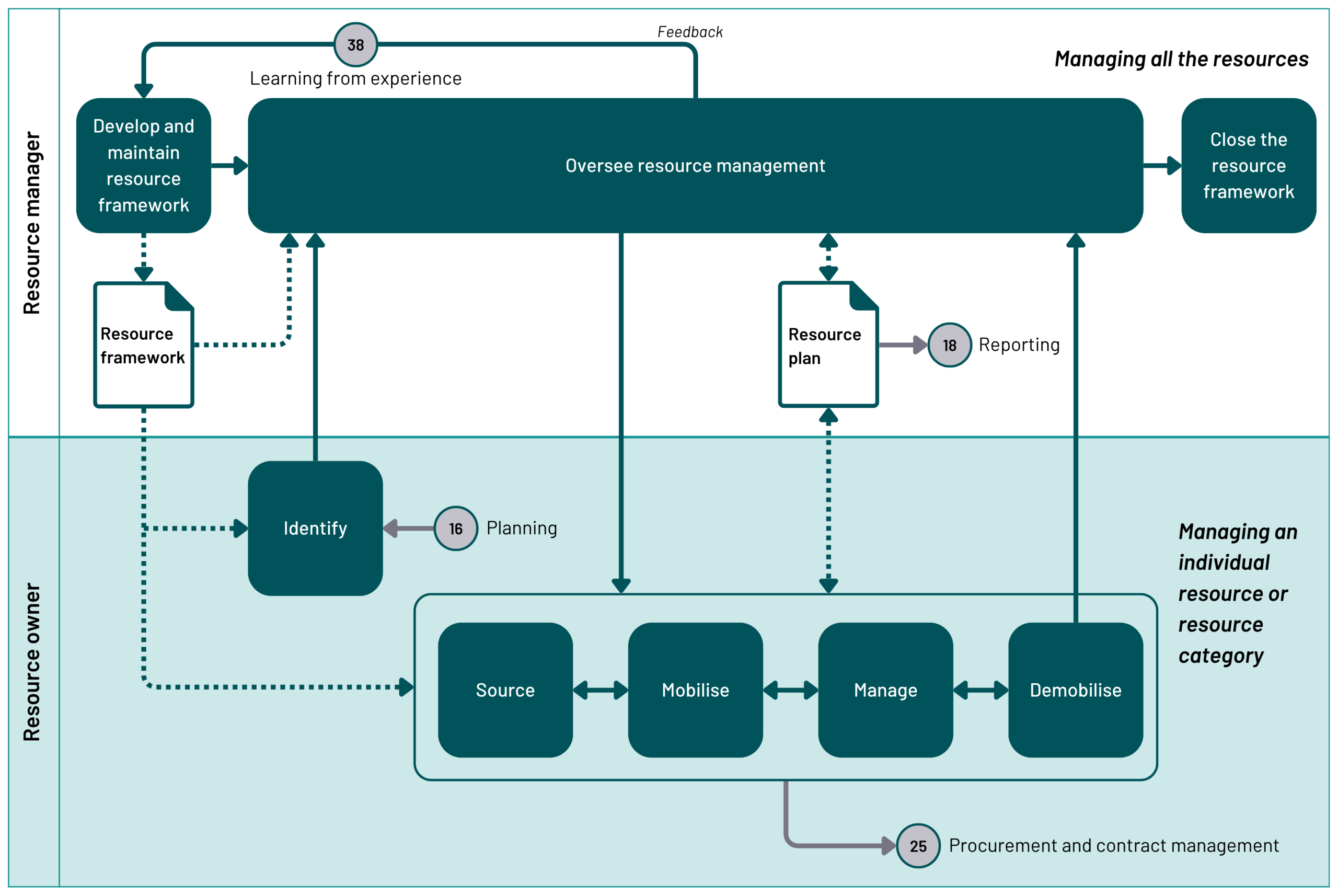
The approach to resource management should be defined including any processes, methods, tools and techniques to be used. This forms part of the overall governance and management framework for the work (see Chapter 4: Governance and management). The important aspects of this activity are discussed in more detail in section 28.6.2. The framework should be maintained to address relevant feedback from its use.
The framework should describe:
Overseeing resource management involves making sure the work has the right people and other resources at the right time, and that resource decisions support delivery priorities.
This includes:
Resource requirements should be identified as part of overall planning (see Chapter 16: Planning) and captured within a resource forecast or workforce plan.
The amount of information provided in the plan depends on the level of the plan. A higher level plan only needs to include the necessary capability along with the aggregated capacity, while a more detailed plan could include information on each individual resource. In the case of people, such detail could include job role type, location, required skills, knowledge, and experience. Government professional standards can be used to identify the job roles and what skills, knowledge, and experience they provide, such as the Project delivery capability framework. Job titles can vary, however, there is guidance for Standardised job titles for project delivery roles (requires sign in) in the project delivery profession. In the case of equipment, this could be the model type, battery life, or ease of use.
Employee or contingent labour requirements should be estimated for each work activity, both in terms of competency (professional skills, both type and level) and capacity (how many people are needed). They should be expressed as work days on a full time equivalent (FTE) basis, with estimated costs per FTE, so that resources can be costed.
Requirements for professional services, consultancy and other contracts should be identified separately and included as part of the procurement plan, specified in terms of outputs or outcomes and estimated costs and timescales.
By the time it is approved, the integrated plan (see Chapter 16: Planning) should include a robust, evidence-based resource plan, fully aligned to the schedule, and making provision for risk and contingency.
When deciding on how to source resources, the resource owner should consider whether resources are available in-house, for example from an existing organisational pool, internal recruitment or other resource, or if they need to be sourced externally through recruitment or procurement (see 28.6.1.1 on exploring resourcing options). Check legal and commercial requirements on sourcing (see 25.6.1 on what to consider when procuring and managing contracts), for example the off-payroll working rules, known as IR35. See HMRC’s guidance on Understanding off-payroll working (IR35).
Plans for sourcing should be agreed as part of portfolio plan and business case approvals, with sourcing activities scheduled to meet resourcing requirements through the life cycle. Typically, sourcing activities are progressive through the life cycle, and it is important to ensure that the appropriate sourcing expertise is available for the period required. Recruitment, both internal and external, can be resource intensive, and advice on how best to manage this should be sought from the organisation’s human resources function. Procuring resources from the external market or through the supply chain requires commercial sourcing expertise, and advice should be sought from the organisation’s commercial function (see Chapter 25: Procurement and contract management).
Mobilising resources ensures that the necessary resources are available and ready for the activity they are assigned to. For example, when it comes to equipment, the resource needs to be in the right location and in full working order.
When it comes to people, this includes onboarding them, which involves security clearance, induction, and on-the-job learning so that they can start work. Onboarding should be tailored based on whether the person is new to the delivery or sponsoring organisation. If the person is new to the organisation, the onboarding arrangements should include the organisation’s onboarding process. If the person is not new to the organisation, they should receive a work-specific onboarding experience. The onboarding arrangements for people brought in under contract should cover the requirements of the role as set out in the contract management plan.
See Chapter 39: Project delivery team induction and training.
Managing resources involves managing employees and contracts to deliver planned activities, and efficiently allocating resources to different activities. It also includes ensuring that resourcing and contract data is recorded, kept up to date and reported as required.
All employees engaged in the work should have an agreed job description and line manager (and/or an identified task manager), regular performance meetings and annual performance reporting, and a learning and development plan to support their development. For project delivery professionals, development should be based on the Project delivery capability framework and draw on the learning opportunities within the Government Projects Academy; for other professions, the relevant professional capability framework should be followed.
People employed under contingent labour contracts should have an identified contract manager, are deployed in line with their contract and provided with appropriate induction and support to carry out their role.
All line managers and contract managers should be aware of their responsibilities and follow the requirements of the Government Functional Standard for People and Government Functional Standard for Commercial at all times.
Demobilising resource involves releasing reusable resources that are no longer needed. If the reusable materials, equipment, and technology are owned by the organisation, they should either be returned, transferred to another user by agreement, or disposed of appropriately, bearing in mind environmental and sustainability considerations (see Chapter 6: Environment and sustainability, and Chapter 37: Use and disposal).
It is important to be clear on the expected term of assignment for employees and contracted staff. When an employee’s role is approaching its end, the individual should be supported in seeking another role. Depending on the nature of the role and assignment, the end of an employee’s role can trigger formal redeployment or redundancy arrangements, and advice should always be sought from the organisation’s human resources function on how to handle this.
When demobilising employees, exit interviews should be conducted to understand how the individual has performed in the role and any learning for future assignments.
If the resources were procured under contract, the contract manager should ensure that the notice required is provided under the contract and that other contractual arrangements, for example the transition and/or exit plan, are completed before contract end and the release of resources. Where other resources are used, utilisation should be reviewed and documented as part of closing the contract.
Once the work has been completed and resource management is no longer needed, the management framework should be either closed or merged into the management framework for the organisation or solution as appropriate. Information and data should be retained in accordance with the delivery and sponsoring body’s information retention policy (see Chapter 24: Information and data management).
Updated references to the Government Functional Standard for Human Resources to the Government Functional Standard for People; updated the ‘Oversee resource management’ section with an expanded list of activities; updated the ‘Identify resource requirements’ section to include references to the Project delivery capability framework and standardised job titles for project delivery roles; updated the final paragraph of ‘Ensuring accurate resource monitoring’ to refer to professional services and consultancy rather than contractors or suppliers; added a reference to Chapter 24 in the ‘Close the resource management framework’ section; added ‘Standardised job titles for project delivery roles’ to the further reading list; removed Managing Public Money from the further reading list.
Page permissions updated for public launch.
First published for closed beta consultation.